
You’re in a crowded airport terminal. Hundreds of people are rushing by, all trying to get somewhere important. Your resume is like your boarding pass: if it’s clear, correct, and easy to scan, you get through security.
If anything is off about it, forget making your flight.
Like security, hiring involves humans and robots. Humans and robots that are very busy doing their job. To succeed, you need to appease both of them…quickly.
🧩 What’s Changed (And What Hasn’t)
A decade ago, resumes were mostly about dates, duties, and design.
Today, your resume must satisfy three audiences:
- Applicant Tracking Systems (ATS) software that scans resumes for keywords.
- Recruiters who skim for relevance and impact.
- Hiring managers who want to see proof you can do the job. Teal HQ+1
So let’s break down the foundational advice for 2026 and how to write a resume that actually works.
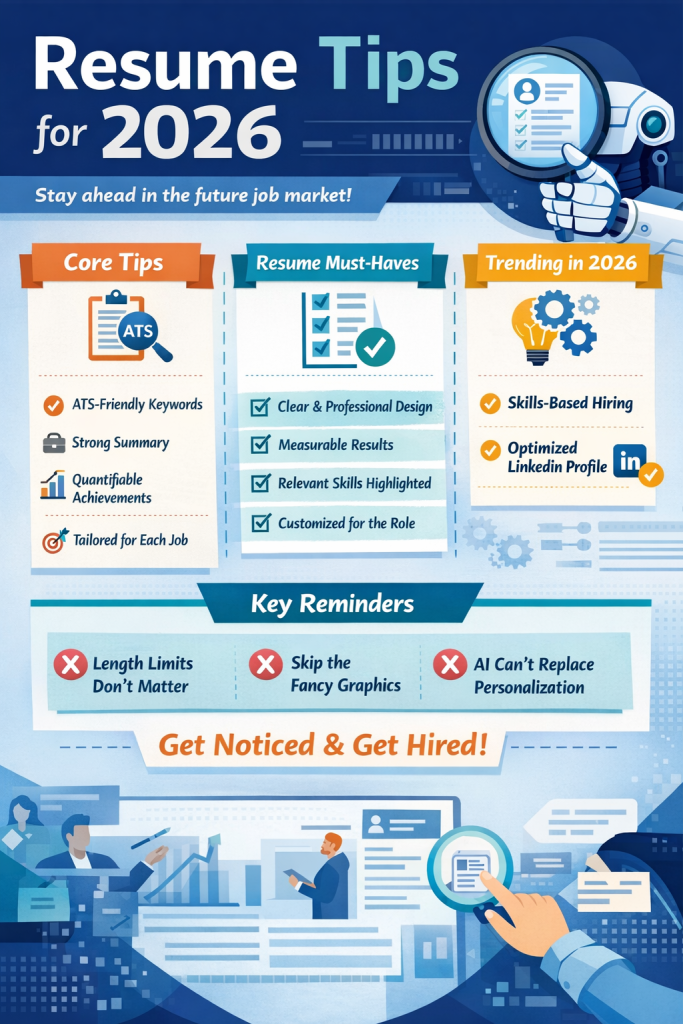
✨ Core Resume Tips for 2026
1. Start with Strategic Formatting
A clean, simple, and well‑organized layout is non‑negotiable:
- Use standard fonts like Calibri or Carlito.
- Put clear headings and white space between sections.
- Avoid fancy columns, heavy graphics, or tables that confuse ATS software.
- Save as a .docx or PDF (check the job instructions).
Pro Tip: Your top third should consist of your name/contact info, title, and summary. Use this section to immediately communicate who you are, the role you want, and the value you’ll add.
2. Lead With a Strong Headline and Summary
Recruiters want to instantly grasp three things:
- What job you’re targeting
- Your most relevant skills
- Your unique value or specialization
Include a clear target title right under your name and a sharp summary that answers, “Why would our team love working with you in this role?”
3. Optimize for ATS (and Humans, Too)
AI screens most resumes before anyone sees them.
- Mirror keywords from the job posting organically, not stuffed.
- Use industry terms like software tools, methodologies, languages, and core competencies.
- Integrate keywords into your work experience and skills sections.
⚠️ Avoid over‑relying on generic AI writing tools; customization and authenticity matter more than ever.
4. Show Results (Not Just Responsibilities)
Four sets of eyes might skim your resume only one can give five minutes to read every line.
So, ditch vague duties like “responsible for…” and highlight measurable achievements:
✔️ “Increased portfolio value by 30% in 12 months by…”
✔️ “Scaled social engagement by 150% via…”
✔️ “Reduced onboarding time by 20% through…
Hiring teams want proof you can deliver results, not a list of tasks. The general pattern should look like this: “Achieved X by doing Y.” The struggle? You need to convey that in two lines or less!
5. Design With Readability First
Recruiters process dozens (or hundreds) of resumes daily.
Do this to make yours easy to digest:
- Clean section headers (EXPERIENCE, EDUCATION, SKILLS)
- Spacing that lets important lines stand out
- Bullets, not paragraphs
- 10–12 pt font size
- Consistent formatting throughout
6. Customize for Every Job
Generic resumes get ignored. Tailoring isn’t optional anymore:
- Adjust your summary and skills to match each job.
- Prioritize the experiences you highlight based on what the employer needs most.
- Use job description language but own it with your achievements.
DID YOU KNOW? My resume clients get free access to my custom-built “Resume Alignment Advisor,” which quickly tells them exactly what to change for every job description.
🧠 What’s Trending for 2026
🚀 Skills‑Based Hiring Is Rising
Companies are focusing more on what you can do rather than where you went to school or how long you’ve been in a role. Highlight skills and capabilities front and center.
📱 Online Presence Matters
Resumes are just one part of your application toolkit. Recruiters cross‑reference LinkedIn profiles, portfolios, and other online channels so make sure they tell the same story.
🚫 Myths to Forget in 2026
❌ Two pages is always best: Not true. Recruiters care about relevance and clarity, not arbitrary length.
❌ Resumes need flashy graphics: Most ATS tools can’t parse them keep it clean and simple.
❌ AI can write your perfect resume: AI can help refine content, but personalization and authenticity are what get attention.
🧱 Your 2026 Resume Checklist
Before you hit submit, make sure your resume:
✅ Has a clear format and target role
✅ Is ATS optimized with keywords
✅ Highlights measurable results
✅ Uses a readable, professional design
✅ Is tailored to that specific job’s needs
💡 Final Thought
In 2026, resumes still matter but they’re part resume, part storytelling tool, and part AI optimization puzzle. Balancing these elements will make you stand out in a crowded field.
If you want help crafting a resume tailored to your career goals and optimized for both humans and AI, I can help! Contact me through https://kyladuffy.com

