Don’t beat yourself up if the job search feels endless. It’s not you.
Stark job-search numbers were released by Huntr last week in its Annual Job Search Trends Report.
Here’s an overview, based on data from 1.6M+ applications, 1M+ job postings, ~250K resumes, and a survey of 1K+ respondents:
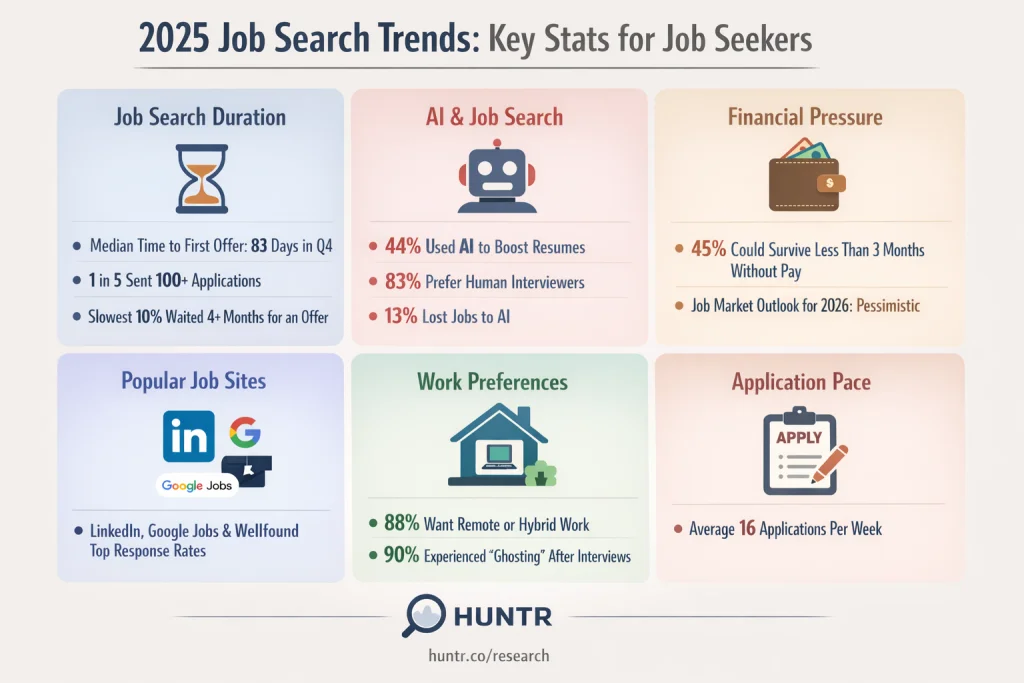
- Median time to first offer increased over the year, rising from about 57 days in Q1 to 83 days in Q4, indicating job offers are taking longer to materialize.
- Half of job seekers receive their first interview within ~23 days.
- The slowest 10% of job seekers waited more than four months for an offer.
- Nearly 1 in 5 job seekers needed to send 100+ applications before landing an offer.
- Once an interview happens, offers often stall for nearly two weeks on average before being extended.
Other Trends of Interest:
- LinkedIn dominates job saves, but niche platforms like Google Jobs, GovernmentJobs, and Wellfound delivered higher response rates than the largest boards in 2025.
- 13% of workers reported they’ve already lost jobs to AI or automation.
- Nearly half of job seekers don’t expect the job market to improve in 2026.
- Remote and hybrid work are now the dominant preferences — nearly 90% want some level of flexibility.
- “Ghosting” is widespread, with nearly 90% of job seekers saying they experienced no follow-up after interviews.
Folks, this is NOT FUN. If you are in a job, heed the warning: start passively applying today. How?
- Thoughtfully select 10-15 companies you’d like to work for.
- Set a calendar reminder to pop into their employment pages weekly (or at least monthly) to see what’s available.
- Set job alerts for those companies and for roles you’d like to have (you can do this through Google Alerts, LinkedIn, Indeed, or most other job search platforms).
- Keep a steady application pace (data elsewhere suggests about 16 applications per week as a benchmark for competitiveness).
For your resume and LinkedIn:
- Keep your LinkedIn up to date – recruiters are back to performing outbound searches for the right candidates.
- Keep a spreadsheet or document where you regularly record your metrics, and set a calendar reminder to update your resume with the new metrics quarterly.
- If you don’t have metrics in your role, think about how success is measured, and keep a log of how you’re hitting that measurement, even if it’s not something official in your company.
- Update your resume with examples of where you’ve shown how AI can’t replace you. This includes deep knowledge of your industry and field, relational intelligence (trust building, negotiation), collaboration, and cognitive flexibility.
Look, you need to be ready. And even more, you need to be PROACTIVE so you don’t get steamrolled when the time comes to look for a new job.
Need help? Reach out. There’s no better time to have a solid resume and LinkedIn profile than the present. https://kyladuffy.com.