AI Is a Thought Partner, Not a Replacement
People often ask if they should use AI to write their resume or LinkedIn profile.
Absolutely. Just not in the way most people do.
If your prompt is, “Write my resume,” AI will happily produce one. It’ll probably sound polished, use all the right buzzwords, and even be grammatically perfect. The problem is that it’s only working with the information you’ve already given it. It can’t ask follow-up questions or notice that you skipped over the biggest accomplishment of your career because you thought it was “just part of the job.”
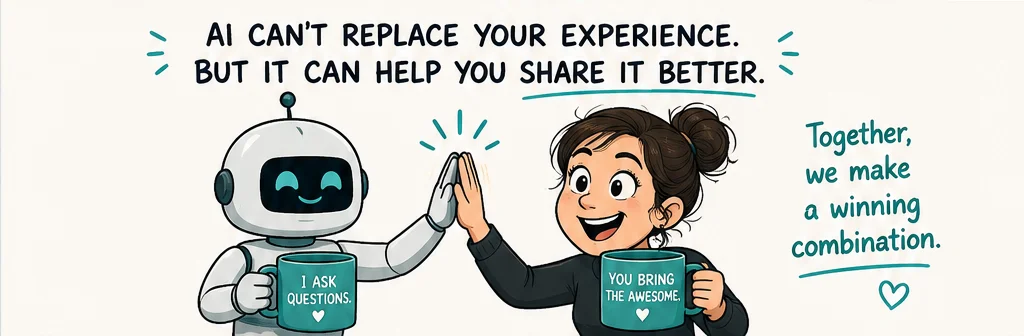
That’s why I think AI works best as a thought partner.
Over the past decade, I’ve worked with more than 4,000 clients. I’ve developed a process for uncovering accomplishments, identifying career themes, and helping people explain the value they bring. More recently, I’ve trained my AI on that same methodology.
Instead of asking AI to write, I ask it to think with me.
It asks follow-up questions. It points out inconsistencies. It notices missing details. It challenges assumptions. Most importantly, it helps uncover stories that might never have made it onto the resume in the first place.
That’s where the real value is.
The Tool Isn’t the Competitive Advantage
One of the biggest misconceptions about AI is that everyone has access to the same thing.
Technically, they do.
Practically, they don’t.
Two people can open ChatGPT and get completely different results because they’re asking completely different questions.
One person types, “Write my LinkedIn profile.”
Another uses a framework built from thousands of client conversations, years of recruiter insight, and a methodology designed to uncover what makes someone stand out.
The difference isn’t the AI.
It’s the thinking behind the prompts.
That’s why I don’t see AI replacing career coaches or resume writers. I see it making the best ones even better.
My Job Isn’t to Write Faster
AI has made writing easier.
That’s wonderful.
But writing has never been the hardest part of my job.
The hard part is helping someone recognize the value they’ve created over the course of their career.
Most people underestimate themselves. They forget projects, overlook accomplishments, minimize leadership, and assume everyone solved the same problems they did.
That’s where I spend my time.
Once we’ve uncovered those stories, writing the resume is relatively straightforward.
AI helps me get to those stories faster, but it doesn’t replace the discovery process. If anything, it makes that process even more important.
When everyone has access to the same writing tools, the people with the strongest stories have the advantage.
And strong stories come from asking better questions, not writing better prompts.
Need help uncovering those stories? Reach me at https://kyladuffy.com.
Related Articles
The Ultimate Job Search Guide
A step-by-step roadmap for navigating today’s competitive job market, from choosing target roles to landing an offer.
How to Get a Handle on an Endless Job Search
Practical strategies for identifying what’s holding your search back and making meaningful improvements instead of simply applying to more jobs.
Use This Trick to Access the Hidden Job Market
Learn how networking and relationship-building can uncover opportunities that never make it to a job board.
The Anatomy of a Healthy LinkedIn Profile
Optimize your LinkedIn profile so recruiters can find you and quickly understand the value you bring.