If your job search feels harder than it should, you’re not imagining it.
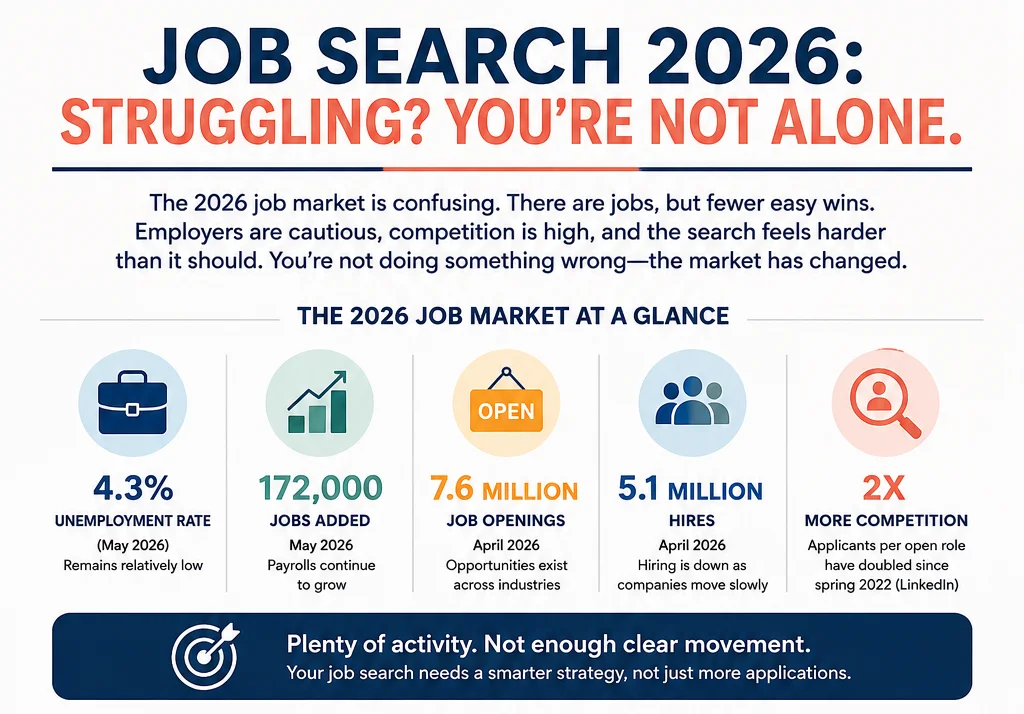
The 2026 job market is confusing because the headlines do not always match the lived experience of job seekers. On paper, the labor market is still moving. Employers are adding jobs, unemployment remains relatively low, and millions of positions are open.
But for many professionals, especially those in corporate, tech, finance, marketing, operations, HR, and other white-collar roles, the search feels slow, crowded, and emotionally draining.
That tension is the story of the 2026 job market.
There are jobs. There are also fewer easy wins.
Employers are more cautious. Recruiters are managing higher applicant volume. AI is changing how candidates are found and screened. Many companies are posting roles while moving slowly, pausing decisions, or waiting for the “perfect” candidate. Meanwhile, job seekers are applying to more positions, hearing back less often, and wondering what they’re doing wrong.
In many cases, the answer is: nothing.
The market has changed.
Why the 2026 Job Market Feels So Difficult
One of the biggest frustrations right now is the gap between job openings and actual hiring.
A job posting does not always mean a company is moving quickly. Some roles are posted before budget is fully approved. Some stay open while hiring managers compare candidates for weeks. Some are reposted. Some receive hundreds of applications within days.
This creates a painful situation for job seekers: plenty of visible activity, but not enough clear movement.
LinkedIn has reported that U.S. applicants per open role have doubled since spring 2022. That means even strong candidates are competing in a much noisier environment. Recruiters are also under pressure. Many are using AI more heavily to identify candidates, screen applicants, and find people with specific skills.
That does not mean your resume is disappearing into a black hole every time. It does mean your materials need to be clearer, more targeted, and easier to understand quickly.
What This Means for Job Seekers
In 2026, “just apply more” is not a great strategy.
Volume still matters, but quality matters more. A successful job search now requires better targeting, stronger positioning, sharper LinkedIn visibility, and more direct human connection.
If you are sending the same resume to every posting, relying only on online applications, or applying to roles where your fit is vague, you are likely making a hard market even harder.
Your goal is not to look broadly employable. Your goal is to look obviously relevant.
That means narrowing your target, translating your experience into the language employers use, and showing evidence that you can solve the problems they are hiring for.
5 Ways to Improve Your Job Search in 2026
1. Get More Specific About Your Target Roles
A scattered job search usually creates scattered results.
Before you rewrite your resume or apply to another position, define what you are actually targeting. Choose a small group of related roles, industries, or problems you want to solve. Look at 10-15 job descriptions and identify the patterns.
What titles keep showing up?
What skills appear repeatedly?
What problems are employers trying to solve?
What language do they use to describe the work?
This helps you build a clearer resume, stronger LinkedIn profile, and more confident interview answers.
If you are open to “anything,” employers may struggle to understand where you fit. Clarity makes you easier to hire.
2. Tailor Your Resume for Relevance, Not Just Keywords
Yes, keywords matter. But tailoring your resume is not just about copying words from a job description.
The stronger goal is alignment.
Your resume should make it easy for the reader to see why your background matches the role. That means your summary, skills, selected accomplishments, and experience bullets should all point in the same direction.
In a competitive market, recruiters may only spend seconds deciding whether to keep reading. Do not make them work to find the connection.
Focus on:
- The problems you solve.
- The scope of your work.
- The results you produced.
- The tools, systems, industries, and stakeholders that matter for the target role.
- The stories that prove you can do the job.
A strong resume does not list everything you have ever done. It highlights the experience most relevant to where you want to go next.
3. Treat LinkedIn Like Part of the Search, Not an Afterthought
LinkedIn matters more in 2026 because recruiters are increasingly using search tools, AI-assisted sourcing, and skills-based filters to find candidates.
Your profile should reinforce the same story as your resume, but it should not read like a copy-and-paste version of it.
Your headline should make your target clear. Your About section should explain who you help, what you do well, and what kind of problems you solve. Your Experience section should include keywords and accomplishments that support your next move.
Also, make sure your Skills section reflects the roles you want, not just the jobs you have already had.
A complete LinkedIn profile helps you show up in recruiter searches. A thoughtful LinkedIn profile helps people understand why they should contact you.
4. Network Before You Need the Favor
Networking is still one of the best ways to cut through a crowded market, but many people approach it too late or too vaguely.
Do not lead with, “Do you know of any openings?”
Lead with curiosity, context, and a specific reason for reaching out.
For example:
“I’m exploring senior operations roles in healthcare and noticed you moved into a similar space. I’d love to hear what you’ve learned about the industry and what skills seem most valuable right now.”
That is a much easier message to answer.
Good networking helps you understand the market, learn the language of your target roles, uncover hidden opportunities, and get referred before a job posting attracts hundreds of applicants.
The goal is not to pressure people. The goal is to build enough real conversations that your search no longer depends entirely on online applications.
5. Watch Your Energy, Not Just Your Activity
A long job search can make even talented people start questioning themselves.
If you are applying constantly, refreshing your email, rewriting your resume every day, and measuring your worth by recruiter responses, you are going to burn out.
Consistency matters, but so does sustainability.
Create a weekly rhythm instead of reacting all day:
- Research target roles.
- Apply to a focused number of good-fit jobs.
- Send networking messages.
- Follow up.
- Improve one part of your materials.
- Practice interview stories.
- Step away.
Your job search should have structure. It should not take over your entire identity.
The Bottom Line
The 2026 job market is not hopeless. It is uneven.
Some industries are still hiring. Some roles are highly competitive. Some employers are moving slowly. Some candidates are landing quickly. Others are doing everything right and still waiting longer than expected.
If your search is taking time, that does not mean you are failing.
It means you need a strategy built for the market we are actually in.
Get clear on your target. Strengthen your resume. Optimize LinkedIn. Build relationships. Apply thoughtfully. Keep your energy steady.
And if you need help seeing what is not working, you do not have to figure it out alone.
I help mid-career, senior-level, and executive professionals create stronger resumes, LinkedIn profiles, and job search strategies so they can compete more effectively in a crowded market.
Need help with your job search? Contact me at KylaDuffy.com.