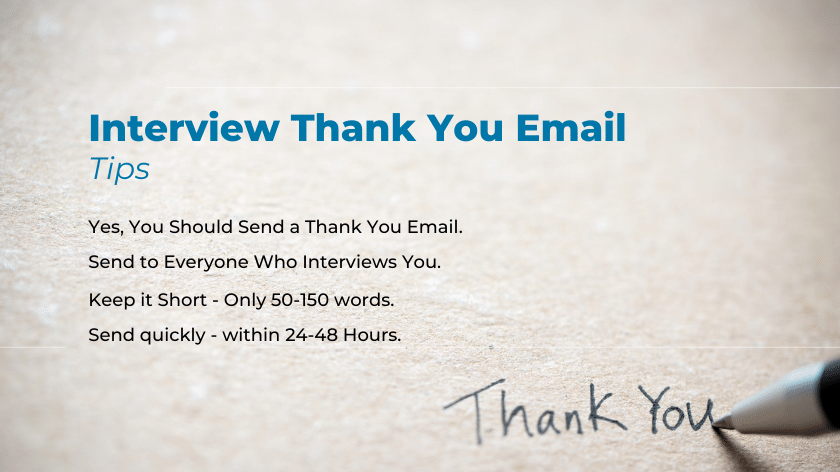
An interview thank you email is a short, personalized message you send within 24 hours of a job interview. It thanks each interviewer, mentions one specific thing from your conversation, and reinforces why you’re a strong fit for the role. Keep it to roughly 100 to 150 words, send a separate note to each person you met, and proofread it twice before you hit send.
That’s the whole answer. The rest of this post is about doing it well, which means not sounding like a robot in a tie.
Quick Takeaways: The Interview Thank You Email
- Send it within 24 hours of the interview, ideally the same day.
- Keep it short: 100 to 150 words, three to four short paragraphs.
- Be specific: reference one real moment from the conversation, not a generic “great chat!”
- Write one email per interviewer. Never copy and paste the identical note to everyone.
- Use a clear subject line that includes the word “thank you” and the job title.
- Proofread like it’s a writing sample, because to the hiring team, it is one.
What Is an Interview Thank You Email?
An interview thank you email (also called a post-interview follow-up note) is a brief message that closes the loop after a job interview. It does three jobs at once:
- It says thank you (the obvious one).
- It reminds the interviewer who you are and what you talked about.
- It gives you one more chance to make your case, especially if you left something out or wish you’d answered a question differently.
Notice that it’s not a “please pick me” plea. It’s a professional courtesy that happens to double as a tiny, polite marketing document. (I’m aware that sounds cynical. I promise it’s also genuinely about being a decent human.)
If you’re looking for the bigger picture of what to do between the interview and the offer, I covered the strategy side in this follow-up strategy post. This post is narrower: the note itself, with templates you can adapt.
Does a Thank-You Note Actually Matter?
Here’s my honest answer: it depends on who’s reading it, and that’s exactly why you send it.
Some hiring managers barely notice a thank-you note. Others quietly keep a mental tally of who sent one and who didn’t, especially when two candidates are neck and neck. Career-advice publishers like the Indeed Career Guide and talent-acquisition resources from SHRM consistently treat post-interview follow-up as standard professional practice. You can’t know which kind of reader you’ll get, so you cover both.
Think of it this way: a thank-you note costs you ten minutes. Skipping it costs you nothing unless it’s the tiebreaker, and then it costs you everything. Those are lopsided odds, and I like lopsided odds in my favor.
There’s also a quieter benefit. Writing the note forces you to replay the interview and pull out what mattered. That’s useful intel for your next round, or for your negotiation if an offer arrives.
Email vs. Handwritten Note: Which One Should You Send?
I get this question constantly, usually from someone who has just bought a very nice card and is now having second thoughts.
| Handwritten Note | ||
| Speed | Arrives within hours | Can take days by mail |
| Best for | Nearly every job search, especially when decisions move quickly | Smaller, relationship-driven workplaces; a second touch after the email |
| Risk | Can look generic if rushed | May arrive after the decision is made |
| My take | The default. Send this first. | A lovely bonus, never a replacement |
The short version: send the email first. If you want to add a handwritten card afterward, go for it, but don’t let the card be your only follow-up. Hiring timelines are fast, and the mail is not.
When to Send It: Fast, Not Frantic
RULE: Send it within 24 hours. Same day is even better.
The goal is to land in the interviewer’s inbox while you’re still fresh in their memory. That said, “fast” doesn’t mean “sprinting out of the parking lot to type on your phone.”
A few timing notes:
- Interviewed in the morning? Send your note that afternoon or evening.
- Interviewed late in the day? Send it that evening or first thing the next morning.
- Multiple rounds in one day? Send individual emails the same evening to everyone you met.
- Missed the 24-hour window? Send it anyway, with a brief, honest line. A late thank you still beats no thank you. Don’t write a three-paragraph apology; one light sentence is plenty.
If you’re still anxiously refreshing your inbox after sending, I wrote a post on getting a handle on the endless job search for exactly that spiral. (Resist the urge to check every eleven minutes. Your inbox is not a pot that boils faster when watched.)
What to Include: The Anatomy of a Good Thank You Email
A strong interview thank you email has five parts. Nothing fancy, and nothing you can’t write in one sitting.
1. A Clear Subject Line
Make it easy to understand at a glance. Include “thank you” and the role.
- Thank you: Marketing Manager interview
- Thank you for your time today, [Your Name]
Skip the cute stuff here. Save your personality for the body.
2. A Warm, Specific Opening
Thank them by name and mention something specific from your conversation. This single detail is what separates a note that gets read from a note that gets skimmed.
Weak: “Thank you for taking the time to meet with me.” Stronger: “Thank you for walking me through how your team is rebuilding the onboarding process. I’m still thinking about your point on reducing time-to-first-win.”
3. A Short “Why I’m a Fit” Paragraph
Connect one of your strengths to something they said they need. This is where you quietly do the work of persuasion. If you mentioned a project or skill in the interview, add a one-line reminder. If you forgot to mention something important, this is your moment.
4. A Forward-Looking Close
Express enthusiasm and mention next steps without pressure. “I’m looking forward to hearing about next steps” works. “I’ll be checking my phone every four minutes” does not.
5. A Clean Sign-Off
Your full name, and optionally your phone number and LinkedIn profile link. If your profile is up to date, it’s a handy breadcrumb. If it isn’t, fix that before you send anyone there.
Interview Thank You Email Examples You Can Adapt
Think of these as scaffolding, not scripts. Swap in your own details, or the note will read like it was mass-produced (because it was).
Example 1: After a First-Round Interview
Subject: Thank you: Project Coordinator interview
Hi Jordan,
Thank you for taking the time to talk with me today about the Project Coordinator role. I especially enjoyed hearing how your team handles cross-department deadlines. It’s a challenge I’ve worked on directly, and it made me even more excited about the position.
My experience coordinating a twelve-person launch team gave me a lot of practice keeping many moving parts on schedule, and I’d love to bring that to your group.
Thanks again, and I’m looking forward to hearing about next steps.
Best, Taylor Morgan
Example 2: After a Panel Interview
A panel interview is one where you meet with several interviewers at the same time. Send each panelist their own email, and change at least one detail in each. Here’s one:
Subject: Thank you, [Name], from today’s panel
Hi Priya,
Thank you for including me in today’s panel conversation. Your question about balancing speed with quality stuck with me, and I realized afterward I could have shared a better example. Last year, I cut review time on a client deliverable by a third by building a simple checklist everyone could follow. It’s the same kind of practical fix I’d bring to your team.
I appreciate your time and thoughtfulness.
Warmly, Taylor Morgan
(That “I realized afterward” move is gold. It shows self-awareness and gives you a second shot at a question you fumbled.)
Example 3: After a Virtual Interview
Subject: Thank you for your time today
Hi Marcus,
Thanks for meeting with me over video this morning. I enjoyed learning how your customer success team measures retention, and I appreciated your candor about the challenges ahead. (Also, thank you for being so gracious about my dog’s cameo.)
Everything you described aligns closely with the work I’ve been doing in account management, and I’d welcome the chance to contribute.
Best regards, Taylor Morgan
If your video call went sideways, a little humor and grace can actually work in your favor. I wrote about what to do when a Zoom interview goes sideways if you need backup.
Example 4: After Meeting a Recruiter
A recruiter screens candidates and manages the hiring process, usually before you meet the person you’d actually work for. Their note can be shorter and more logistical.
Subject: Thank you: Operations Analyst conversation
Hi Dana,
Thank you for the helpful conversation today about the Operations Analyst role and the team’s priorities. I’m very interested in moving forward. Please let me know if there’s anything else you need from me, including references or work samples.
Best, Taylor Morgan
Example 5: After an Interview with the Hiring Manager
A hiring manager is the person who would be your direct boss. They care most about whether you can solve their specific problems, so give them more substance. Notice how recruiters and hiring managers are looking for different things. I broke that down in this post on impressing recruiters and hiring managers.
Subject: Thank you and a quick follow-up idea
Hi Elena,
Thank you for the thoughtful conversation today. Your description of the backlog your team is working through really clarified the role for me.
Since we talked, I’ve been thinking about your point on duplicate requests. One approach I’ve used is a simple intake form that routes tickets by type, which cut repeat requests noticeably in my last role. I’d be glad to share how I’d adapt that here.
Thank you again, and I hope to speak soon.
Best, Taylor Morgan
Common Mistakes People Make With Interview Thank You Emails
I’ve read a lot of these. Some are wonderful. Some are… educational. Here’s what trips people up.
- Sending the identical note to every interviewer. Interviewers compare notes, sometimes literally. A copy-and-paste email is easy to spot and mildly embarrassing.
- Being too generic. “I enjoyed our conversation and I’m very interested in the position” could have been written by anyone, which is the problem.
- Skipping proofreading. A typo in the interviewer’s name is the fastest way to turn a thank-you into a red flag. Check names, titles, and the company name twice.
- Writing a novel. Long notes feel like pleading. Brevity signals confidence.
- Being overly eager or desperate. Enthusiasm is great. “I’ll do anything” is not.
- Using the note to renegotiate or ask about salary. Keep it graceful and forward-looking.
- Forgetting to send it at all. The most common mistake, and the easiest to fix.
Another quiet one: people talk themselves out of sending a note because they think the interview went badly. If that’s you, I’d gently point you toward my post about clients who keep talking themselves out of good opportunities. A rough interview is exactly when a thoughtful follow-up can help most.
RULE: One specific detail beats five generic compliments.
How Kyla Approaches Thank You Emails Differently
Most advice on this topic hands you a template and wishes you luck. I think that misses the point.
When I coach clients through interviews, I treat the thank-you note as the last answer of the interview. It’s your final chance to say, “Here’s the one thing I most want you to remember about me.” So before we write a word, we ask three questions:
- What did they say they were worried about? (Every interviewer has a worry. Your job is to calmly address it.)
- What’s the one thing I wish I’d said better?
- What did I learn that makes me more interested?
The answers become the body of the email. That’s why my clients’ notes don’t sound like templates: they’re built from the real conversation.
I also encourage people to see the interview itself as a conversation rather than an interrogation. If that idea feels foreign, job interviews: I don’t know how to? Yes, you do is a good place to start. And if there was an awkward topic in the room (a career gap, a layoff, a pivot), it can help to name the elephant in the room and ride it, including briefly in your follow-up.
A note on incentives, since I believe in being upfront: I offer interview coaching as a paid service, so obviously I think coaching helps. But everything in this post is free to use whether or not you ever work with me. The templates above are yours.
What This Means for Your Job Search
A thank-you email is a small gesture, but job searching is mostly a series of small gestures that add up. Here’s how to fit this into your process without adding stress:
- Prep before the interview. Decide in advance that you’ll send a note, and leave ten minutes afterward to write it.
- Take notes right after you leave. Jot down two or three specific moments, names, or topics while they’re fresh. This makes the email nearly write itself.
- Get business cards or confirm email addresses at the end of the interview. If you only have a recruiter’s address, ask them to pass your thanks along, or check how the company typically formats emails.
- Treat it as networking. Even if you don’t get this job, those people now know you exist. A well-written note keeps the door open for the next role. For more on building these relationships, take a peek at this post on personal notes.
- Keep your materials consistent. If your note highlights a strength, make sure your resume and cover letter back it up. Cover letters that get read share a lot of DNA with good thank-you emails: short, specific, and human.
For broader career-planning perspectives on how professionals approach their search, the Harvard Business Review career planning hub is a worthwhile read.
Frequently Asked Questions
What should I write in an interview thank you email?
Thank the interviewer by name, mention one specific topic from your conversation, briefly reinforce how your skills fit the role, and close with enthusiasm about next steps. Keep it to about 100 to 150 words. The specific detail is what makes it memorable.
How soon after an interview should I send a thank you email?
Send it within 24 hours, ideally the same day. A prompt note reaches the interviewer while the conversation is still fresh. If you miss the window, send it anyway with a brief acknowledgment; late is better than never.
Should I send a thank you email to every interviewer?
Yes. Send each person their own individualized email, changing at least one detail to reflect what you discussed with them. Identical copy-and-paste messages come across as careless. If you only have one contact, ask them to share your thanks with the others.
Is it better to send a handwritten thank you note or an email?
Email is the safer default because it arrives quickly, and hiring decisions often move fast. A handwritten note can be a nice extra touch, especially at smaller organizations, but it shouldn’t replace the email.
How long should a thank you email be?
Aim for three to four short paragraphs, around 100 to 150 words. Long enough to be specific, short enough to read in under a minute. Brevity reads as confidence.
What should the subject line of a thank you email say?
Keep it clear and professional: include “thank you” and the job title or the date of your interview, such as “Thank you: Marketing Manager interview.” Avoid gimmicks or vague phrases that might get overlooked.
Is it okay to send a thank you email if the interview didn’t go well?
Absolutely. A short, gracious note can soften a rough impression and show professionalism. You can also use it to clarify an answer you wish you’d given differently, as long as you keep the tone positive and concise.
Should I follow up again if I don’t hear back after my thank you email?
Yes, but give it time. If the interviewer shared a timeline, wait until it passes, then send a polite, brief check-in. If no timeline was given, waiting about a week before following up is a reasonable guideline. Keep it friendly and low-pressure.
Ready to Walk Into Your Next Interview (and Follow Up) With Confidence?
If you’ve read this far, you’re probably in one of two camps: you’re about to interview and want to nail it, or you’ve interviewed and you’re quietly wondering why the offers aren’t materializing. Either way, you don’t have to figure this out alone.
In my job interview coaching sessions, we practice your answers out loud (yes, out loud), sharpen your stories, and build your follow-up strategy so the thank-you email is the confident final note instead of a last-minute scramble. And if the bigger question is “what exactly am I going for, and how do I get there?”, career coaching is where we map that out together.
Book your interview coaching session → and let’s make sure the next interview ends with a “yes.”