Meet Dana (a composite of many clients I’ve worked with, not one real person). She’s 41, twelve years into a marketing career, and very good at her job. She’s also quietly miserable. Every Sunday night, she opens a job board, scrolls through roles in fields she knows nothing about, feels ridiculous, and closes the laptop. Repeat weekly.
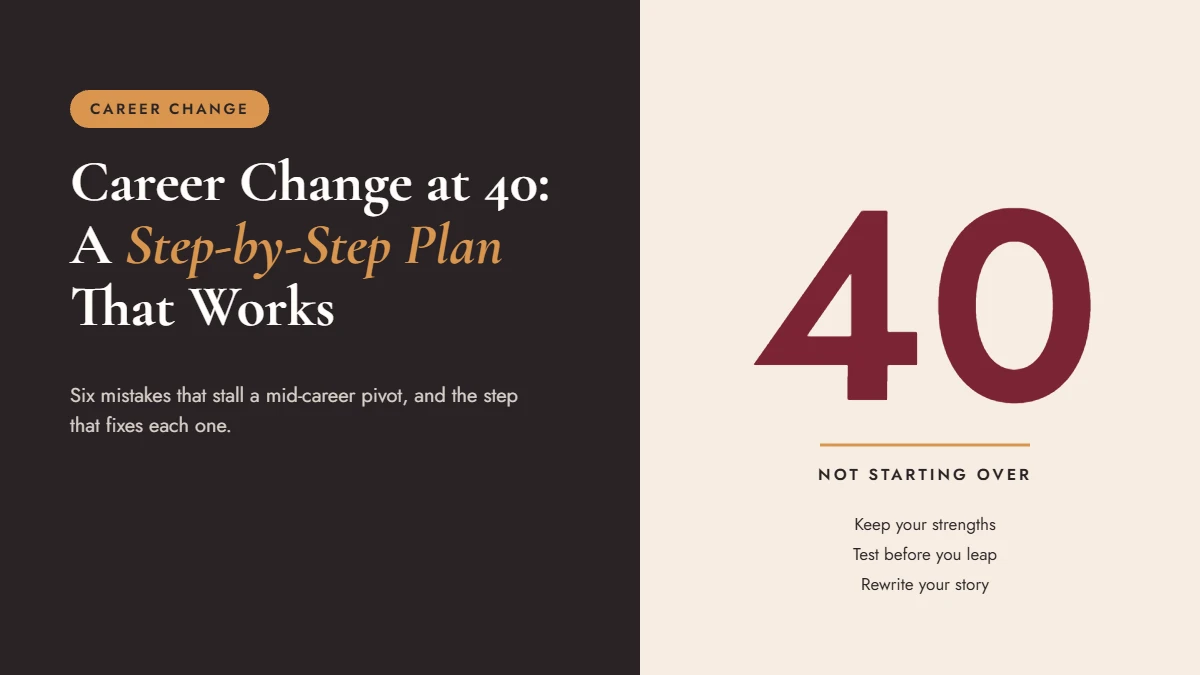
If that sounds familiar, here’s the honest answer: a career change at 40 is not only possible, it’s common, and it works best when you change direction without starting over. The people who pivot successfully keep their strongest skills, test the new field before they leap, and rewrite their story so employers see a bridge instead of a gamble.
A quick definition: a mid-career change means moving into a meaningfully different role, function, or industry after you’ve built real experience somewhere else. It’s different from a promotion or a lateral move, because the people hiring you have to imagine you in a new context. Your job is to make that easy for them.
The Six Mistakes That Stall a Career Change at 40 (and the Step That Fixes Each)
I’ve seen smart, capable people spin their wheels for years. It’s almost never because they lack talent. It’s because of one (or several) of these.
Mistake 1: Asking “What’s my passion?” instead of “What do I want more of?”
Waiting for a lightning bolt of passion is how people stay stuck for a decade. (I have strong feelings about this, which I’ve written up as why you shouldn’t follow your passion.)
Step 1: Inventory what to keep. Write two lists. First, the parts of your work that energize you, even a little. Second, the things colleagues always come to you for. The overlap is your starting point. If even that feels fuzzy, you’re in good company. Here’s what I tell clients who worry they don’t have a clear vision yet.
Mistake 2: Jumping to the furthest possible field
The most dramatic pivots make the best stories. They also take the longest and cost the most. A marketer who wants out doesn’t have to become a nurse. She might thrive in customer education, product marketing, or a nonprofit communications role that values exactly what she already does well.
Step 2: Map adjacent moves first. List three to five roles that use at least half of your current skills. The Occupational Outlook Handbook from the U.S. Bureau of Labor Statistics is a great place to read what different roles actually involve, what training they typically need, and how they’re described.
Mistake 3: Quitting first, testing later
Leaping without data is brave. It’s also the fastest way to discover, six months in, that you hate the new thing too.
Step 3: Run small experiments. Take a short course, do a freelance project, volunteer for a cross-functional assignment, or shadow someone for a day. You’re collecting evidence, both for yourself and for future employers.
Feeling the “where do I even start?” overwhelm right about now? That’s normal, and it’s exactly the stage where a structured outside perspective helps most. My career coaching program is built for this moment, and you can book a free consultation to talk it through before you commit to anything.
If you only remember one thing: at 40, you’re not starting over. You’re re-pointing twenty years of skills at a new target.
- Employers don’t need you to be a beginner. They need to see why your experience transfers.
- Your job is to translate, not apologize.
Mistake 4: Telling your career story in your old field’s language
Your resume says “drove a 22% increase in campaign engagement.” Your target employer in operations reads that and thinks, “So… they’re a marketer?”
Step 4: Rewrite your story for the new audience. Lead with the outcomes that matter in the new field (process, people, revenue, efficiency) and use their vocabulary. My guide to positioning yourself for a job in a new field walks through exactly how. A refreshed mid-career resume is usually the first deliverable.
Mistake 5: Applying cold to job postings
Career changers have the hardest time getting through online applications, because software and screeners are matching you against people who’ve done the job before.
Step 5: Network your way in. Reach out to people already doing the work. Ask for 20 minutes of their perspective, not a job. Many roles are filled through referrals and conversations long before they’re posted, which is why I’m a big fan of tapping into the hidden job market. Make sure your LinkedIn backs you up when they look you up; here’s how to use LinkedIn to get noticed.
Mistake 6: Talking yourself out of good opportunities
This one breaks my heart. Mid-career changers routinely skip roles they’re qualified for because they don’t check every box. Men and women both do it, and it costs them interviews they’d have won. I’ve written about how my clients talk themselves out of good opportunities, and how to stop.
Step 6: Apply when you meet the core of the role. If you match the main responsibilities and can show you learn fast, apply. Let them decide.
Your Career Change at 40, Mapped Out
Here’s how those six steps typically fit together. Timelines vary; treat this as a shape, not a deadline.
| Phase | What you’re doing | What you’ll have at the end |
|---|---|---|
| Weeks 1–3 | Inventory skills and energy; list adjacent roles | A short list of 3–5 target roles |
| Weeks 4–8 | Informational conversations and small experiments | Evidence of fit (and a clearer “no” to some options) |
| Weeks 6–10 | Rewrite resume and LinkedIn for the new direction | Materials that read like a bridge |
| Weeks 8 onward | Referral-led applications and interviews | Real conversations with hiring managers |
A Word About Age
At 40, you’re right at the age when U.S. federal law starts protecting you. The EEOC explains that age discrimination protections apply to people 40 and older. That’s reassuring, but bias doesn’t vanish because a law exists. The best defense is a modern, focused resume, an active LinkedIn profile, and current skills you can talk about with energy.
And remember the upside: you bring judgment, perspective, and a network that a 25-year-old simply doesn’t have yet. If you’ve ever left the corporate world and come back, you’ll know this feeling already. I wrote about it in mastering the corporate transition.
Should You Do This Alone?
You can. Plenty of people do, especially with a clear target and a strong network. But a career change is one of the few projects where an outside view saves real time. If you’re curious what that looks like in practice, here’s what a career coach actually does. For more on planning your next chapter, Harvard Business Review’s career planning collection is also worth your time.
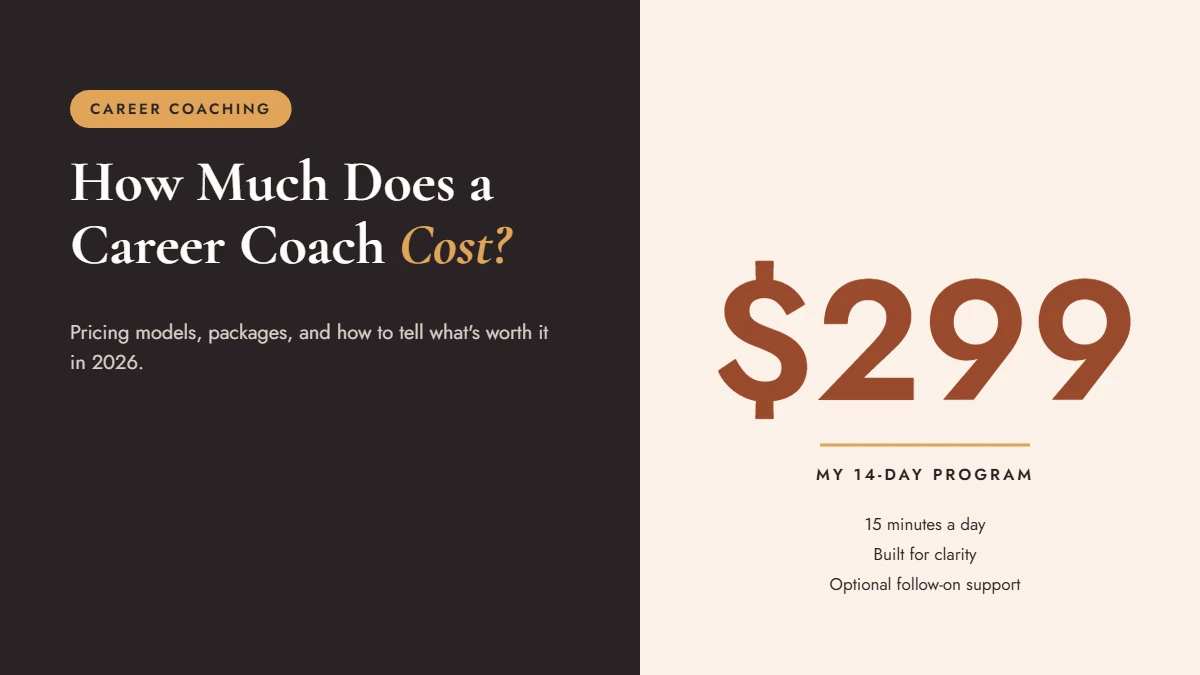
My career coaching starts with a 14-day “Find Your Path” challenge ($299), designed to take about 15 minutes a day. It’s built for exactly the “I know I want something different, I just don’t know what” stage. You’ll find all my options on the services page.
Questions I Get Asked a Lot
Is 40 too old to change careers?
No. Forty is roughly the middle of a working life, which means you likely have twenty-plus years ahead of you. Mid-career changers also bring transferable skills, judgment, and professional networks that younger candidates are still building.
What is the first step in a career change at 40?
Get clear on what you want to keep, not just what you want to leave. List the parts of your current work that energize you and the skills people rely on you for, then look for roles that use more of both.
Do I need to go back to school to change careers at 40?
Not always. Many pivots need a targeted certificate, a short course, or hands-on project work rather than a full degree. Talk to people already in the field before you invest in a program.
How long does a mid-career change take?
It varies with the size of the leap. Moving to an adjacent role can take a few months; moving into an entirely new field with new credentials can take a year or more. A clear plan shortens both.
Will I have to take a pay cut?
Sometimes, especially for a big leap into an unrelated field. Adjacent moves that build on your existing skills often avoid a cut entirely. Map your transferable skills before you assume you’re starting at entry level.
How do I explain a career change on my resume?
Lead with a summary that names your new direction, then frame past results in the language of the new field. Your resume should read like a bridge, not a history lesson.
Is age discrimination a concern at 40?
In the U.S., federal law protects applicants and employees age 40 and older from age discrimination. That doesn’t remove bias entirely, so a modern resume, an active LinkedIn presence, and current skills still matter.
Should I work with a career coach for a mid-career change?
A coach is most helpful when you’re unsure what you want next, or when you know the destination but can’t get traction. Coaching gives you structure, honest feedback, and accountability while you test options.
Let’s Map Your Next Move
If you’re 40-something and stuck between “I can’t keep doing this” and “I have no idea what’s next,” you don’t have to figure it out alone. Book a free consultation and tell me where you are. We’ll talk through what to keep, what to test, and what a realistic first step looks like for you. It might be smaller (and less scary) than you think.