LinkedIn technically allows up to 50 skills on your profile, but the real answer to how many you should list is closer to 15-25 chosen deliberately, not maxed out. More skills doesn’t mean more visibility. A cluttered, unfocused skills list actually makes it harder for the three that matter most to stand out, both to a human scanning your profile and to LinkedIn’s own search algorithm.
LinkedIn’s Actual Technical Limit
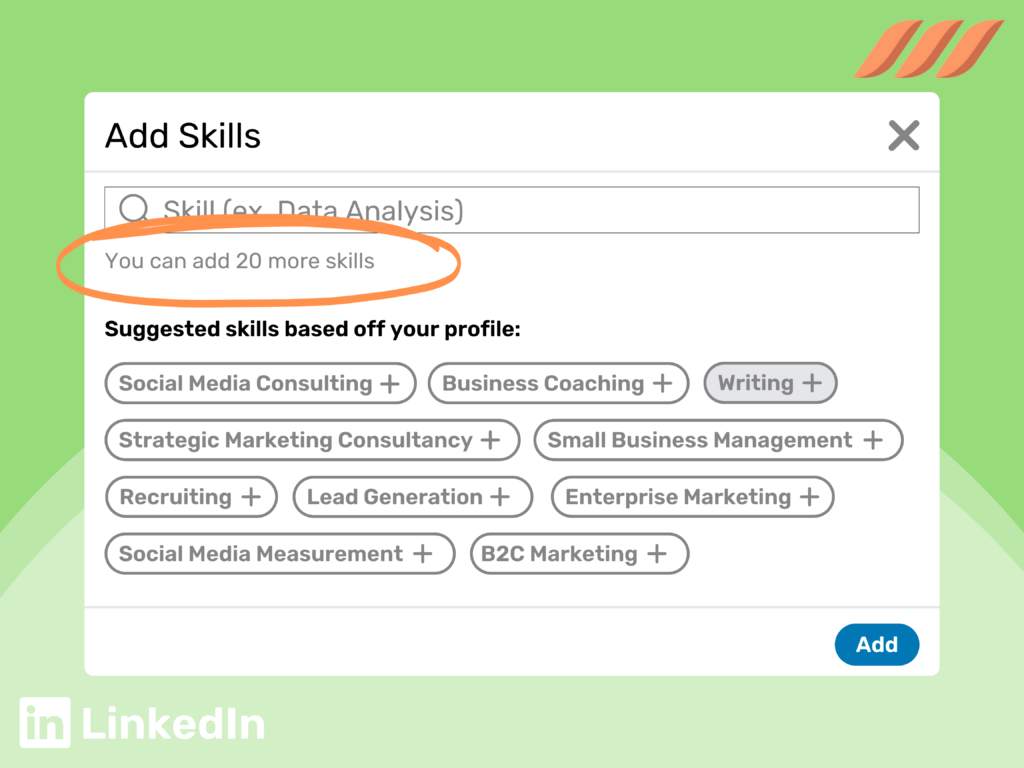
According to LinkedIn’s own platform documentation, you can list up to 50 skills on your profile. Of those, only the top 3 can be pinned meaning they display prominently near the top of your skills section, and they’re the ones LinkedIn’s interface highlights most visibly to anyone viewing your profile.
That 50-skill ceiling exists so people don’t list an unlimited, unmanageable number of skills. It was never meant to be read as a target to fill completely. Treating it as a checklist to max out is like assuming a resume should be as long as possible simply because there’s no hard page limit enforced by the software.
Why More Isn’t Better
It Dilutes What Actually Matters
If you list 45 skills, ranging from your actual specialty to “Microsoft Office” and “Teamwork,” anyone scanning the list has to work harder to figure out what you’re actually good at. Recruiters and hiring managers skim; they don’t study.
It Can Look Unfocused
A profile listing skills spanning five unrelated disciplines can read as scattered rather than versatile, particularly if you’re trying to position yourself clearly for a specific type of role. Focus reads as expertise. Breadth without focus can read as uncertainty about your own specialty.
Endorsements Cluster Around What’s Already Popular
People tend to endorse whatever skill is already at the top of your list or the most obvious guess, not necessarily your most important one. If your most valuable skill is buried in position 30, it may never accumulate the endorsements that make it look credible.
A Long List Can Signal You Haven’t Prioritized
There’s an implicit message in a carefully curated list of 18 skills versus a maxed-out list of 50: the first suggests someone who knows exactly what they’re good at, and the second can suggest someone who added everything they could think of rather than making decisions about their own positioning.
A Realistic Example
Imagine two marketing managers with nearly identical backgrounds. The first lists 47 skills, including “Microsoft Excel,” “Public Speaking,” “Teamwork,” “Social Media,” and dozens of similarly broad or generic entries, with three random skills pinned at the top that don’t obviously relate to each other.
The second lists 18 skills, all specifically relevant to B2B demand generation things like “Marketing Automation,” “Lifecycle Marketing,” “Demand Generation,” “Salesforce,” and “ABM Strategy” with the three most search-relevant terms pinned deliberately at the top.
A recruiter searching for “demand generation” or “ABM” finds the second profile immediately. The first profile might technically include relevant terms buried somewhere in 47 entries, but between the clutter and the arbitrary pinned skills, it does a much weaker job of representing what this person actually specializes in.
The Real Answer: How Many You Should Actually List
A range of 15-25 skills works well for most professionals, with meaningful variation by career stage and how established your specialty is.
| Career Stage | Suggested Range | Why |
| Entry-level | 10–15 | Fewer skills to draw from yet better to list what’s genuinely true than pad the list |
| Mid-level | 15–20 | Enough range to show depth in a function without diluting focus |
| Senior / executive | 20–25 | Broader scope of responsibility genuinely spans more skill areas |
| Highly specialized / technical | 20–30 | Specific tools, languages, or certifications often need individual listing |
For more on what else shifts by career stage, see the entry-level and senior-level resume pages skills strategy tends to track closely with how your resume evolves at each stage.
How to Choose Which Skills Make the Cut
Quantity is only half of this question which skills you choose matters just as much as how many. I’ve written a full breakdown of how to actually choose which skills to include, but the short version is: start from the job descriptions of roles you actually want, not a generic list of buzzwords you assume sound impressive.
A practical way to narrow the list: pull up 3-5 job postings for roles you’d genuinely want next, and note which skills appear repeatedly across them. Those repeated terms are a strong signal of what recruiters in that specific niche are actually searching for, and they should heavily influence both your full list and your top 3 pinned choices.
It’s also worth distinguishing between skills that belong in this dedicated section and skills that are better woven into your About section as narrative. The skills section is built for scanning and search matching short, discrete terms. Your About section is where you demonstrate a skill in context, through a real example, rather than just naming it. Strong profiles use both, and neither should be trying to do the other’s job.
Your Top 3 Pinned Skills Matter Most
Since only 3 skills get pinned prominently, treat that decision as the most important part of this whole exercise. Ask yourself: if a recruiter only saw three skills and nothing else about you, which three would most accurately and compellingly represent your value?
Those three should usually be the skills most central to the roles you’re targeting right now, not necessarily the ones you’re proudest of historically. A skill you’re deeply experienced in but actively moving away from professionally probably shouldn’t occupy one of your three most visible slots.
How Endorsements Factor In
Endorsements add a layer of social proof, but they’re easy to over-index on. A skill with 60 endorsements from people who never actually worked with you on that skill isn’t more credible than one with 5 genuine endorsements from close colleagues it just looks that way at a glance.
Resist the urge to participate in endorsement-trading groups or automated endorsement exchanges. It’s a common tactic, and it’s usually easy for anyone paying close attention to spot as inauthentic, particularly when someone with no obvious connection to a skill has endorsed it anyway.
What About Skill Assessments and Badges?
LinkedIn also offers skill assessment quizzes for certain skills, and passing one adds a verified badge next to that skill on your profile. These are worth doing selectively for your most important 2-3 skills, particularly technical or measurable ones like specific software platforms or languages, where a badge adds real, verifiable credibility.
They’re less useful for soft skills or broad categories that don’t have a meaningful assessment format, and there’s no need to work through every available quiz just because the option exists the same “curate, don’t maximize” principle applies here too.
Does This Change by Industry?
Somewhat. Highly technical fields software engineering, data science, IT often justify a slightly longer, more specific list, since individual tools, languages, and platforms each warrant their own entry (Python, SQL, AWS, Kubernetes, and so on each functioning as a distinct, searchable term).
Fields built more around relationship or strategic skills sales, marketing, consulting, general management usually do better with a tighter, more curated list, since the differentiation comes from specialization and results rather than a long inventory of discrete tools.
Common Mistakes People Make
- Filling all 50 slots regardless of relevance, just because the option exists.
- Never revisiting the list after the first time it was created, even as a career evolves.
- Leaving the 3 pinned skills to whatever LinkedIn defaulted to, rather than choosing deliberately.
- Listing overly generic skills (“Communication,” “Teamwork”) that don’t differentiate from any other candidate.
- Ignoring the skills section entirely, which wastes a section recruiters specifically filter and search by.
How This Fits Into a Broader, Optimized Profile
Your skills section doesn’t work in isolation. It should reinforce the same story your About section tells and align with the overall structure of a genuinely healthy LinkedIn profile. If you’re rethinking your skills list, it’s often a sign the rest of the profile is due for a look too and if you’re weighing whether to handle that yourself or bring in help, the DIY-vs-professional breakdown covers that decision in more depth.
Keeping your profile active also matters here skills you update alongside regular LinkedIn engagement tend to stay more current than a profile that’s touched once and forgotten.
Why This Actually Matters for Getting Found
This isn’t cosmetic. SHRM, the leading professional association for HR and talent-acquisition practitioners, has noted that recruiters increasingly rely on skills-based search and filtering tools, which means a well-curated, accurate skills section directly affects whether you surface in a recruiter’s search at all.
General job search guidance from Indeed’s Career Guide reinforces the same point: specific, relevant keywords not a maximized quantity of them tend to perform better across virtually every part of a job search profile, resumes included.
The Bigger Picture
It’s worth stepping back from the specific number for a second. The actual goal of your skills section isn’t to satisfy an algorithm or hit a target count it’s to make it effortless for the right person to recognize, in about two seconds of scanning, exactly what you’re good at. A shorter, sharper list does that better than a longer, vaguer one almost every time, which is really the entire argument behind the number 15-25 rather than 50.
Frequently Asked Questions
Does having more skills listed improve my LinkedIn search ranking?
Not automatically, and possibly the opposite if irrelevant skills dilute your profile’s clarity. Relevance and endorsement quality tend to matter more than raw skill count.
Can I remove skills I added a long time ago?
Yes, and you should periodically. A skills section should reflect your current professional direction, not everything you’ve ever touched throughout your career.
Do endorsements from people I don’t know well hurt my profile?
They’re not damaging, but they don’t add much credibility either. A smaller number of endorsements from people who genuinely worked with you on that skill carries more weight than a large number from casual connections.
Should my skills list match my resume keywords exactly?
They should overlap significantly, since both are trying to surface you in searches for similar terms. See how resume keywords work for the same underlying logic applied to your resume.
What if I don’t know which 3 skills to pin?
Start with the skill most central to the job you want next, not the job you’re currently in if you’re trying to make a change. Ask a colleague or mentor which skill they’d associate with you first, which often reveals your actual professional reputation more clearly than your own guess.
How often should I update my skills list?
Whenever your role or responsibilities change meaningfully, and at minimum once a year even without a major change, just to prune anything outdated or no longer relevant.
Is it bad to have zero endorsements on a skill?
Not necessarily, particularly for a newly added or highly specific skill. It’s more important that the skill itself is accurate and relevant than that it already has social proof attached.
Should I list soft skills like ‘leadership’ or ‘communication’?
Sparingly, and only if they’re specific enough to be meaningful. “Cross-functional team leadership” tells a reader more than “Leadership” alone. Generic soft skills are the ones most likely to get cut when you’re trying to trim a bloated list down to something focused.
What happens if I have fewer than 15 relevant skills to list?
That’s completely fine, particularly earlier in a career or within a narrow specialty. A shorter, entirely accurate and relevant list is always preferable to padding it out with weaker entries just to hit a target number.
Want Help Getting This Right?
If your skills section still reflects a job you had five roles ago, that’s worth fixing. I’m Kyla Duffy, and my LinkedIn profile optimization services include a real look at your skills, keywords, and overall profile strategy, not just a copy-paste from your resume. Curious what that costs? My rates are posted publicly, and my FAQ page covers what people usually ask first.