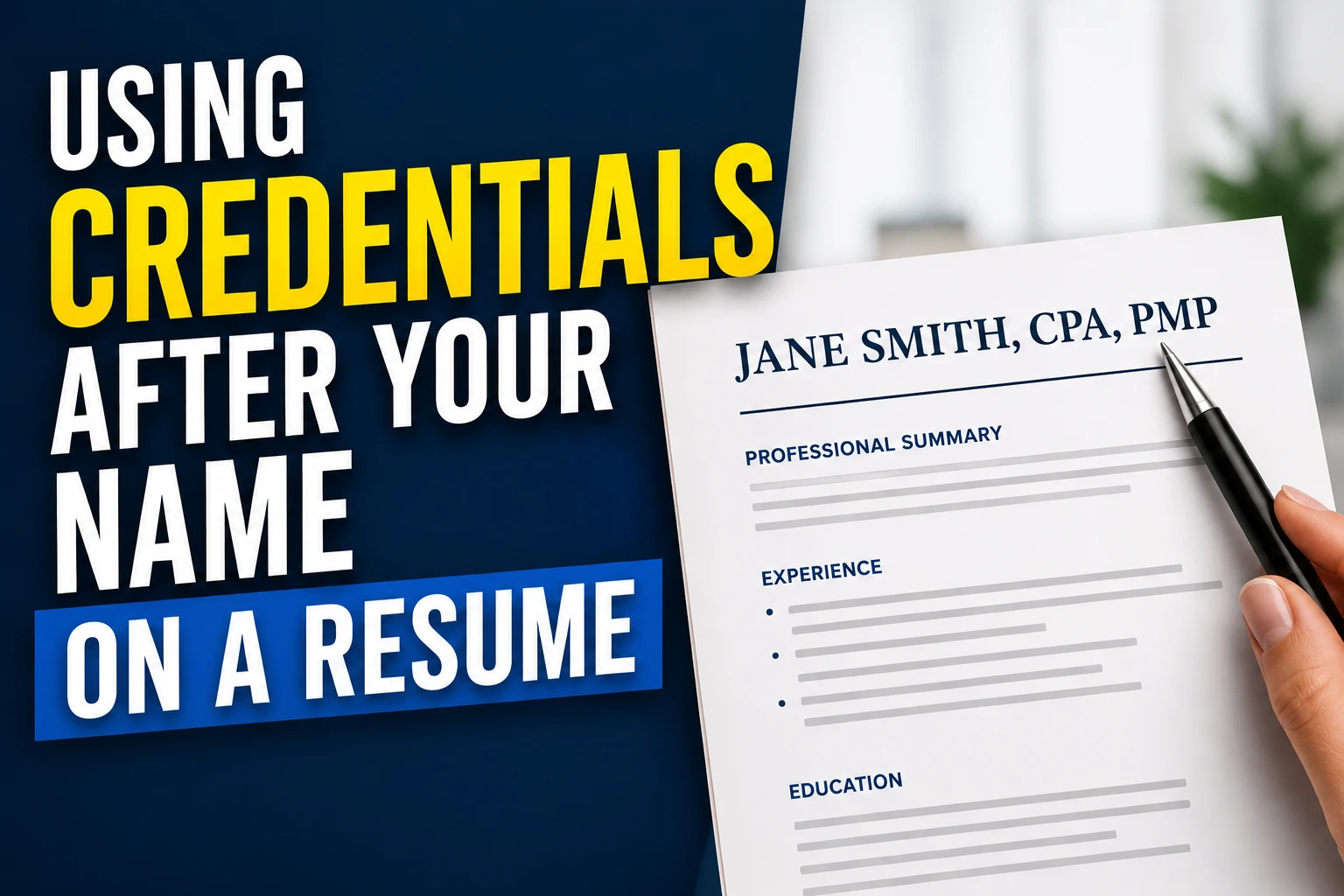
Yes, but only for credentials that carry real, immediately recognizable weight in your field licenses like RN, CPA, JD, or PE, and widely recognized certifications like PMP. List them right after your name, separated by a comma, using standard abbreviations without periods. Skip anything minor, expired, or unlikely to mean something to the person reading your resume.
When It Makes Sense to Add Credentials After Your Name
The test is simple: would someone in your field immediately recognize this credential and understand why it matters, without you explaining it?
- Professional licenses required to practice: RN, CPA, JD, PE, LCSW.
- Widely recognized certifications with real market weight: PMP, CFA, SHRM-SCP.
- Advanced degrees directly relevant to your field, when convention supports it: PhD, MD.
If your target reader would need a Google search to understand what the letters mean, that’s a signal it probably doesn’t belong in your header.
A Realistic Example
Imagine two project managers with similar backgrounds applying for the same senior PM role.
The first lists their name plainly: “Jordan Ellis.” Their PMP certification is mentioned later, buried in a bullet point under a previous role, easy to miss on a fast scan.
The second lists their name as “Taylor Reyes, PMP.” The exact same credential, but positioned where a hiring manager or ATS keyword scan sees it immediately, in the first two seconds of reading the resume.
Both candidates have the same qualification. Only one of them gets credit for it in the first glance a busy reader gives the page which is really the whole argument for using this space deliberately instead of leaving it blank by default.
Should You Put PMP After Your Name Specifically?
Yes, generally. PMP (Project Management Professional) is one of the most widely recognized certifications across industries, and it carries real signal for project management, operations, and consulting roles. “Jordan Ellis, PMP” is standard, expected formatting for anyone actively working in project management.
The exception: if you’re pivoting away from project management entirely and PMP isn’t relevant to your new target roles, it may be more useful lower in your resume than prominently in your header, where space and attention are limited.
How to Format It Correctly
For a broader look at credentials, certifications, and licenses on a resume beyond just this header-formatting question, see credentials on your resume. This post focuses specifically on the after-your-name formatting decision.
Use a Comma, Not a Space or Dash
“Jordan Ellis, PMP” is correct. “Jordan Ellis – PMP” or “Jordan Ellis PMP” without punctuation both read as less polished.
Skip the Periods
Standard formatting drops periods between letters: PMP, not P.M.P. This holds for virtually all standard professional credentials.
Order Multiple Credentials by Relevance
If you hold more than one credential worth listing, order them by relevance to the job you’re targeting, not by which you earned first or which sounds most impressive to you personally.
Example: “Jordan Ellis, PMP, CSM” for a project management role lead with the most universally recognized, most relevant credential first.
Don’t Stack More Than Two or Three
A name followed by five credentials starts to look cluttered and can undercut the credibility it’s meant to signal. If you have that many worth mentioning, most belong in a dedicated certifications section instead.
Licenses vs. Certifications: A Quick Distinction
These terms get used loosely, but they mean different things, and the distinction affects how confidently you should display a credential.
A license is typically required by law or a governing body to legally practice in a field CPA, RN, JD, PE, and similar credentials fall here. These almost always belong after your name if you’re actively practicing, since they signal you’re legally qualified to do the work at all.
A certification is usually optional and skill-based, earned through training or an exam but not legally required to work in the field PMP, CSM, and most industry-specific certifications fall here. These belong after your name when they’re widely recognized and directly relevant, but the bar is slightly more subjective than with a license.
When Not to Include Credentials After Your Name
- The credential is expired or no longer active list expired credentials, if at all, in your certifications section with context, not your header.
- The credential is minor or unlikely to be recognized outside a narrow niche.
- You’re intentionally repositioning away from the field the credential signals, and including it creates confusion about your target direction.
- You only have one credential and it’s genuinely not that significant padding a thin header with a low-value credential can look like you’re trying too hard.
Credential Examples: Header vs. Certifications Section
| Credential | Header (After Name)? | Why |
| PMP | Yes | Widely recognized, high market value |
| CPA | Yes | Required license, immediately understood |
| JD | Yes, if practicing law | Standard convention in legal contexts |
| Six Sigma Yellow Belt | Usually not | Lower-tier certification, better suited to a certifications list |
| Expired real estate license | No | No longer active misleading if implied as current |
Credentials After Your Name vs. a Separate Certifications Section
Your name and header are prime real estate the first thing anyone reads, covered in more depth in how to write a resume header that doesn’t get skipped. Only your most universally recognized, most relevant credential or two belong there. Everything else additional certifications, training, memberships belongs in a dedicated section further down the page, where there’s room to add brief context if needed.
This is closely related to the broader question of what belongs in your resume header and title area overall credentials are one input into that decision, not the whole picture.
Does This Change at the Executive Level?
Somewhat. An MBA, PhD, or JD can carry meaningful weight at senior levels, particularly for board-facing or highly technical executive roles, and executive resumes often make more deliberate use of this header space to signal both credibility and specialization immediately. The same core rule applies, though: relevance and recognizability still matter more than how many letters you can fit after your name.
Does This Apply on LinkedIn Too?
LinkedIn has more room, and the convention is slightly looser. Some people add key credentials directly to their name field, though LinkedIn’s own guidelines discourage adding anything other than your actual name there. A more common and accepted approach is working the credential into your headline or About section instead, where there’s space to give it context rather than just a bare abbreviation.
How I Approach This With Clients
This is exactly the kind of small-but-consequential detail I go through during the discovery process behind a professional resume not because it’s the most important decision on the page, but because getting it wrong (cluttered, outdated, or irrelevant credentials) can quietly undercut an otherwise strong header. I also make sure your resume stays ATS-compliant, since unusual formatting around credentials can occasionally cause parsing issues if it’s not handled cleanly.
Why This Actually Matters
This isn’t just a formatting preference. SHRM, the leading professional association for HR and talent-acquisition practitioners, has noted that recruiters often scan resumes in seconds which means a clearly displayed, relevant credential can register instantly, while a cluttered or confusing header can just as quickly create the wrong impression.
The U.S. Bureau of Labor Statistics tracks occupational licensing requirements across many fields, which is a useful resource if you’re unsure whether a credential you hold is considered a formal license versus an optional certification that distinction can affect how confidently you should display it.
General guidance from Indeed’s Career Guide reinforces the same underlying principle: relevant, specific signals outperform generic or excessive ones, whether that’s in your credentials, your skills list, or your resume summary.
Frequently Asked Questions
Should I put my degree after my name, like “Jordan Ellis, MBA”?
It depends on your field and level. An MBA can carry weight in business and executive contexts, but it’s less universally displayed than a license like CPA or a certification like PMP. When uncertain, it’s safer in your education section unless it’s central to your positioning.
Can I list a credential after my name if it recently expired?
No, not without context. Implying an active credential that’s actually expired can create a misleading impression. If it’s still relevant to mention, do so in your certifications section with an honest note about its status.
What if my credential isn’t well known outside my specific industry?
Consider your audience. If you’re applying within your industry, a niche-but-respected credential may be worth including. If you’re applying more broadly or changing industries, it may create more confusion than clarity in your header.
Is there a comma between my name and the credential?
Yes. Standard formatting is a comma between your name and the credential: “Jordan Ellis, PMP,” not “Jordan Ellis PMP” without punctuation.
How many credentials is too many to list after my name?
More than two or three starts to look cluttered. If you have several worth mentioning, list your one or two most relevant and universally recognized credentials in the header, and move the rest to a certifications section.
Do international credentials follow the same formatting rules?
Generally yes, though recognizability varies more by region. A credential that’s standard and well understood in one country may need more context for a different audience use judgment based on where you’re applying.
Should students include credentials they’re actively pursuing but haven’t finished?
Not after your name specifically that space implies a credential you’ve already earned. An in-progress credential belongs in your education or certifications section with an expected completion date noted.
What if my industry has its own unwritten norms about this?
Follow the norm of your specific field over a generic rule. Some industries, like healthcare and law, have very established conventions about which credentials appear after a name. If you’re unsure, look at how respected professionals in your specific niche format their own resumes and LinkedIn profiles, and match that convention rather than guessing.
Want a Second Set of Eyes on Yours?
Small formatting decisions like this one add up across an entire resume, and it’s easy to get too close to your own document to notice what’s actually working. I’m Kyla Duffy, and my resume and cover letter writing services cover every detail on the page, credentials included. Curious what it costs? My rates are posted publicly, and my FAQ page covers what people usually ask first.