The professional summary is one of the most important sections of your resume.
A recruiter will probably read it.
A hiring manager definitely will.
In just a few sentences, it should answer the questions every employer is already asking themselves.
Skip the Objective Statement
Objective statements have largely disappeared from modern resumes.
Most of them sound something like this:
Seeking a challenging opportunity where I can grow my skills while contributing to a dynamic organization.
That tells me one thing:
You’re looking for a job.
I already knew that.
Instead of using valuable space to explain what you want, use it to explain why someone should hire you.
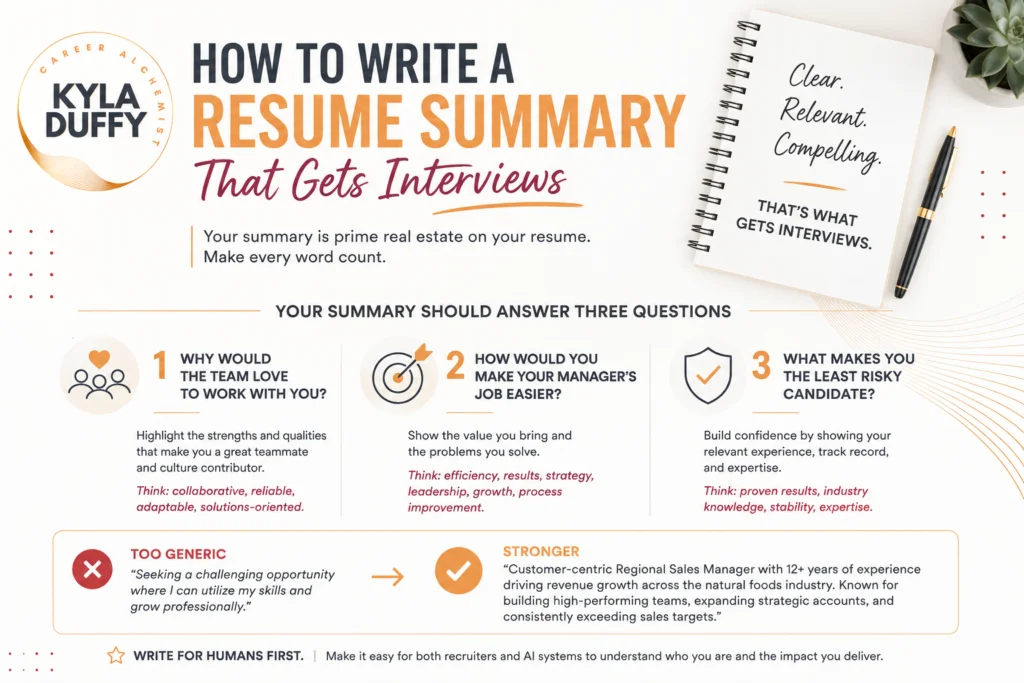
Your Summary Should Answer Three Questions
When I write a professional summary, I’m trying to answer three questions that every hiring manager is asking, whether they realize it or not.
1. Why would this team love working with you?
Every company wants someone who makes the workplace better.
That could mean you’re collaborative, calm under pressure, a strong communicator, highly organized, naturally curious, or someone who builds trust quickly.
Think beyond technical skills. What is it like to work with you?
One of my favorite exercises is asking former coworkers:
“What would you miss if we never worked together again?”
The answers often reveal your greatest strengths.
2. How would you make your manager’s job easier?
Managers hire people to solve problems.
Your summary should quickly communicate the value you bring.
Do you build high-performing teams?
Improve processes?
Grow revenue?
Reduce costs?
Navigate ambiguity?
Strengthen customer relationships?
Help the reader picture how their day gets better because you’re on the team.
3. What makes you the least risky candidate?
Hiring is a risk.
Every offer comes with uncertainty.
Your summary should reduce that uncertainty by highlighting the experience, results, industry knowledge, leadership, certifications, or specialized expertise that give employers confidence.
You’re answering the question:
“Why should we trust you with this job?”
Write for the Reader
One of the biggest mistakes I see is people writing summaries about themselves instead of writing them for their audience.
Before you write yours, ask yourself:
- What is this employer trying to accomplish?
- What problems are they hiring someone to solve?
- Which parts of my experience would give them confidence?
- Which strengths would make me someone they’d enjoy working with?
If your summary answers those questions, you’ve already given the reader a reason to keep going.
Use AI to Think, Not to Write
AI can absolutely help you write a stronger summary.
Just don’t start with:
Write my professional summary.
Instead, ask questions like:
- What accomplishments am I overlooking?
- What themes do you notice across my career?
- Which experiences make me the least risky candidate?
- What questions would a great resume writer ask before writing this summary?
Those prompts lead to much stronger content because they focus on discovery instead of wording.
I’ve trained my own AI on the same methodology I use with clients. It doesn’t just generate polished sentences. It helps uncover the stories, accomplishments, and patterns that make each person unique.
Don’t Forget Your Header
Keep your header simple and professional.
Include:
- Your name.
- City and state.
- Phone number.
- Professional email address.
- Customized LinkedIn URL.
Skip your full mailing address, and if you’re applying for jobs in the United States, leave the photo off your resume.
The Bottom Line
A great professional summary isn’t about squeezing your entire career into three paragraphs.
It’s about giving employers confidence.
If your summary helps them believe they’d enjoy working with you, that you’d make their manager’s job easier, and that you’re a safe hiring decision, you’ve accomplished exactly what it was designed to do.
Related Articles
- What to Know about Writing Your Resume in 2026
- Resume Formatting for 2026
- One Simple Resume Header Fix
- How to Write a Resume Title, Headline, and Summary
Need help uncovering what makes you the right candidate? That’s my favorite part of the process. I’ve helped more than 4,000 professionals identify the strengths, accomplishments, and career stories that make employers want to keep reading. Contact me through https://kyladuffy.com.