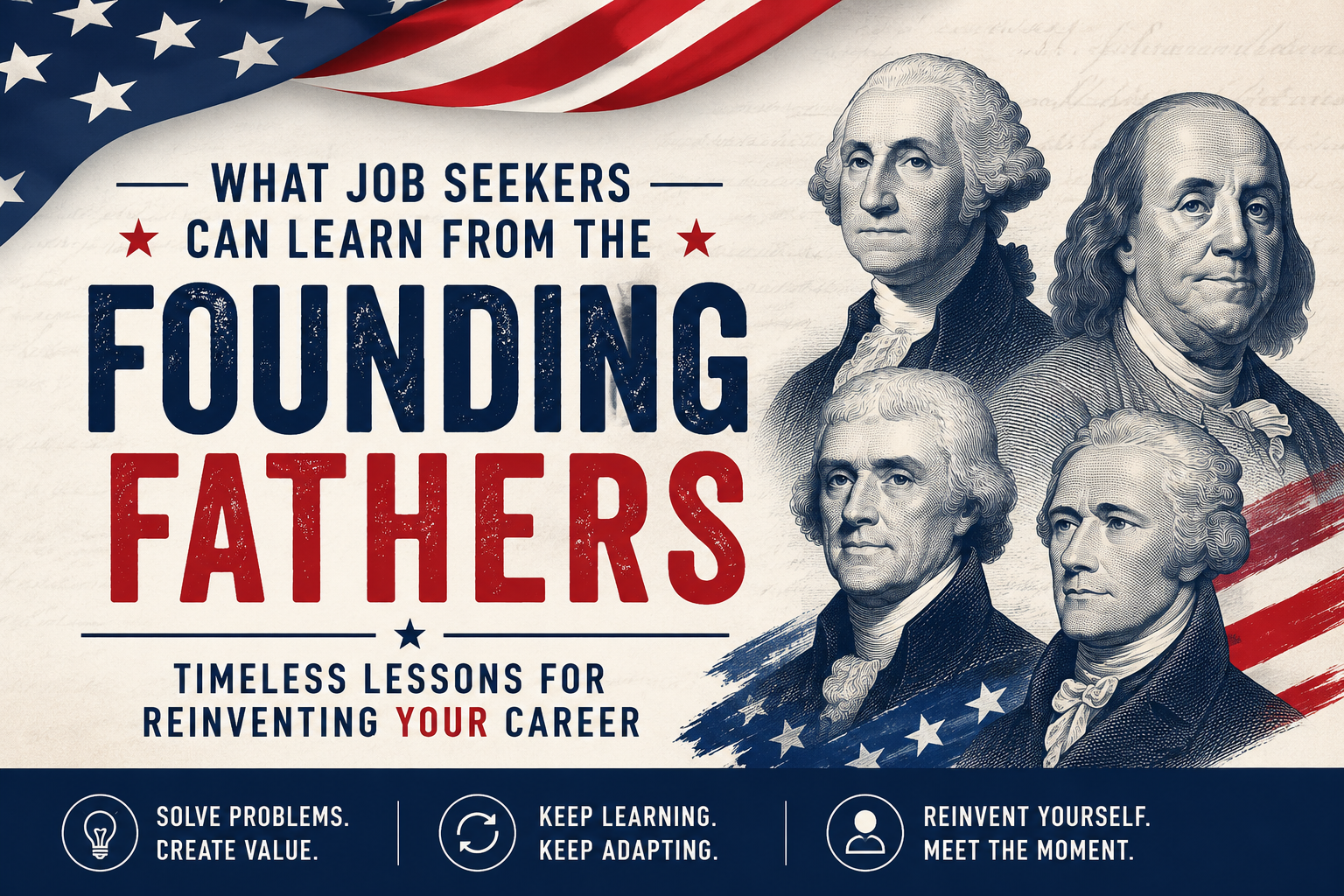
We don’t often think of the Founding Fathers as having careers, but they did. In fact, they were constantly reinventing themselves to meet the moment.
- Benjamin Franklin: printer → writer → inventor → scientist → diplomat → postmaster → statesman.
- George Washington: surveyor → military officer → farmer → commander → president.
- Thomas Jefferson: lawyer → author → diplomat → president → architect → university founder.
- Alexander Hamilton: soldier → lawyer → author → Treasury Secretary → financial architect.
As a career coach and mother of a toddler, I’m constantly thinking about the future of work. As we slide deeper into a world integrated with artificial intelligence, how are careers changing? What qualities will people need to thrive?
A recurring theme among futurists is that the future of work belongs to problem-solvers.
I felt pretty smart repeating this “deep thought” to friends and clients until I started writing this 4th of July post and realized how silly it sounded.
Work has always belonged to problem-solvers.
Long before universities handed us catalogs of careers, people looked around, identified unmet needs, developed useful skills, and earned a living by creating value for others.
The Founding Fathers weren’t trying to become presidents or diplomats. They stepped into whatever challenges their communities and country needed them to solve. They learned. They adapted. They reinvented themselves.
Huh.
In my opinion, the hullabaloo about AI replacing jobs is overblown. Yes, some roles are disappearing. Many more are evolving.
We’re seeing a widening gap between education and mid-career as AI takes over some entry-level work and creates an experience gap for newcomers in many industries. We’re also seeing professionals learn to work alongside machines or transition into entirely new fields.
But is this really any different from what we’ve experienced throughout history?
For much of our lives, we’ve enjoyed relatively stable career paths. Society told us, “Here’s a catalog of careers. Pick one, earn a degree, and you’ll probably have work.”
So we did.
Before that, people had to think a little differently. They looked around, figured out what was needed, built useful skills, and found ways to contribute. That’s how they made a living.
I think we’re getting back to that.
Today, entrepreneurial thinking might look like coding, project management, AI implementation, leadership, or marketing instead of blacksmithing or agriculture. Even those examples illustrate how the market evolves. Blacksmithing gave way to manufacturing automation. Agriculture became precision farming, environmental science, and mechanical engineering.
The industries didn’t disappear.
They transformed.
That’s exactly what’s happening now.
Here’s what I think has changed most:
Companies aren’t really hiring job titles. They’re investing in people who can create value.
They don’t wake up thinking, “I hope we hire another project manager today.” They wake up thinking, “We’re behind schedule.” “We’re losing customers.” “Our systems aren’t scaling.” “We need to grow.”
A job title is simply one way to address those challenges.
The people who will thrive are the ones who can walk into an interview and confidently say:
“Here’s what I bring to the table. Here’s how I approach unfamiliar challenges. And here’s why you can trust me to keep learning as your business evolves.”
That may be the biggest career lesson the Founding Fathers still have to teach us.
None of them built remarkable careers by clinging to a single identity. Benjamin Franklin wasn’t “just” a printer. George Washington wasn’t “just” a soldier. Thomas Jefferson wasn’t “just” a lawyer. Each repeatedly learned new skills, embraced new responsibilities, and expanded the ways they could contribute.
The future has never belonged to people who stay exactly where they are.
It belongs to those who continually reinvent themselves to meet the moment.
Need help figuring out the future of work for you? Contact me!