There’s a myth that won’t die: that a career change at 50 means going back to the bottom of the ladder, competing with 24-year-olds for entry-level jobs, and pretending your last 25 years didn’t happen.
It’s not true. The most successful career changers in their fifties don’t start over. They pivot sideways into roles that put their experience, judgment, and network to work, and they present that experience in a way that feels modern and forward-looking. The goal isn’t to hide your age. It’s to make your experience impossible to ignore.
Key takeaways
- At 50, the strongest pivots build on what you already know: adjacent roles, consulting, training, advisory, or leadership in a new sector.
- Know your financial runway before you leap. It changes which options make sense.
- Age-proof your resume: focus on the last 10–15 years, lead with recent results, and use a modern format.
- Your network is your biggest advantage. Use it before you use job boards.
- In interviews, quietly answer the questions employers may not ask out loud: adaptability, energy, and fit.
A quick note on terms. When I say pivot, I mean changing the role, function, or industry you work in while carrying your core strengths with you. When I say bridge role, I mean a job, contract, or consulting arrangement that lets you test a new direction while earning income. Both matter a lot at this stage.
If you’re a little younger and wondering how this differs, I’ve also written a step-by-step plan for a career change at 40. The fundamentals overlap, but at 50 the resume strategy, the financial math, and the options all shift.
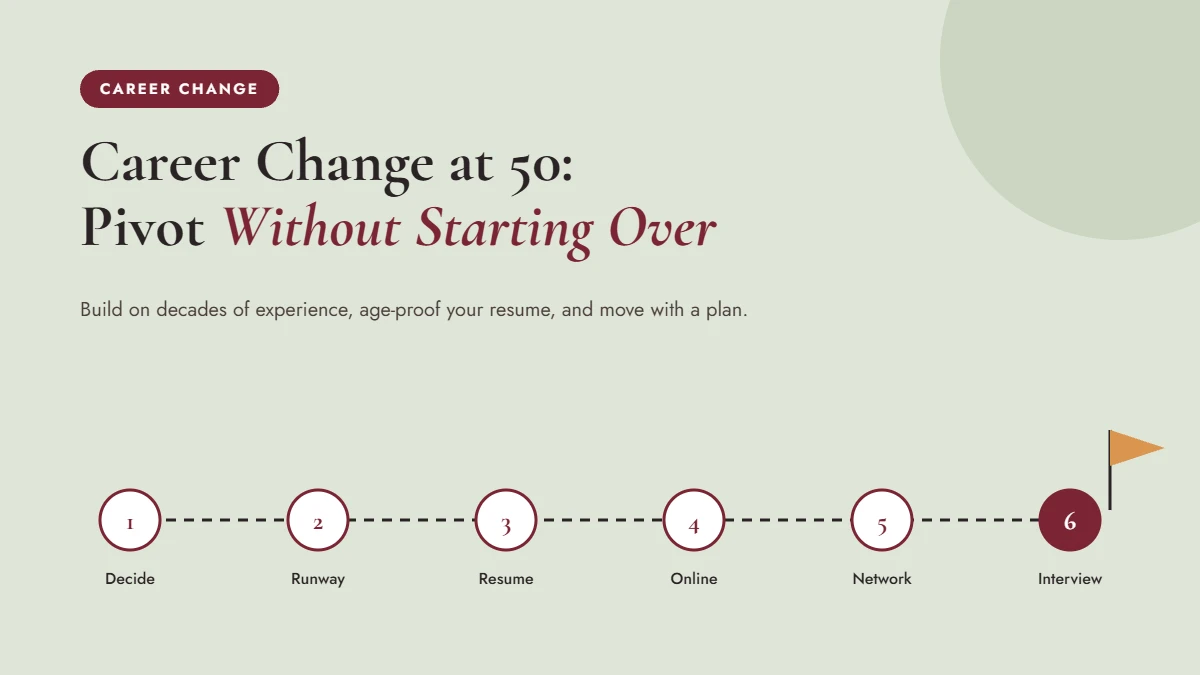
Step 1: Decide What Kind of Change You Actually Want
“I want a change” can mean wildly different things. Before you update a single document, figure out which of these you mean:
- Same field, different role. You love the industry but not the job. Think moving from sales leadership into enablement, or from engineering into product.
- Same skills, different industry. Your expertise travels, but you want a new mission, often nonprofit, education, or healthcare.
- A genuinely new field. Exciting, and possible, but it may need training and more time.
- A different way of working. Consulting, fractional leadership, contract work, or a portfolio of part-time roles.
Most people I work with land in the first, second, or fourth category, and they get there faster than they expected. The Occupational Outlook Handbook is a helpful, no-nonsense way to explore what different roles involve and what training they typically need.
Step 2: Know Your Runway
I’m not a financial advisor, and I won’t pretend to be. But I will say this: the people who pivot most calmly know roughly how many months they can bridge, and whether they need full salary right away. That one number decides a lot. A long runway opens up training or a slower, more selective search. A short one points you toward bridge roles and adjacent moves first. If your change is being forced on you rather than chosen, start with my guide on what to do if you’ve been laid off or sense it’s coming.
Step 3: Age-Proof Your Resume
This is where most 50-something job seekers lose interviews they should win. Not because of their experience, but because of how it’s packaged. Here’s an illustrative before-and-after of a resume summary (a composite, not a real client):
Before: “Seasoned professional with over 30 years of experience in a variety of operational roles. Hard-working team player with excellent communication skills. Proficient in Microsoft Office.”
After: “Operations leader who builds scalable processes for growing organizations. Recently led a multi-site systems migration and redesigned vendor management for a regional healthcare network. Known for turning messy, cross-team problems into clear plans people actually follow.”
What changed? The “after” drops the year count, swaps clichés for specific recent wins, and points toward the future. A few more age-proofing moves:
- Focus on the last 10–15 years. Earlier roles can be summarized in a single “Earlier career” line if they still matter.
- Remove graduation dates if you prefer. Your degree still counts without a year next to it.
- Show current skills and tools. Recent training, certifications, and software you actually use belong near the top.
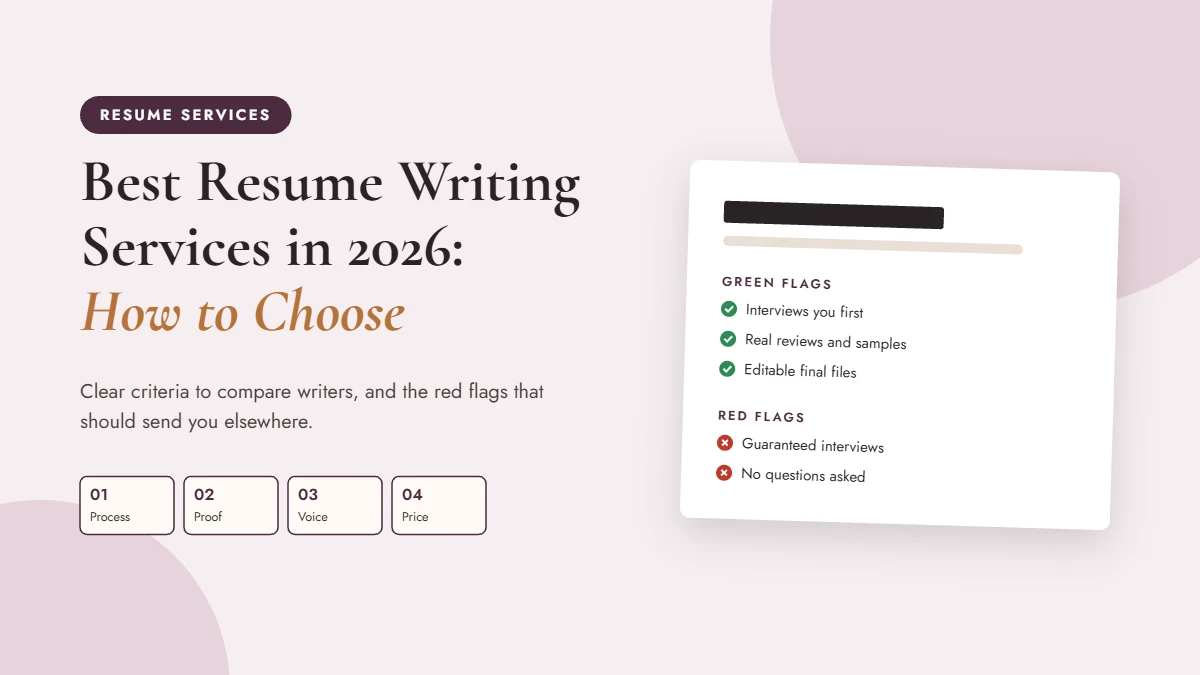
- Use a modern format. Clean, simple, ATS-friendly. Here’s what resume formatting looks like in 2026.
Most of my clients at this stage fit my senior-level resume or executive-level resume services, depending on the roles they’re targeting.
Wondering whether your experience reads as “seasoned” or “dated”? That’s one of the first things I look at. Book a free consultation and we’ll talk through your goals and what your materials need.
Step 4: Refresh Your Online Presence
Recruiters and hiring managers will look you up. When they do, your LinkedIn profile should match your new direction, not your old one. Start with the two things people see first:
- Your photo. Recent, well-lit, and warm. Here’s how to tell if your LinkedIn photo is helping or hurting.
- Your headline. Lead with the role you’re moving toward and the value you bring. My guide to writing a LinkedIn headline walks through it.
Then show that you’re current. Share an article now and then, comment thoughtfully on posts in your target field, and list recent learning. It quietly answers the “is this person keeping up?” question before anyone asks it. If you want ideas for staying relevant as roles change around AI, here’s how to become indispensable in an AI-driven workplace.
Step 5: Lead With Your Network
At 50, you have something younger job seekers don’t: decades of colleagues, clients, vendors, and former bosses. Many of them are now decision-makers. Before you apply online anywhere, make a list of 25 people who know your work and reach out with a specific, low-pressure ask: “I’m exploring a move into X. Could I get 20 minutes of your perspective?”
This is also where bridge roles tend to appear. A former client needs a consultant for a project. A past colleague’s company needs an interim leader. These opportunities rarely show up on job boards, and they let you test a new direction while you earn. If you’ve been doing side work, don’t hide it; here’s how to talk about a side hustle when you’re job hunting.
Step 6: Interview for Adaptability
Let’s be honest about the unspoken concerns some employers have about experienced candidates: Will they be expensive? Will they adapt? Will they take direction from a younger manager? You don’t need to raise these yourself. Just make sure your stories answer them:
- A time you learned a new tool or system quickly.
- A time you worked well with (or for) someone much younger.
- A time you changed your mind because the data said so.
The underlying idea is simple: be the least risky candidate in the room. Experience is an asset; flexibility makes it a safe bet.
And on the legal side, it’s worth knowing that in the U.S., the EEOC enforces protections against age discrimination for people 40 and older. That doesn’t erase bias, but it’s useful context. For the bigger-picture “what do I want the next 15 years to look like?” questions, Harvard Business Review’s career planning articles are a thoughtful read.
A Note for Women Over 50
Many of the people I coach through a career change at 50 are women who stepped back, took on caregiving, or spent years being the steady one who kept everything running. If that’s you, your experience counts. Volunteer leadership, project management for a family business, board work, and caregiving logistics all built real skills. We’ll name them properly. (Supporting women in their careers matters a lot to me; it’s why I give back with free resumes for women.)
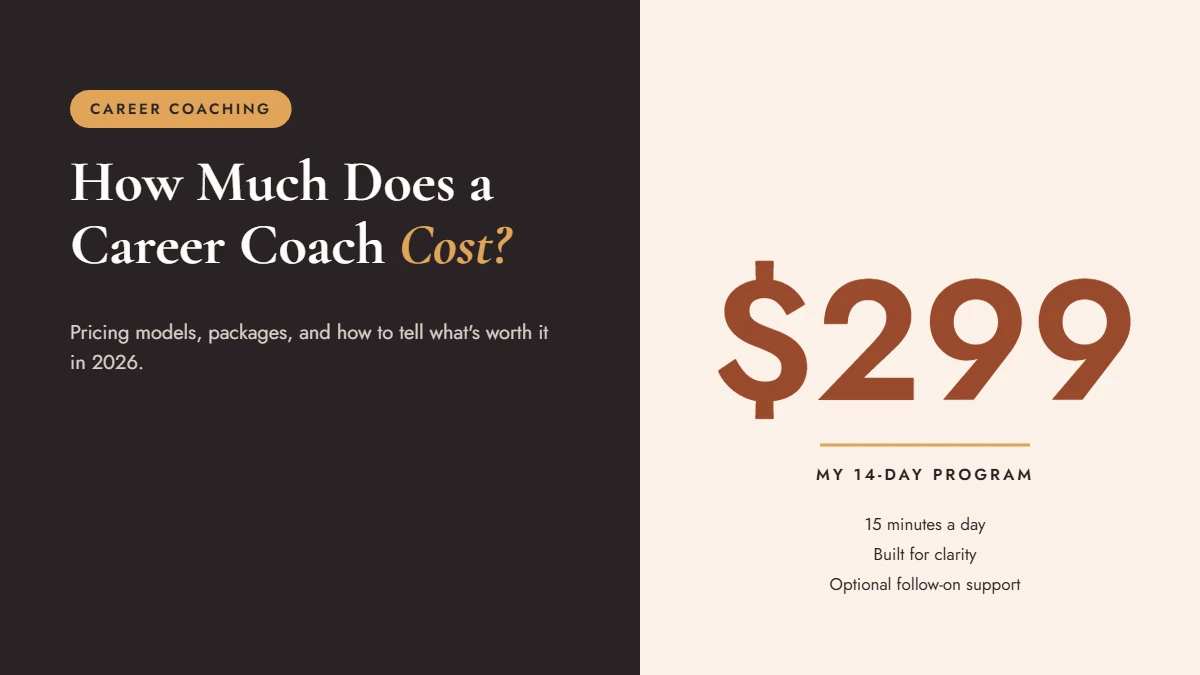
If you’re ready for structured support, my career coaching begins with a 14-day “Find Your Path” challenge ($299) that takes about 15 minutes a day.
Quick Answers to Common Questions
Is it realistic to change careers at 50?
Yes. Many people make successful changes in their fifties, especially when they move into roles that build on their experience rather than starting at entry level. Planning, a modern resume, and an active network make the biggest difference.
How do I age-proof my resume?
Focus on the last 10 to 15 years of experience, remove graduation dates if you prefer, use a clean modern format, and lead with recent results and current skills. Your resume should show what you can do next, not everything you’ve done.
What jobs are good for a career change at 50?
Roles that reward judgment and experience tend to be good fits: consulting, training and education, project and operations leadership, client advisory roles, nonprofit leadership, and fractional or contract work in your area of expertise.
Should I work with a career coach at 50?
A coach can help you get clear on direction, test options without risking your income, and present decades of experience in a way that feels current. It’s especially useful if you’ve been with one employer for a long time.
Your Next Chapter Doesn’t Have to Start at Zero
You’ve spent decades building skills, relationships, and judgment. A career change at 50 is about pointing all of that in a new direction, not throwing it away. If you’d like a partner in figuring out where to point it, book a free consultation. We’ll talk about what you want, what you’ve got, and the smartest first step from where you are.