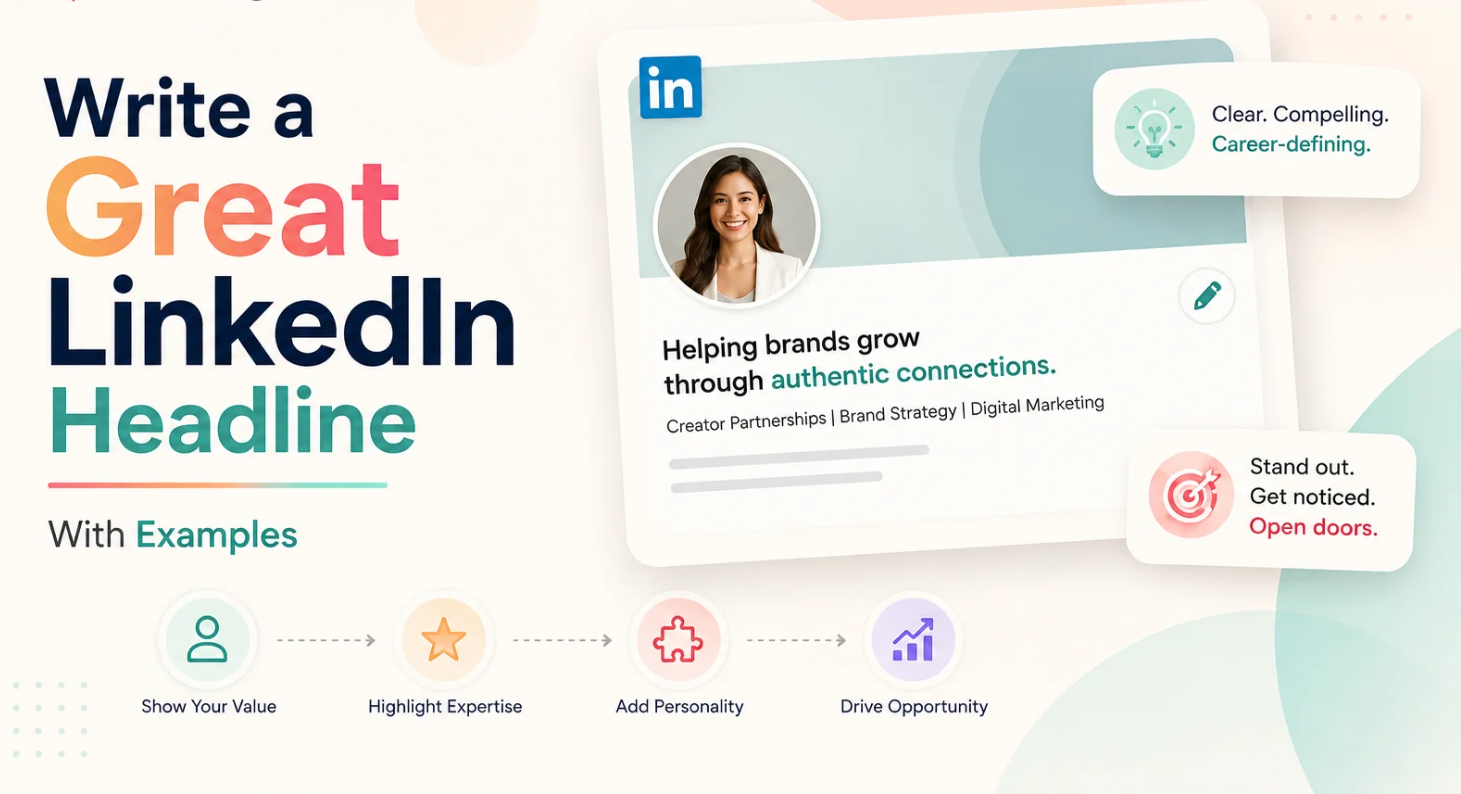
Your LinkedIn headline is the roughly 220-character line under your name that shows up everywhere your profile does in search results, comments, connection requests, and messages. A strong headline states your specialty and the value you bring, using language recruiters actually search for. Most people waste this space listing only their current job title.
Why Your Headline Matters More Than You Think
Most people think of their headline as a small detail under their name on their own profile page. In reality, it shows up in far more places: search results, the list of people who liked a post, comment threads, connection requests, and message previews. It’s often the very first thing someone reads about you, frequently before they’ve even opened your full profile.
This is also prime real estate for search visibility. Recruiters searching LinkedIn for candidates rely heavily on keyword matching, and your headline is one of the most heavily weighted fields for that search arguably even more than your skills list, since it’s shorter and more visually prominent.
The Anatomy of a Strong Headline
A strong headline generally has two or three components:
- Your role or specialty not just a job title, but what you specifically focus on within it.
- The value you provide or the audience you serve who you help, or what outcome you drive.
- Optionally, a differentiator a certification, methodology, or unique angle that sets you apart.
Formula: Role/Specialty | What You Do | Who You Help or Result You Drive
Headline Examples by Career Stage
| Stage | Weak Version | Strong Version |
| Entry-level | Marketing Coordinator at Acme Co. | Marketing Coordinator | Social Media & Content | Helping Small Brands Grow Their Reach |
| Mid-level | Project Manager | Project Manager | Cross-Functional Software Delivery | On-Time, Under Budget |
| Senior-level | Senior Director of Operations | Senior Director of Operations | Scaling Manufacturing Teams | Process & Efficiency Leader |
| Executive | Chief Operating Officer | COO | Operational Transformation for Mid-Market Manufacturers | Board-Ready Executive |
This mirrors the same shift covered in best skills to put on LinkedIn by career stage specificity and scope both need to track with where you actually are, not a generic template applied at every level.
Headline Examples by Situation
Career Change
Lead with the transferable skill or destination, not the industry you’re leaving. “Operations Leader Transitioning to Healthcare | Process Improvement & Team Leadership.” This connects to the broader strategy covered in how to position yourself for a job hunt in a new field.
Actively Job Searching
You can signal openness without sounding desperate: “Senior Marketing Manager | Brand Strategy & Demand Gen | Open to New Opportunities.” If you’re using LinkedIn’s #OpenToWork feature, it’s worth reading that breakdown first there are more and less effective ways to signal availability.
Between Roles
Avoid a blank or outdated headline showing your last job as current. Something like “Operations Manager | Supply Chain & Process Improvement” dropping the specific former employer keeps you positioned by function rather than tied to a company you’ve left.
Common Headline Mistakes
- Job title only, with no specialty or value statement the single most common and most wasteful mistake.
- Buzzword soup: “Results-driven synergistic thought leader” says nothing specific to anyone.
- Keyword stuffing so dense it reads as spam rather than a coherent statement.
- A headline that doesn’t match the rest of the profile’s positioning inconsistency undercuts credibility.
A Realistic Example
Consider a mid-level sales professional whose headline simply read “Account Executive at Regional Tech Solutions” for three years without a single change, despite her role and focus evolving considerably during that time.
After updating it to “Account Executive | SaaS Sales & Client Retention | Helping Mid-Market Companies Scale Their Tech Stack,” she began appearing in recruiter searches for terms like “SaaS sales” and “client retention” that her old headline never surfaced for at all. Within a month, she’d received more profile views than the previous six months combined not because anything else about her background changed, but because the headline finally described what she actually did in language recruiters were searching for.
The lesson isn’t that headlines guarantee a specific result. It’s that an accurate, specific headline makes you findable for searches an outdated or generic one simply never appears in.
Does This Vary by Industry?
Somewhat. Highly technical fields engineering, data science, IT often benefit from naming specific tools, languages, or platforms directly in the headline, since those exact terms are what recruiters search for. Fields built more around relationships and strategy sales, marketing, consulting tend to perform better leading with outcomes and audience served rather than a list of tools.
Matching Your Headline to Your Actual Goal
Not everyone is writing a headline for the same reason, and the best version shifts depending on what you’re actually trying to accomplish.
Passive Visibility (Not Actively Searching)
Lead with your strongest, most searchable specialty. You’re optimizing for recruiters finding you in a keyword search you’ll never see happen, so clarity and searchability matter more than a compelling narrative hook.
Active Job Search
Balance searchability with a clear signal of what you’re looking for next, without sounding desperate. Specialty plus outcome, with openness woven in naturally, tends to work better than a headline that reads like a job-search announcement.
Building a Personal Brand or Thought Leadership Presence
Here, a slightly more distinctive or opinionated angle can work well, since you’re optimizing for people clicking through to read more of your content, not just recruiters scanning for keywords. Even then, don’t sacrifice basic clarity about what you actually do for the sake of sounding clever.
Character Limit and Mobile Truncation
According to LinkedIn’s own platform specifications, headlines allow up to roughly 220 characters. In practice, mobile views and search results often truncate well before that, sometimes to 60 characters or fewer. Front-load your most important specialty and value language at the very beginning, since that’s what’s guaranteed to display no matter the context.
How to Test and Refine Your Headline
Write two or three versions and view your profile on both desktop and mobile to see how each truncates. Ask a colleague what they think you do professionally based only on your headline if their answer doesn’t match your intent, revise. Revisit the headline whenever your role, focus, or job search status changes meaningfully, rather than leaving it static for years.
How This Fits Into Your Broader Profile
Your headline works alongside your About section and the overall structure covered in a genuinely healthy LinkedIn profile. If you’re rewriting your headline, it’s often a sign the rest of the profile could use a look too the before/after breakdown of what changes in a full makeover shows headline transformations alongside the rest of the profile.
If you’d rather not tackle this alone, the DIY-versus-professional breakdown covers that decision, and what a full optimization service includes explains where headline work fits into a larger engagement.
Why This Actually Matters
This isn’t just about looking polished. SHRM, the leading professional association for HR and talent-acquisition practitioners, has noted that recruiters rely heavily on LinkedIn as a sourcing tool, and headline keywords are among the first fields a search algorithm weighs.
General guidance from Indeed’s Career Guide reinforces that specific, relevant language consistently outperforms generic titles across virtually every part of a job search profile, headlines included.
Frequently Asked Questions
Should I put my company name in my headline?
Not usually necessary, unless your employer’s brand recognition genuinely adds credibility for your target audience. Specialty and value generally matter more than the company name.
Can I use emojis or symbols in my headline?
Sparingly, if at all. A small, tasteful divider symbol is common and fine; heavy emoji use tends to look unprofessional in most industries and can distract from the actual message.
How often should I update my headline?
Whenever your role, focus, or job search status changes meaningfully. Outside of that, revisiting it once a year is a reasonable habit to catch anything that’s quietly become outdated.
Should my headline match my current job title exactly?
Not necessarily. Your headline can reflect your broader specialty or the direction you’re heading, especially if you’re in transition, rather than being locked to your exact current title.
Is it okay to mention that I’m a career changer in my headline?
Yes, and it’s often more effective than hiding it. Naming the transition directly, paired with transferable skills, tends to reduce confusion rather than create it.
What if my target roles span multiple specialties?
Choose the specialty most central to your primary target, or find a phrase broad enough to cover the overlap without becoming vague. A headline trying to cover too many distinct specialties usually ends up communicating none of them clearly.
Does my headline affect my resume in any way?
Not directly, but the two should tell a consistent story. See resume title, headline, and summary best practices for how the same positioning principles apply to your resume’s equivalent space.
Can my headline be a question or something more creative?
It’s possible, but risky for most professional contexts. A creative or question-format headline can work for certain personal-brand-focused fields, but it usually sacrifices searchability, since it’s less likely to contain the specific keywords recruiters search for. If you go this route, weigh the tradeoff deliberately rather than by accident.
Should I include my location in my headline?
Generally not necessary, since LinkedIn already displays your location separately on your profile. The exception is if you’re targeting a highly specific local market and want that context immediately visible alongside your specialty.
Want Help Getting This Right?
A stronger headline takes minutes to write once you know the formula, but it’s easy to default to just your job title without thinking twice. I’m Kyla Duffy, and my LinkedIn profile optimization services cover your headline as part of a complete, strategic profile rewrite. Curious what it costs? My rates are posted publicly, and my FAQ page covers what people usually ask first.