AI tools can now draft a resume summary, suggest interview questions, and tell you which jobs to apply for, all in a few seconds. So it is a fair question: do you still need a human career coach, or can an AI career coach do the job?
I use technology every day, including apps I built myself, and I think AI is genuinely useful for job seekers. I also see what happens when people hand the whole search over to it. Here is my honest read on what each one is good for, where AI quietly costs you interviews, and how to use both together so you get speed without sounding like everybody else.
What is an AI career coach?
“AI career coach” usually means a chatbot or an app that answers career questions, reviews your documents, or runs practice interviews. Some are general-purpose assistants. Others are purpose-built for job search, resume scoring, or interview rehearsal, often wrapped around the same underlying models.
They are fast, they are available at two in the morning, and they are often free or inexpensive. Those are real advantages, and I would not pretend otherwise. The question is not whether the tools work. It is which parts of a job search they are actually suited to.
Where AI genuinely helps
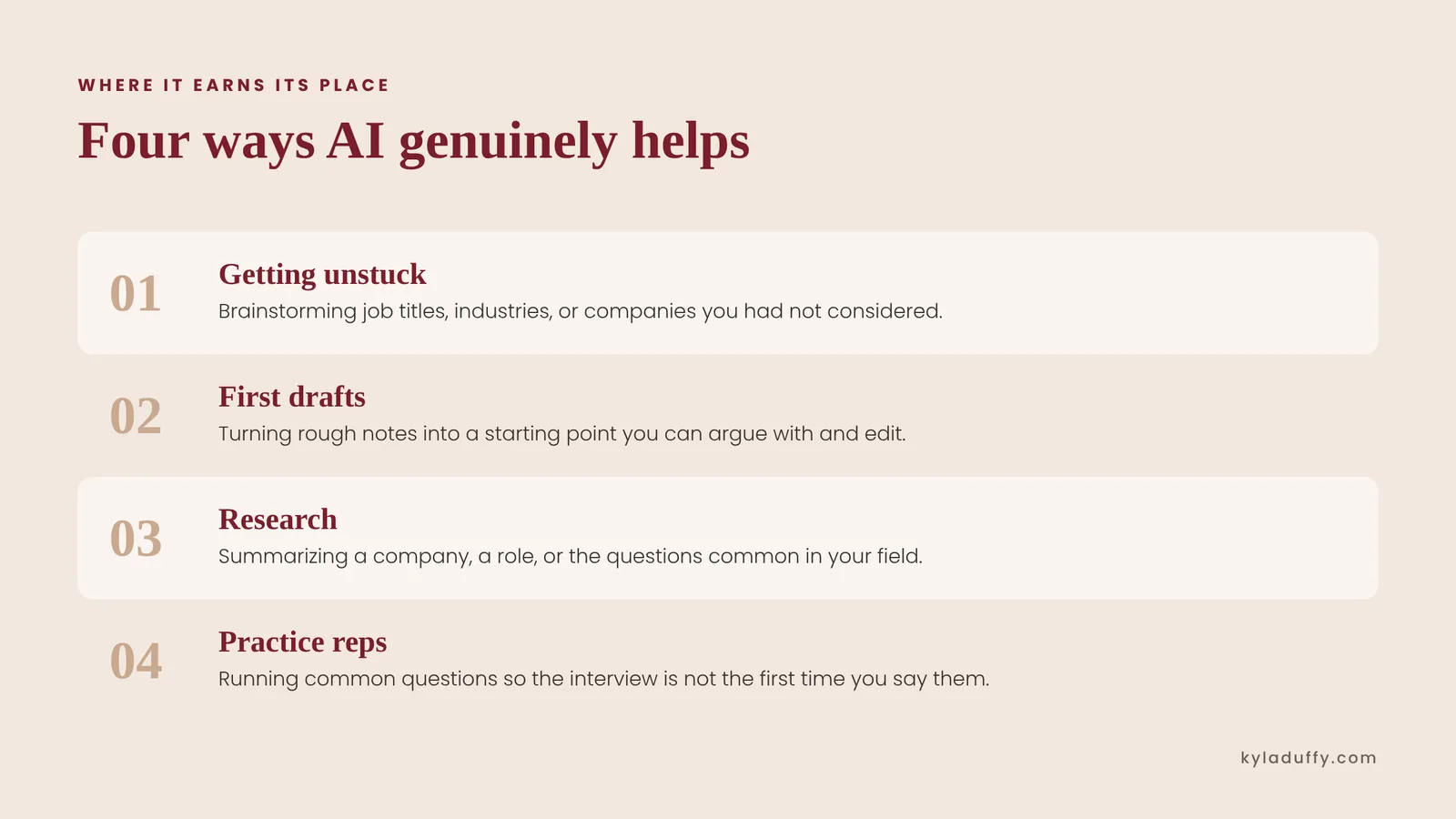
- Getting unstuck. Brainstorming job titles, industries, or company types you had not considered. A blank page is a real obstacle, and AI removes it in seconds.
- First drafts. Turning rough notes into a starting point you can argue with. Editing something mediocre is far easier than producing something from nothing.
- Research. Summarizing a company, a role, a competitor landscape, or the questions commonly asked in a field before you walk into a conversation.
- Practice reps. Running through common questions so the interview is not the first time you have said your answers out loud.
- Tedious reformatting. Reshaping dates, tightening bullet length, or converting a long document into a shorter one.
Used this way, AI is a very good assistant. It shortens the boring parts so you can spend your attention on the parts that decide outcomes.
Where an AI career coach falls short
Here is what I consistently see when people rely on AI alone.
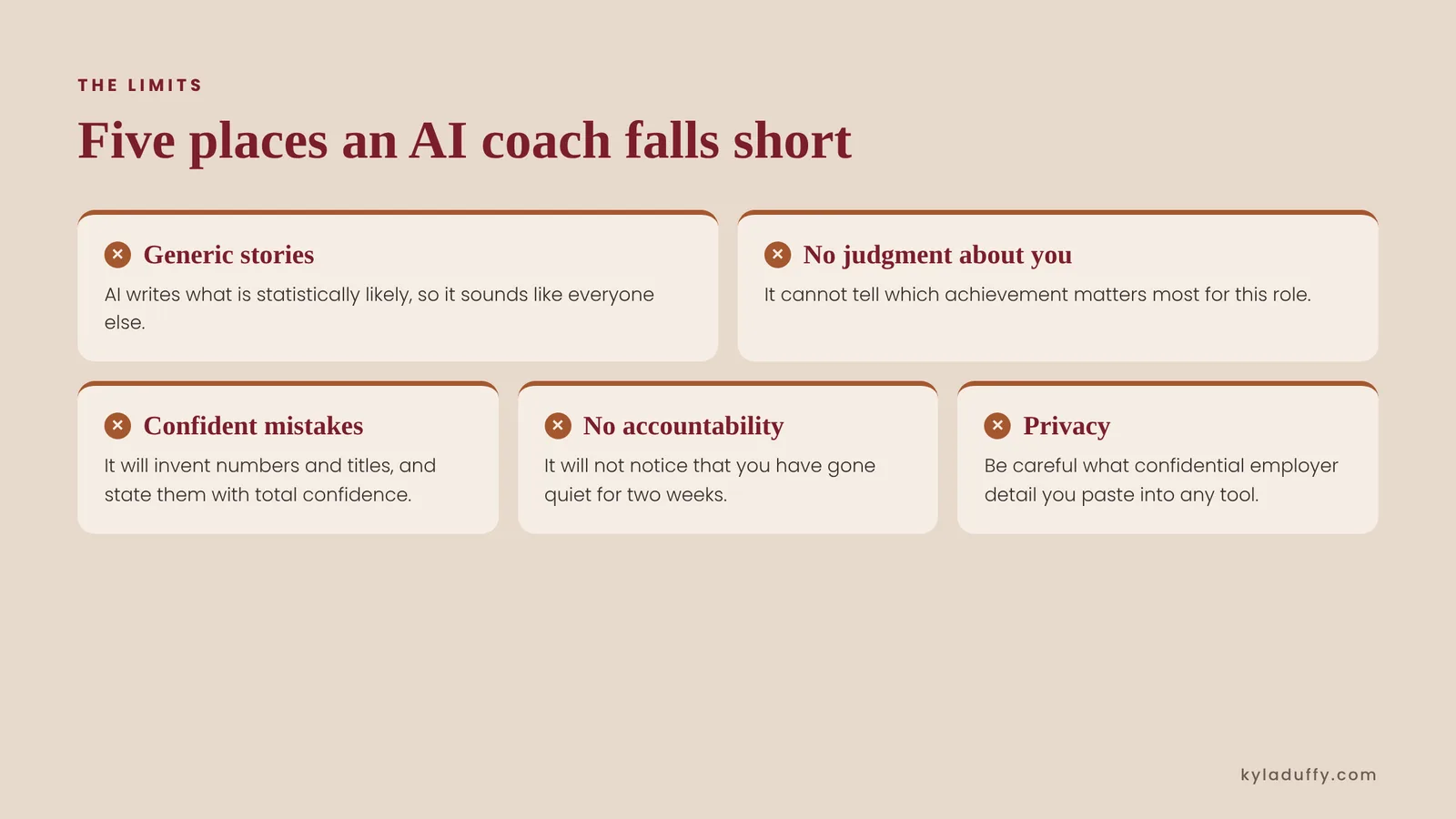
Generic stories
AI writes what is statistically likely, which is a polite way of saying it writes what everyone else is writing. “Results-driven professional with a proven track record of driving cross-functional excellence” is a sentence no human has ever said out loud. Recruiters read hundreds of these a week, and they skim straight past them.
No judgment about you specifically
A tool cannot tell which of your accomplishments matters most for a particular role, which one is quietly working against you, or which gap a hiring manager in that industry will actually care about. It does not know that the job you are most proud of is the one making you look overqualified.
Confident mistakes
AI will invent numbers, inflate titles, and merge two jobs into one, and it will do all of it in a confident, well-formatted paragraph. On a resume, that is not a style problem. It is a credibility problem that surfaces in a reference check or an interview, at the worst possible moment.
No accountability
A chatbot will not notice that you have gone quiet for two weeks, will not push back when you widen your target out of frustration, and will not talk you through a rejection that landed harder than you expected. Job searches fail for emotional reasons at least as often as strategic ones.
Privacy
Be careful about pasting confidential employer information, client names, or unpublished figures into any tool. Treat anything you type as something that could be stored. If you would not email it to a stranger, do not paste it.
I wrote more about this in why AI for resumes is only as good as the framework behind it.
AI career coach vs. human coach: a quick comparison
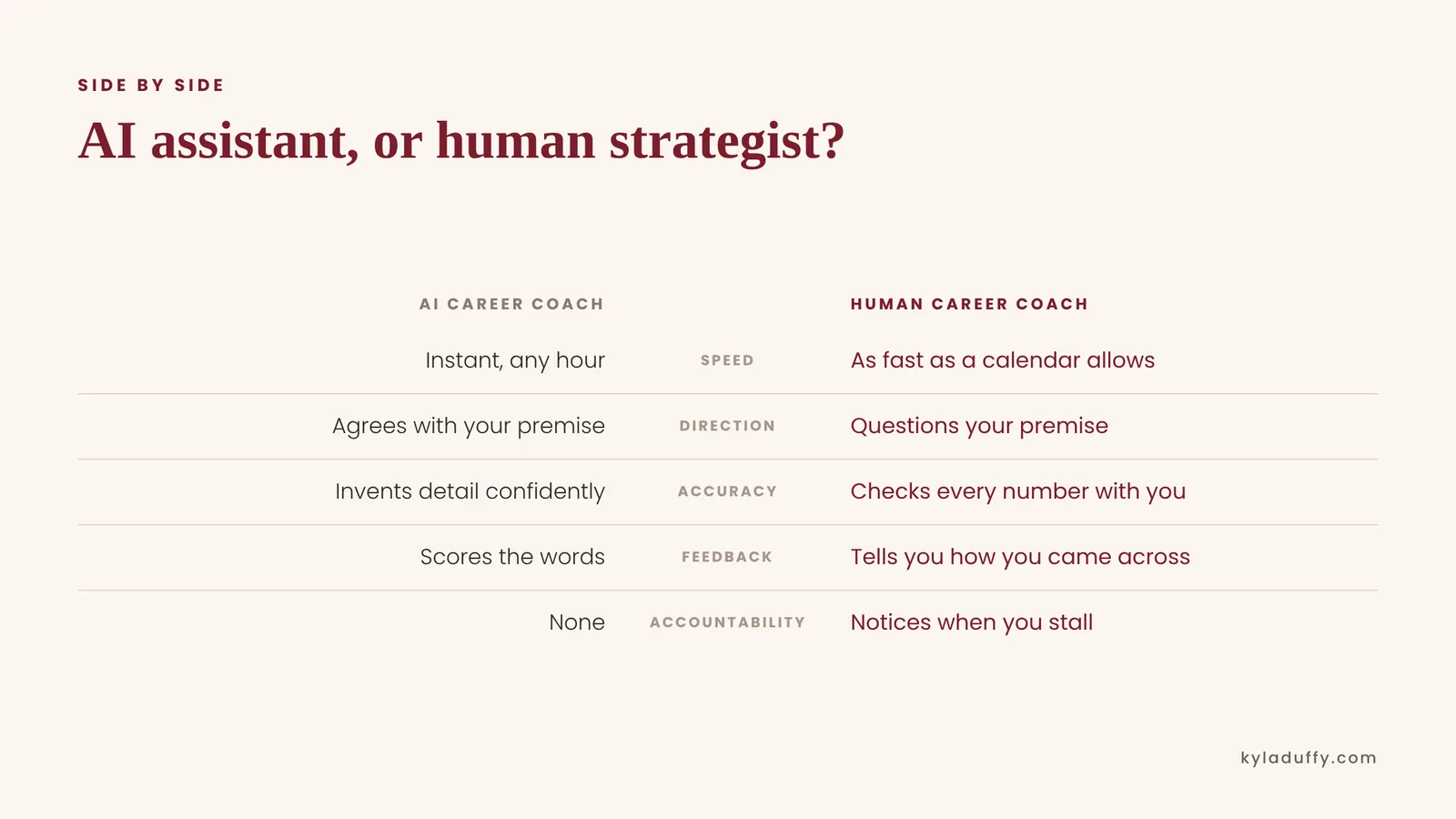
Think of AI as a fast assistant and a coach as a strategist who knows you. AI is excellent at volume, speed, and first drafts. A human coach is better at direction, nuance, honest feedback, and the parts of a search that are emotional rather than technical.
There is also a difference in what each one is accountable for. An AI tool produces output. A coach is responsible for whether the approach is working, and should be willing to tell you when it is not, including when the honest answer is that you do not need to buy anything else.
How to use both, and get better results
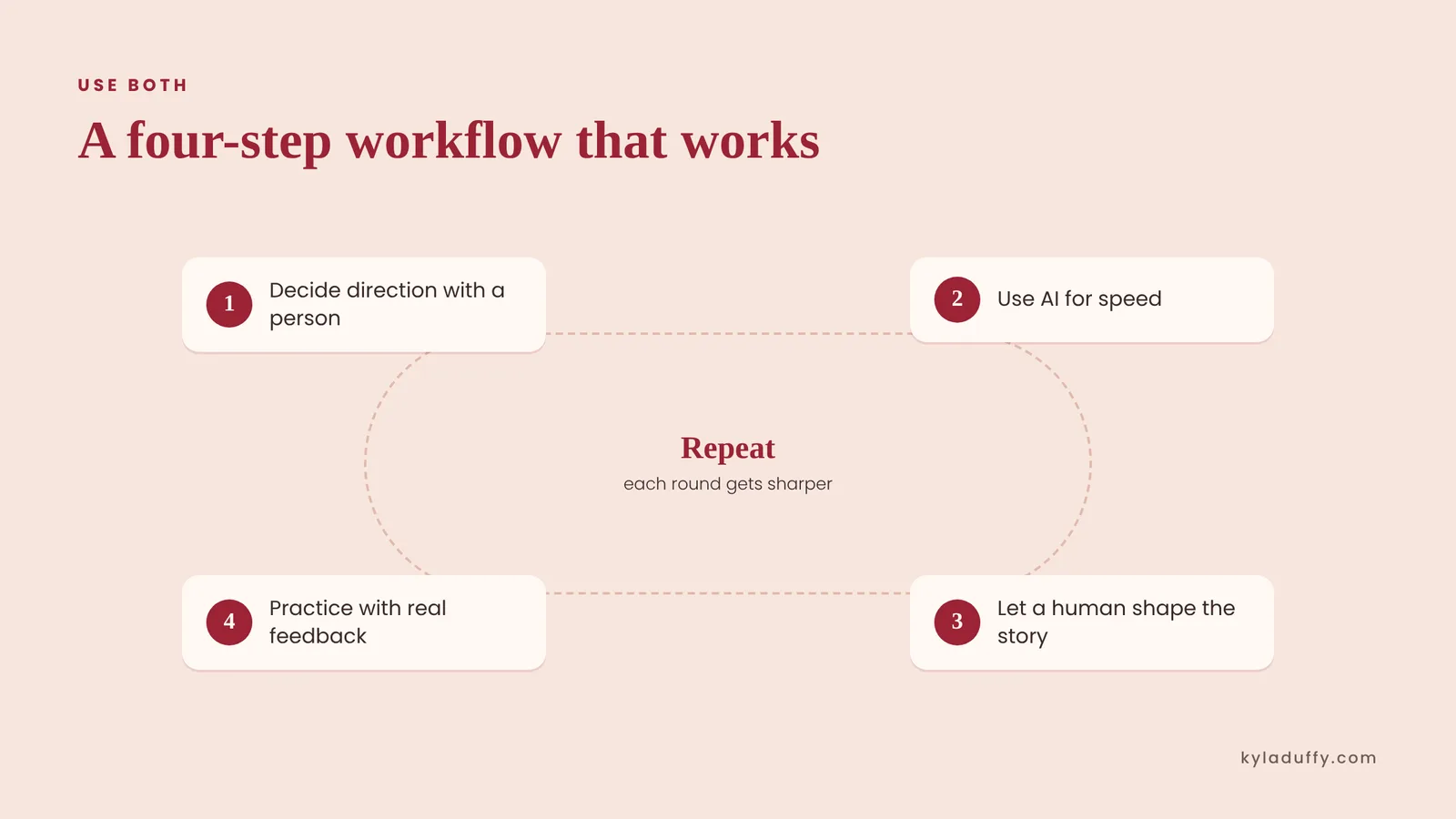
You do not have to choose. This is the workflow I recommend to clients who want the speed without the sameness.
- Decide your direction with a person. Your goals, your strengths, and your dealbreakers deserve a real conversation with somebody who will ask uncomfortable questions. This is the step AI is worst at, because it will agree with almost any premise you give it.
- Use AI for speed. Research companies, draft outlines, generate practice questions, and tidy formatting. Let it do the work that does not require knowing you.
- Let a human shape the final story. Your resume, your LinkedIn profile, and your interview answers should sound like you and contain results that are accurate to the number.
- Practice with feedback. AI can ask the questions. A person can tell you how you actually came across, which is the part that changes outcomes.
Where each one belongs, stage by stage
Rather than arguing about which is better in the abstract, it helps to map them onto the actual stages of a search.
Deciding what you want
This is the weakest spot for AI, because a model will take whatever premise you hand it and build on it enthusiastically. If you tell it you are considering product management, it will help you consider product management. It will not ask why you keep circling back to a field you left twice. A person will. If you are not clear on what coaching covers here, what a career coach actually does lays it out.
Writing the resume
Mixed. AI is useful for structure, tightening, and getting a first version onto the page. It is poor at deciding what to lead with, which is the decision that determines whether anyone reads the second bullet. Start from a sound structure rather than a prompt: how to write a resume covers the frame, and how to write powerful resume bullets covers the sentences.
Building your LinkedIn profile
Also mixed, and with an extra risk. LinkedIn is public, so a profile that reads as machine-written is visible to everyone in your network, including people who knew you before. Use AI for drafting and then rewrite it in your own voice. The LinkedIn profile optimization checklist is the fastest way to find the gaps.
Preparing for interviews
AI is a good sparring partner for volume and a poor judge of delivery. It will not notice that you took ninety seconds to reach the point, or that you softened the one result worth leading with. If that is where your search is stalling, online interview coaching is the targeted fix.
Negotiating
AI can tell you what questions to ask and roughly how the components of an offer work. It cannot read the room, and it has no stake in the outcome. This is a conversation worth rehearsing with a person.
The sameness problem, and how to beat it
The deepest issue with AI-written job search material is not accuracy. It is sameness. When thousands of candidates use the same handful of tools against the same job postings, the outputs converge. Every summary says “proven track record,” every bullet opens with the same four verbs, and every cover letter is impressed by the company mission in the same words.
That convergence is an opportunity if you go the other way. Three things reliably break the pattern.
- Specific numbers. Not “significantly improved,” but the actual figure, the baseline, and the timeframe. AI cannot supply these, because only you know them.
- A real decision. Most resumes describe activity. Very few describe a choice: what you considered, what you rejected, and why. That single move makes a bullet sound like a person.
- Plain language. Write the way you would explain it to a competent colleague who does not work in your company. Jargon reads as padding, and padding reads as AI.
None of that takes long. It just cannot be outsourced to a prompt, because the raw material is your memory of the work.
Signs you need a person, not another prompt
AI is great when you know what you are asking for. It is much less helpful when the real question is bigger than the prompt. You will probably get more from a human coach if any of these describe you.
- You have rewritten your resume with AI several times and still are not getting interviews.
- You are not sure what role you actually want next.
- You are changing careers and need to explain a jump that does not look obvious on paper.
- You keep reaching final interviews and not receiving offers.
- The search has started to wear on your confidence, and you are applying to things you do not want.
None of those are writing problems. They are strategy, story, and confidence problems, and that is where coaching earns its fee. If the search itself has gone on too long, how to get a handle on an endless job search is the right starting point, and is career coaching worth it is the honest version of the spending question.
Will AI screen my application anyway?
Often, yes, in the sense that applicant tracking systems parse and rank what you submit. That is a reason to write a clean, readable, keyword-honest resume, not a reason to stuff it with terms. Systems have improved, and recruiters still make the decisions that matter.
The practical implications are simple. Use a straightforward structure with real section headings. Match the language of the posting where it is genuinely true of you. Avoid tables, text boxes, and graphics that parse badly. Send a standard file format unless the employer asks for something specific. I have covered the detail in how to write an ATS-friendly resume and in my guide to resume keywords.
Employers are still working out their own rules for AI in hiring, and professional bodies such as SHRM publish extensively on where the practice is heading. It is worth knowing roughly how the other side is thinking, because it explains why some processes have added extra verification steps.
How to get better results from AI career tools
If you are using AI on your own, a few habits make a disproportionate difference.
- Give it real context. Paste the job description and your actual results, not just your job title. Vague input produces vague output, every time.
- Ask for options, not answers. Request three versions, then choose and edit the one that sounds most like you. Treat the first output as a draft, never as a decision.
- Check every fact. Numbers, dates, titles, and company names should all come from you, and you should verify them before anything is sent.
- Read it out loud. If you would not say it in an interview, it does not belong on your resume. This single test removes most of the damage.
- Keep your own voice in the final pass. Rewrite at least one sentence per section in your own words so the document still sounds like a person wrote it.
The free guides at the Indeed Career Guide are a reasonable sanity check if you want a second opinion on structure, and commentary in Harvard Business Review is useful for the wider question of how AI is reshaping the work itself.
What a human career coach costs compared with AI
Many AI tools are free, or cost a monthly subscription somewhere in the range of a streaming service. Human coaching costs more, and what you are buying is judgment, accountability, and someone who is responsible for whether the approach works.
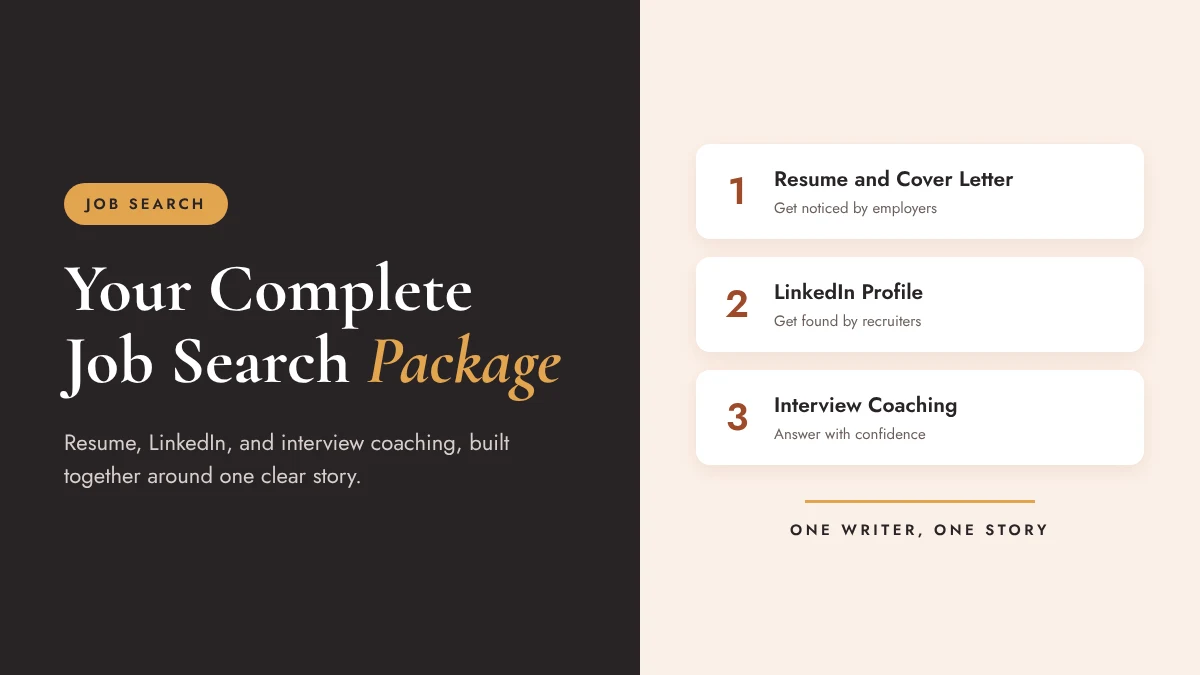
My pricing is public on my rates page. Career coaching is $299 for the 14-day “Find Your Path” challenge, which takes about 15 minutes a day with daily one-on-one support on WhatsApp. Resumes run $199 to $599 by career level, a cover letter on its own is $149, LinkedIn starts at $179 with a resume order, and interview coaching is $125 a session or $299 for the full “Nail Job Interviews” course. For the market-wide picture, see how much a career coach costs.
If you are weighing the same question specifically for your resume, read professional resume writer vs. AI resume writer, and if you want the broader argument about whether paid help is worth it at all, are resume writing services worth it covers it without the sales pitch.
A sensible rule of thumb
If the task is mechanical, let the machine do it. If the task involves judgment about you, bring in a person. Formatting, research, question banks, and first drafts are mechanical. Deciding what you want, choosing what to lead with, and knowing when the plan is not working are not.
It also helps to keep your expectations anchored to the market rather than to the tool. The Bureau of Labor Statistics Occupational Outlook Handbook will tell you more about whether your target field is actually hiring than any chatbot will, because it is reporting rather than predicting what you want to hear.
Used well, AI makes a good search faster. It does not make a confused search clearer, and that is the distinction worth holding onto.
Frequently asked questions
Can an AI career coach replace a human coach?
For quick answers, research, and first drafts, AI is genuinely helpful. For direction, judgment, and accountability, a human coach still does what AI cannot, because those depend on knowing your situation and being willing to disagree with you.
Is it okay to use AI on my resume?
Yes, as a starting point. Check every fact, cut the generic phrases, and make sure the final version sounds like you. The risk is not using AI. It is sending what it produced without editing it.
Do you use AI in your work?
I use technology where it saves my clients time, including my own custom-built apps. Every word you get from me still goes through my judgment and my experience.
Will a recruiter know my resume was written by AI?
Often they will suspect it, because AI-written resumes share a vocabulary and a rhythm. The tell is not a detection tool. It is that the document says a great deal and specifies almost nothing.
Can AI do my interview prep?
It can generate questions and let you rehearse, which is useful. What it cannot do is tell you that you sounded defensive, rushed the ending, or buried the result. That feedback needs a person.
What should I never paste into an AI tool?
Confidential employer data, client names, unpublished financials, and anything covered by an agreement you signed. Treat every tool as if what you type could be stored and read by someone else.
Want a real person in your corner? Book a free strategy call, or read more about my career coaching services.
Related reading: what a certified career coach credential really means, and what an executive career coach does if you are searching at a senior level.