An MBA opens doors, but it does not walk you through them. Between recruiting season, networking events, case prep, and a resume that suddenly has to fit on one page, a lot of MBA students and graduates end up busier than they have ever been and still unsure how to land the role they went back to school for.
So do you need an MBA career coach? Sometimes yes, sometimes no. I have coached people through this at every stage, from pre-term applicants to graduates three years out who realized the first post-MBA job was the wrong one, and the honest answer depends on which problem you are actually solving. Here is how I would think it through.
What an MBA career coach helps with
A private MBA career coach works one-on-one with you on the parts of the search that are hardest to do alone, and hardest to do well under time pressure.
- Your story. Why you did the MBA, what you want next, and why your pre-MBA background makes you a credible candidate for it. This is the single highest-leverage piece, and the one most people improvise.
- Your materials. A focused one-page resume, a LinkedIn profile that matches it, and cover letters where they still matter.
- Your interviews. Behavioral questions, “walk me through your resume,” and the “why this company” answer that trips up genuinely brilliant people every single season.
- Your plan. Which roles and companies to target, and how to spend a limited number of hours on the networking that actually leads somewhere.
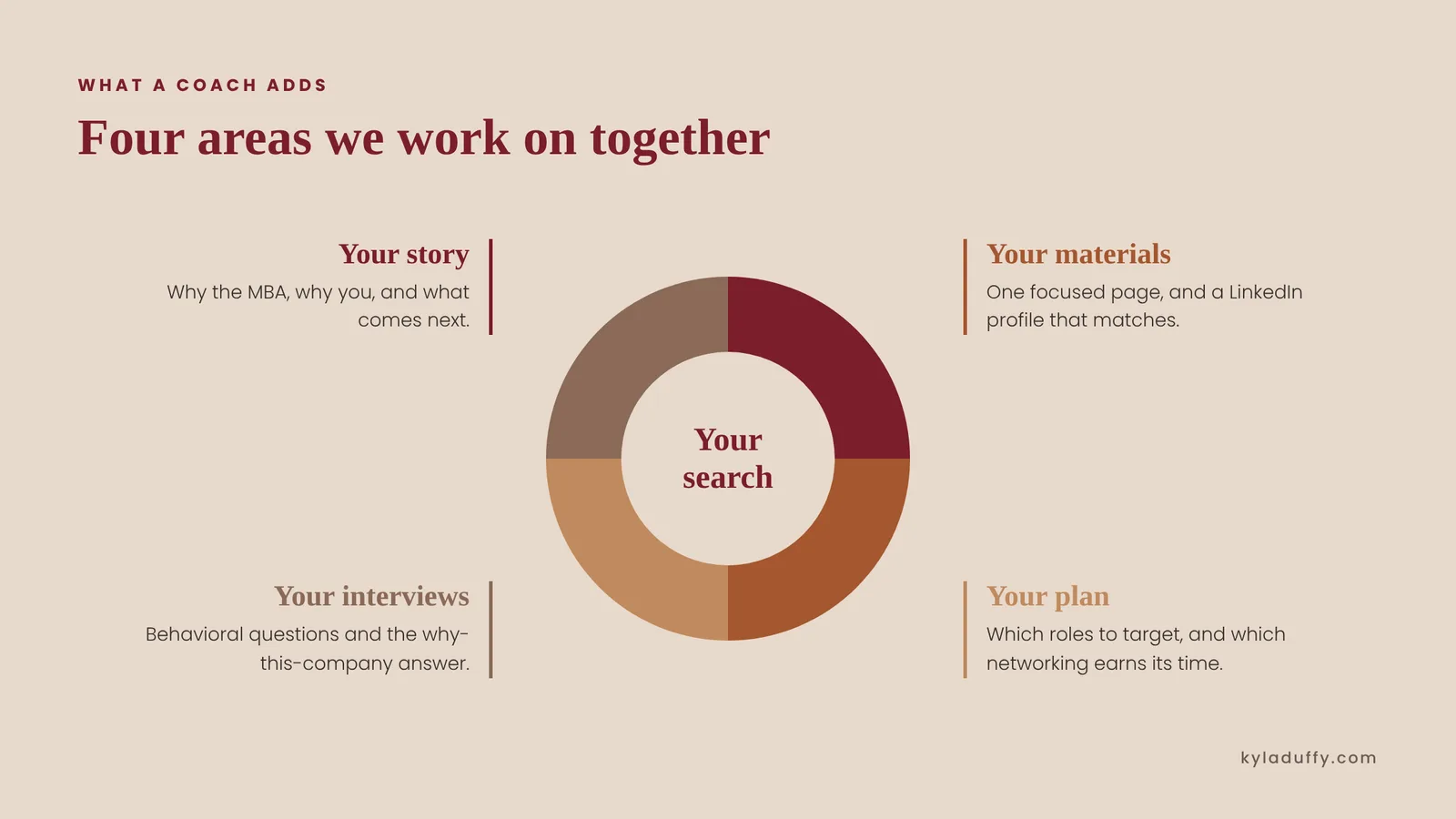
Notice what is not on that list: no coach can promise you an offer, and anybody who does is selling you something. What coaching buys you is a sharper story, better preparation, and fewer wasted weeks.
Your career center vs. a private MBA career coach
Your school’s career center is a real asset, and I would never tell you to skip it. They know the recruiting calendar, they hold the employer relationships, they run genuinely good workshops, and they have seen hundreds of people walk the path you are on.
What they usually cannot offer is time. Career advisors often support hundreds of students at once, their calendars compress into the same few weeks that everyone else needs, and their guidance has to be broad enough to work for a whole class. A private coach gives you something different.
- One-on-one attention focused only on your goals, not on a cohort average.
- Support that continues after graduation, when campus access quietly fades.
- An outside perspective that is not shaped by which companies happen to recruit on your campus.
- Honest feedback. An advisor who will see you again at alumni events sometimes softens the message. I will not.
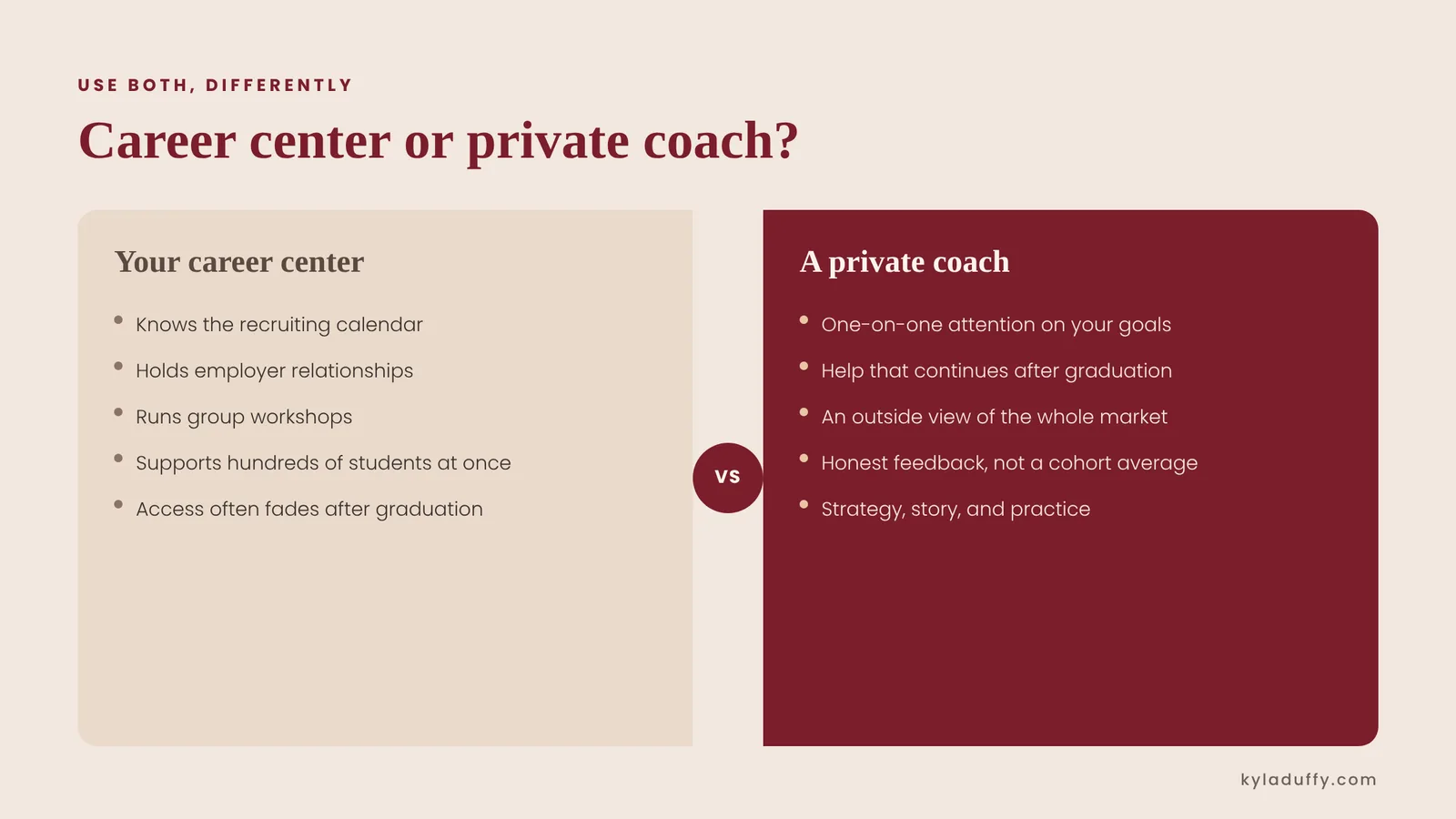
The best approach is almost always both: lean on the career center for access and timing, and use a coach for strategy, story, and practice. If you want a sense of how employers are actually recruiting this cycle, the research published by NACE is the most reliable public read on hiring trends for graduating classes.
When an MBA career coach is worth it
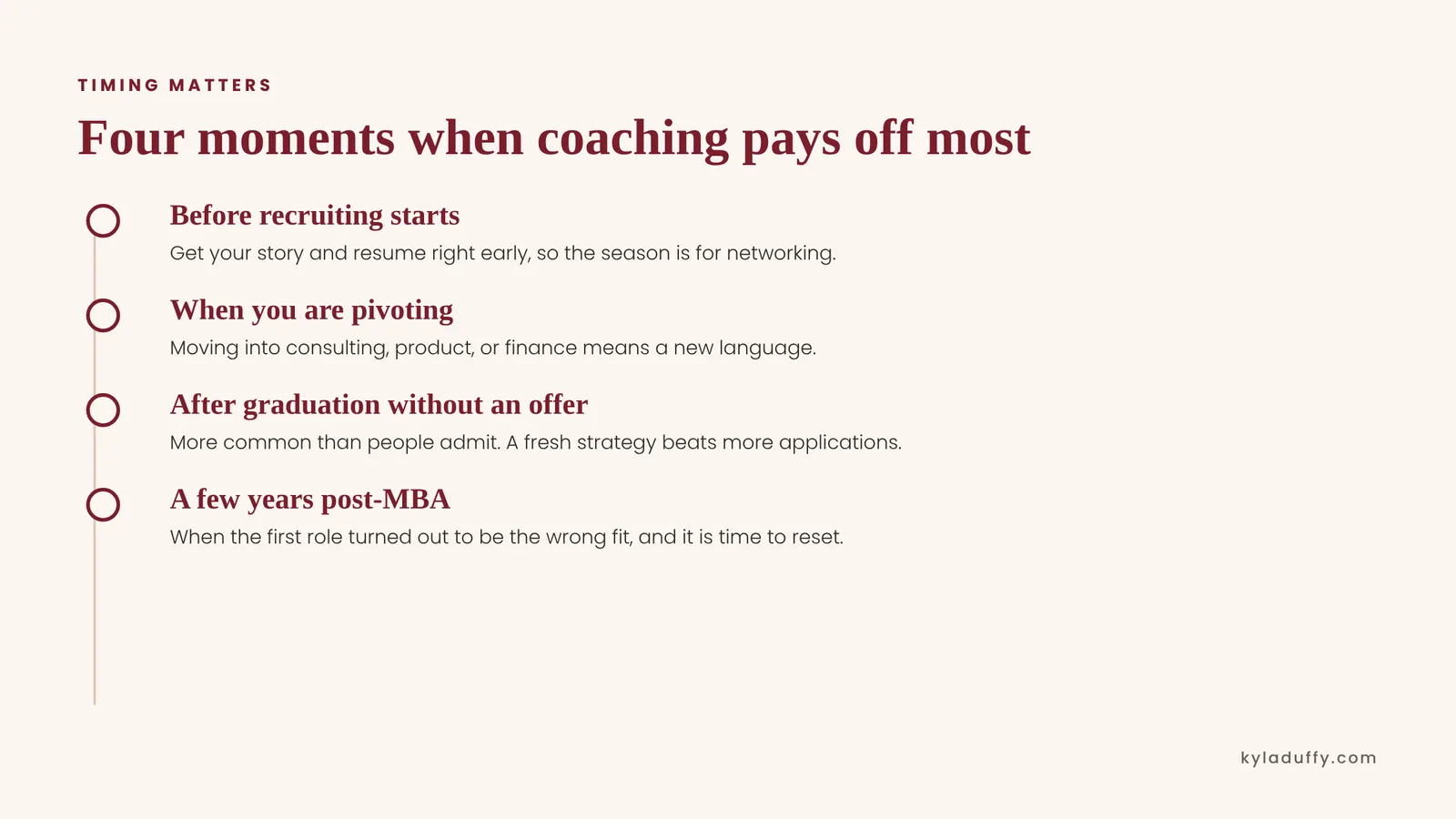
These are the four moments when the MBA clients I work with get the most out of coaching.
- Before recruiting starts. Getting your story and your resume right early means you spend recruiting season networking and interviewing rather than rewriting documents at midnight. This is the cheapest time to buy help and the one people most often skip.
- When you are pivoting. Moving into consulting, product, finance, or a new industry means translating your past experience into a new language. Pivots are where a good coach pays for themselves, because the translation is genuinely hard to do from the inside.
- After graduation without an offer. It is far more common than LinkedIn would suggest, and it is not a verdict on your ability. What it does need is a fresh strategy, not more applications of the same kind.
- A few years after your MBA. Plenty of graduates find that the first post-MBA role was a reasonable choice that turned out to be the wrong fit. Resetting direction at that point is much easier than people expect. My work on career change coaching covers that reset in detail.
What working together looks like
Everything happens online, so it fits around classes, recruiting events, travel, or a full-time job you are still doing.
- A free strategy call. We talk through your goals and your timeline, and you get an exact quote before anything starts.
- Direction. My 14-day “Find Your Path” challenge takes about 15 minutes a day, with daily one-on-one support on WhatsApp. Short daily reps work better than one long session, especially in a busy term.
- Materials. I write your resume and your LinkedIn profile myself, so your story stays consistent everywhere somebody might check. First drafts typically reach you in 2 to 3 business days.
- Interviews. We practice the questions you are most likely to face, with direct, specific feedback rather than general encouragement.
I do not drill case math, and I will say so plainly rather than pretend otherwise. Case frameworks and quant drills are well served by your classmates, your case partner, and your school resources. Where I help most is everything around the case: why you, why this firm, why now, and how you come across when the pressure is on. If you are heading into consulting, my guide to the consulting resume is the right place to start, and I have written separately about how coaching helps with case interviews and technical interviews.
Common MBA job search mistakes
MBA students are among the most capable people I work with, and they still fall into the same five traps, year after year.
Targeting everything
Applying to consulting, banking, tech, and startups all at once spreads your preparation thin and makes your story vague to everyone. Each of those paths wants a different narrative and a different resume emphasis. Pick a lane, or two at most, and go deep. If you are not sure whether a particular role deserves your time, I wrote a short filter for that: should I apply for this job.
Leaning on the degree
The MBA gets you into the room. It is your pre-MBA results, and how clearly you talk about them, that get you the offer. Interviewers at this level assume the credential and then probe everything underneath it.
Networking without a goal
Coffee chats are valuable when you know what you want to learn and who that person can introduce you to next. Without that, they become pleasant conversations that produce nothing but a calendar full of pleasant conversations. Go in with one question you genuinely cannot answer from the website.
Waiting too long to practice out loud
Behavioral answers feel easy in your head and fall apart the first time you say them to another person. Start practicing in week one, not the night before. The Indeed Career Guide interviewing section is a decent free source of question banks to rehearse against, and my own post on how to answer “why do you want to work here” covers the one that catches the most people.
A resume written for the past
Your resume should point at the role you want next, not simply record the job you had before school. That means leading with results, not responsibilities. If your bullets read like a job description, start with how to write powerful resume bullets.
The good news is that every one of these is fixable, usually inside a few focused conversations.
Building an MBA story that survives retelling
Here is the exercise I run with nearly every MBA client, because it exposes the weak joint fast. Say out loud, in three sentences: what you did before the MBA, what you learned or changed through it, and what you want to do next. Then ask a friend to repeat it back.
If what comes back is a list of schools and employers, the story is not working yet. If what comes back is a direction with a reason attached, you are ready to recruit. Most people need four or five passes to get there, and the passes are quick once somebody is pushing on the soft spots.
A strong version has three properties. It is specific, meaning it names a function and a kind of company rather than “something strategic.” It is credible, meaning the pre-MBA evidence supports it. And it is repeatable, meaning a classmate could pitch you accurately to an alum they happen to sit next to. Research and commentary in Harvard Business Review have made the same point for years: the people who move well are the ones others can describe easily.
Once that story holds, your LinkedIn profile should say the same thing in the same words. Start with your LinkedIn headline and work down through the LinkedIn profile optimization checklist.
How the story changes by target function
One reason a single generic MBA resume underperforms is that the three most common targets want different things from the same history.
Consulting
Consulting recruiters are reading for structured thinking, client credibility, and evidence that you can be dropped into an unfamiliar problem and be useful inside a week. Lead with analysis, ambiguity, and influence without authority. Keep the bullets tight, quantified, and free of internal jargon that only your old employer would recognize.
Product and tech
Product teams want to see judgment about users and trade-offs, not just project delivery. The strongest MBA product stories show a decision you made with incomplete information, what you gave up, and what happened. A pre-MBA engineering or analytics background is an asset here, and it needs translating into outcomes rather than tools.
Finance and corporate strategy
Here the bar is precision. Numbers need to be right, scope needs to be clear, and the narrative needs to connect your pre-MBA work to the balance sheet or the strategy agenda. Vague ownership language gets punished quickly in these interviews.
If your pre-MBA background sits a long way from the target, the bridge is the part to build deliberately. My post on the career change resume walks through how to do that without hiding anything.
A recruiting-season timeline that works
Most MBA calendars compress a lot of decisions into a short window. Here is the rhythm I would aim for, adjusted to your program dates.
- Three months out. Settle direction. Two target functions at most, with a short list of company types rather than a long list of company names. This is the right moment for structured direction work, because everything after it gets cheaper once it is decided.
- Two months out. Build materials. Resume, LinkedIn profile, and a reusable cover letter structure. Get them reviewed by somebody who will be blunt, then stop editing them.
- Six weeks out. Start conversations. Alumni first, then second-degree introductions. Aim for a steady weekly number you can sustain through term, rather than a heroic week followed by nothing.
- Four weeks out. Practice out loud, on video, with somebody giving feedback. Record one session and watch it, which is unpleasant and more useful than any amount of silent preparation.
- During the season. Protect your energy and keep a simple tracker. Who you spoke to, what you promised to send, and when to follow up. Dropped follow-ups cost more offers than weak answers do.
- After. Whatever the outcome, debrief honestly while it is fresh. The patterns you spot now are what make the next cycle, or the next search, faster.
For broader labor market context on how your target functions are actually growing, the Bureau of Labor Statistics Occupational Outlook Handbook is a steadier guide than the mood on campus, which tends to swing with whoever got an offer last week.
What does an MBA career coach cost?
Private MBA coaching ranges widely, and some programs are priced for executives rather than students. Packages sold through MBA-specific consultancies can run into several thousand dollars, which may be right for some people and is a lot of money to spend before you know what you need.
My rates are public and the same for everyone, and they are listed on my rates page:
- Career coaching: $299 for the 14-day “Find Your Path” challenge
- Resume and cover letter: $199 to $599 depending on career level
- Cover letter on its own: $149
- LinkedIn profile: from $179 with a resume order
- Interview coaching: $125 a session, or $299 for the full “Nail Job Interviews” course
- Fast Track: $1,199
If you are comparing interview support specifically, I have broken down what interview coaching costs across the market.
Questions to ask before you hire
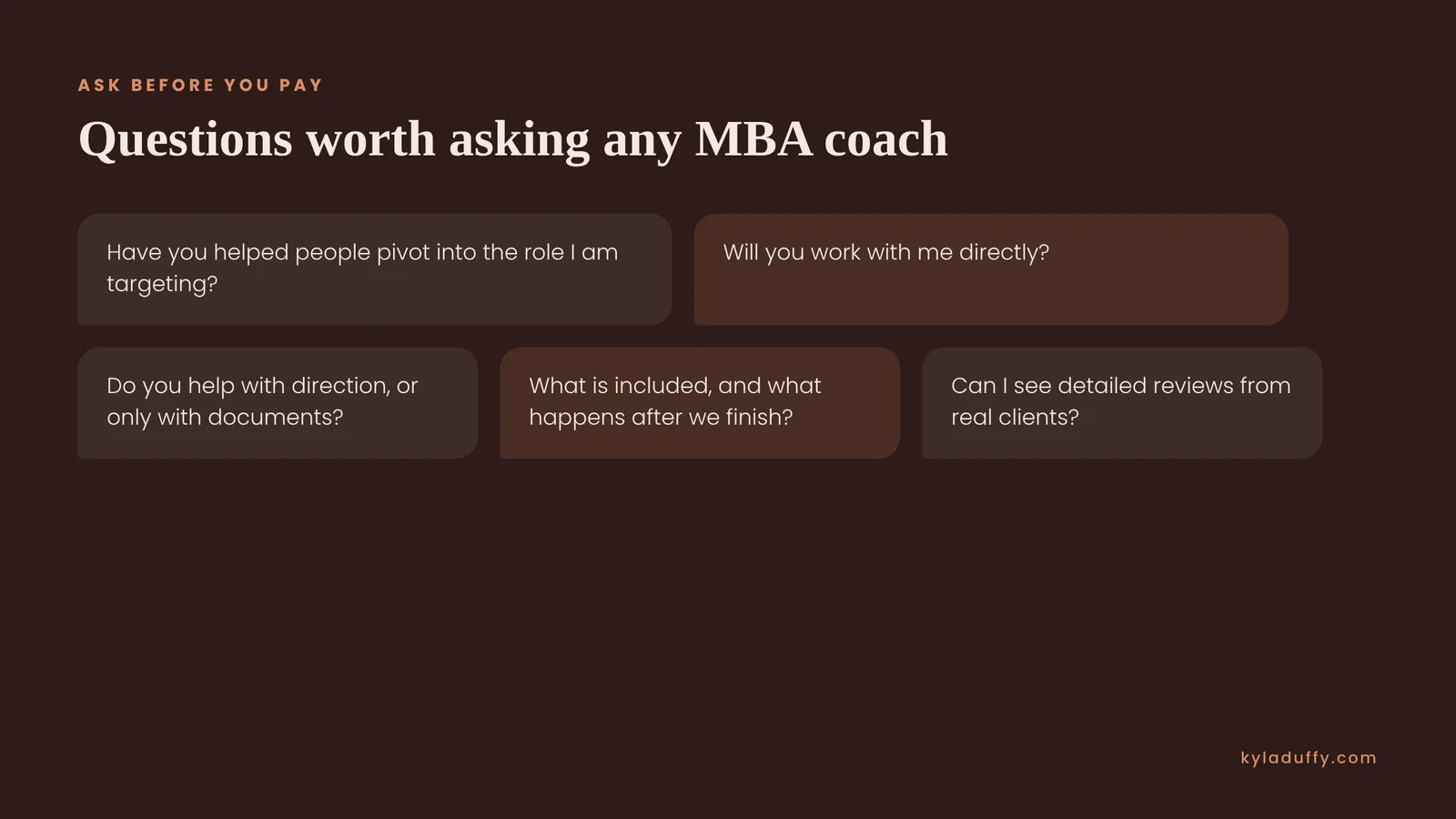
- Have you helped people pivot into the kind of role I am targeting?
- Will I work with you directly, or with someone on your team?
- Do you help with direction, or only with documents?
- What is included, and what happens after we finish?
- Can I see detailed reviews from real clients?
For context on mine: more than 11 years of resume writing and coaching, a master’s degree, over 4,000 professionals helped, and a 4.9-star average from 55 Google reviews. You work with me directly from the first call to the final draft, with no account managers and no junior writers. If you want the wider view of the market, including hourly coaches and job search services, see my guide to working with a job search coach.
One more filter worth applying. Ask what the coach thinks you should not buy. A coach who has an honest answer to that is thinking about your situation. A coach who recommends the largest package to everyone is thinking about theirs.
Frequently asked questions
Should I hire a coach during my MBA or after?
Earlier is usually better, because recruiting timelines move fast and the preparation compounds. That said, coaching after graduation is just as valuable if you are still searching, or rethinking a first role that did not fit.
Does an MBA resume need to be one page?
For most MBA recruiting, yes. One focused page that leads with results is the standard most employers expect, and the discipline of cutting to a page usually improves the document anyway.
Can a coach help with interview prep for specific companies?
Yes. We prepare for the interview formats you are actually facing and build stories that show how you think, how you lead, and what you delivered. For firm-specific case math, pair that with your case partner and school resources.
Is an MBA career coach worth it if my school already has a career center?
It is worth it when you need depth the center cannot give you: a pivot, a weak story, repeated final-round losses, or support that continues past graduation. If recruiting is going well and your story is landing, you may not need one at all.
Do you work with international students?
Yes, and everything is online, so time zone is the only logistics question. I will not advise on visa or immigration matters, which belong with your school and a qualified attorney, but the story, materials, and interview work are the same.
How quickly can we start?
Usually within a few days of your free strategy call. Resume first drafts typically arrive in 2 to 3 business days once I have what I need from you.
Not sure where your MBA should take you next? Book a free strategy call, or read more about my career coaching services and my interview coaching.
Related reading: what an executive career coach does if you are further along than the MBA pipeline, and AI career coach vs. human coach if you are leaning on AI tools during recruiting.