Here’s a fact that clears up a lot of confusion: in the U.S., the Bureau of Labor Statistics describes career counselors and advisors as a distinct occupation, typically requiring a master’s degree. Career coaching, on the other hand, isn’t regulated the same way. That one difference shapes almost everything else.
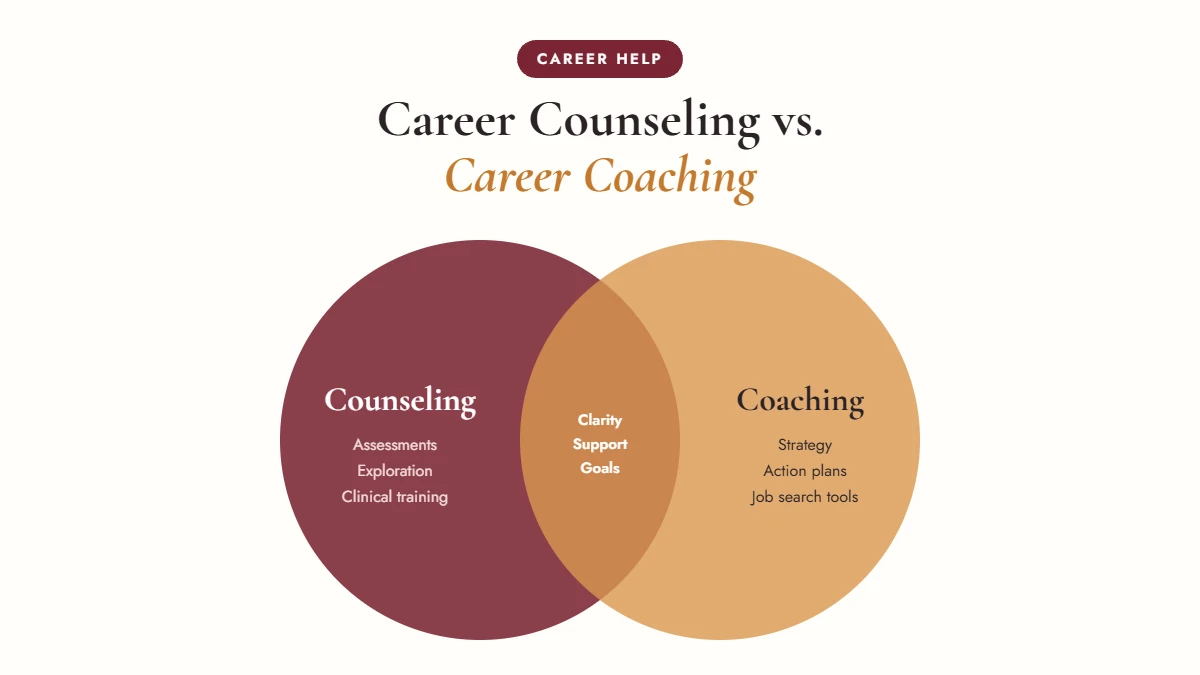
So when you’re comparing career counseling services with career coaching, the short answer is this: career counseling tends to focus on exploration, assessment, and the personal factors behind your career choices, while career coaching tends to focus on goals, strategy, and taking action in your job search. They overlap in the middle, and the right choice depends on where you’re stuck.
Two quick definitions. Career counseling is guidance from a trained counseling professional that helps you understand your interests, values, and options, often using formal assessments. Career coaching is a partnership focused on helping you set goals and move toward them: clarifying direction, building a strategy, and getting your materials and job search working.
Your Options for Career Help
When people search for “career services,” they usually find four kinds of help. Here’s how they compare:
| Career counselor | Career coach | College or public career services | Therapist | |
|---|---|---|---|---|
| Typical training | Counseling education, often a master’s degree | Varies widely; look at experience and results | Career development staff | Licensed mental health training |
| Main focus | Exploration, assessment, decision-making | Goals, strategy, job search execution | Students, alumni, or local job seekers | Emotional and mental health |
| Best when | You don’t know what fits, or personal factors are in the way | You need a plan, materials, and momentum | You’re early in your career or need free support | Anxiety, depression, or burnout are driving the problem |
| Typical output | Clarity on options and fit | A plan, stronger materials, interviews | Guidance, workshops, job postings | Coping strategies and healing |
A note on that last column: if emotional or mental health concerns are a big part of what’s going on, a licensed mental health professional is the right first call. The BLS also profiles mental health counselors separately, which is a helpful way to see the distinction.
Where Career Counseling and Coaching Overlap
Both help you get clearer. Both involve good questions, honest feedback, and someone in your corner. Many counselors use coaching techniques, and many coaches use assessments. The National Career Development Association is a good resource if you want to learn more about the career development profession and its standards.
The real difference is emphasis. Counseling leans toward understanding; coaching leans toward doing.
Already know roughly where you want to go, but can’t seem to get there? That’s coaching territory. Book a free consultation and we’ll see whether working together makes sense.
What It Looks Like in Practice: One Goal, Two Approaches
Here’s an illustrative example. A client arrives saying: “I’m burned out in accounting and I think I want something more creative, but I have no idea what.”
A counseling-led approach might start with interest and values assessments, explore what “creative” really means to this person, and look at personal factors (confidence, family expectations, fear of change) that are shaping the decision.
A coaching-led approach might start by defining what a good outcome looks like in six months, identify two or three adjacent roles that use accounting skills in a more creative setting (FP&A storytelling, finance for a design firm, product pricing), and set up small experiments and conversations to test them.
Same person, same goal. Different starting points. Neither is wrong; it’s about what you need first. (And if “follow your passion” is the advice you keep hearing, I have thoughts on why that advice can backfire.)
How to Choose the Right Kind of Career Help
- Choose career counseling services if you have no idea what direction fits, you’d benefit from structured assessments, or personal and emotional factors are tangled up in your career decisions.
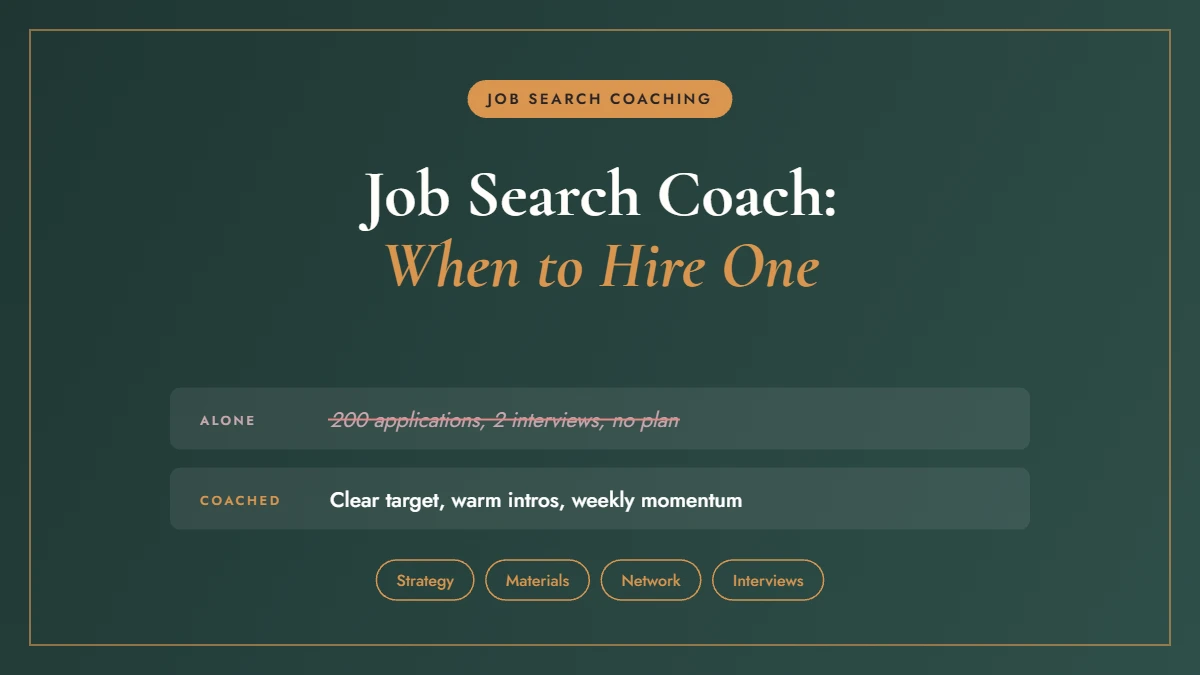
- Choose a career coach if you have a direction (even a rough one), you’re stuck on the “how,” or your job search has stalled and you need a strategy, better materials, and accountability.
- Choose your college or local career center if you’re a student, recent grad, or need free, general guidance. (Students hitting a wall might relate to an internship search that feels like Mt. Everest.)
- Choose a therapist first if anxiety, depression, or burnout are the main thing holding you back.
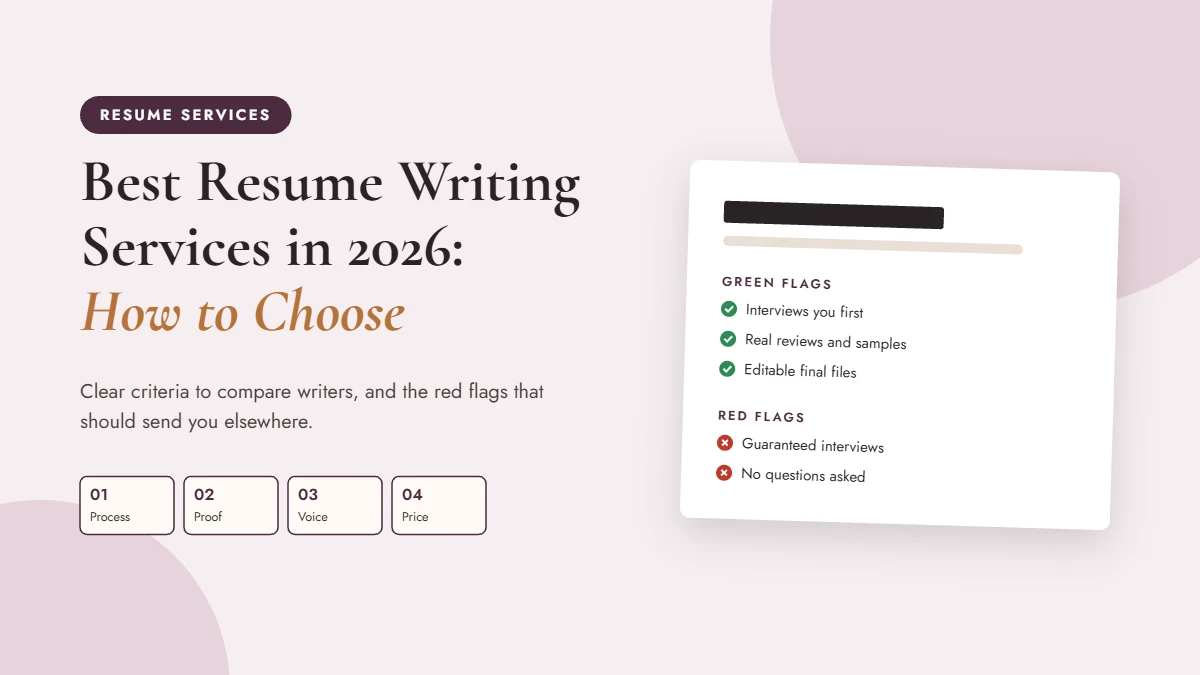
Whoever you choose, ask about their training, their process, and what results their clients typically get. I’ve written a guide on how to choose the right career coach, including questions to ask.
How I Work as a Career Coach
My work is career coaching: helping people get clear on direction, build a strategy, and turn it into interviews and offers. If you’re curious what that involves session to session, here’s what a career coach actually does. Being coached is also a skill in itself, which I explain in how being coached is a skill.
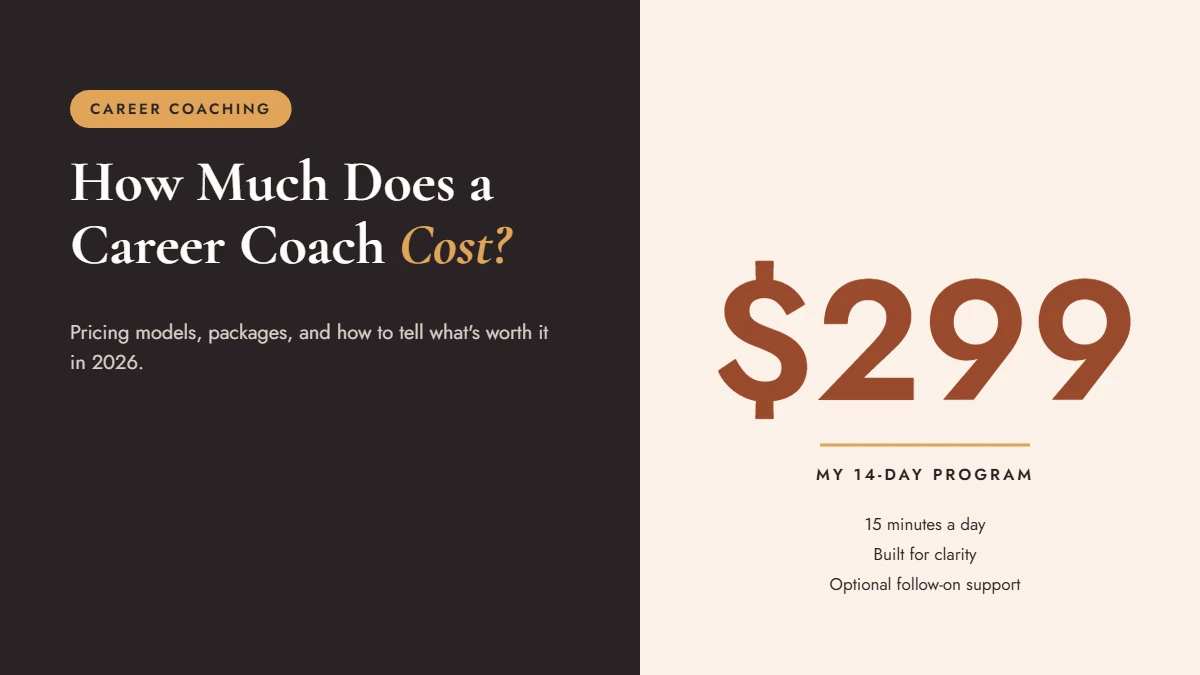
My career coaching program starts with a 14-day “Find Your Path” challenge ($299) that takes about 15 minutes a day. If you’re mid-career and considering a pivot, my career change at 40 plan shows how coaching fits into a bigger move. If you’ve been searching for months with little to show for it, read how to get a handle on an endless job search. I work with clients virtually and locally in Denver and Boulder; all of my services are listed in one place.
Quick Answers to Common Questions
What is the difference between career counseling and career coaching?
Career counseling is typically provided by professionals trained in counseling, often with a master’s degree, and focuses on exploration, assessment, and the personal factors behind career decisions. Career coaching is more action-oriented, focusing on goals, strategy, and the job search itself.
Are career counselors licensed?
Requirements vary by state and by setting. Many career counselors hold a master’s degree in counseling, and some hold state counseling licenses. Ask any provider about their training and credentials before you start.
Is career coaching regulated?
Career coaching isn’t regulated the way licensed counseling is. That’s why it’s important to look at a coach’s experience, process, reviews, and results before you hire them.
Which is better, a career counselor or a career coach?
Neither is better in general. A career counselor is often the right fit if you need structured assessment or have personal or emotional barriers affecting your career. A career coach is often the right fit if you know roughly where you want to go and need a plan and accountability to get there.
Where can I find free career counseling services?
Many colleges offer career services to students and alumni, and public workforce centers often provide free career guidance. These are great starting points, especially for early-career job seekers.
How much does career coaching cost?
Pricing varies widely across the industry. My career coaching starts with a 14-day ‘Find Your Path’ challenge for $299, and interview coaching is $125 per session.
Can I work with both a career counselor and a career coach?
Yes. Some people work with a counselor to explore options and address deeper barriers, then work with a coach to build materials and execute a job search.
The short version
- Career counseling leans toward exploration, assessment, and personal factors; it’s often provided by professionals with counseling training.
- Career coaching leans toward goals, strategy, and action in your job search.
- Pick based on where you’re stuck: “what should I do?” (counseling) or “how do I get there?” (coaching).
Not Sure Which You Need? Let’s Talk It Through
If you’re still on the fence, that’s completely fine. Book a free consultation and tell me what’s going on. If coaching is the right fit, we’ll map out a plan. If you’d be better served by a counselor or another resource first, I’ll tell you that honestly.