The email lands on a Tuesday afternoon: “Thank you for your interest. Please complete your HireVue interview within 5 days.” You click the link, see a countdown timer, and suddenly you’d rather be doing literally anything else. (Your taxes. A root canal. Both.)
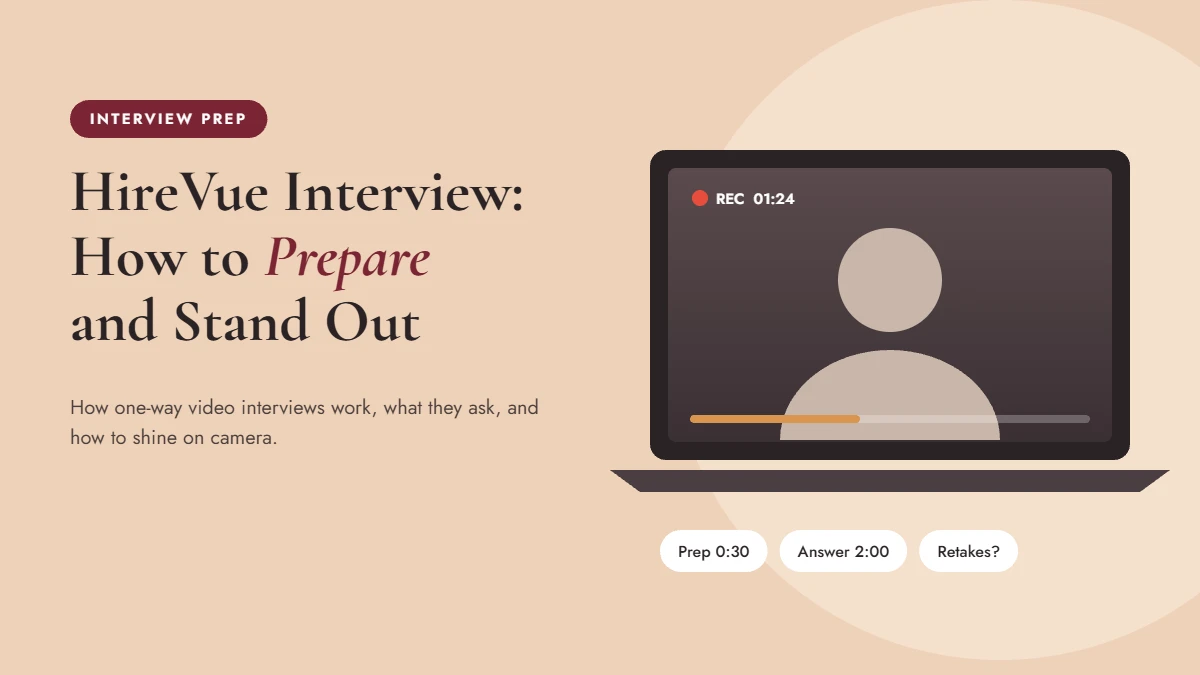
Here’s the good news. A HireVue interview is usually a one-way video interview: you see a question, get a short time to prepare, and record your answer, with no live interviewer on the other end. You stand out by preparing a few strong, specific stories in advance, setting up your space like a professional studio (lite), and answering in a tight, structured way. It feels strange, but it’s very learnable.
What Is a HireVue Interview, Exactly?
HireVue is a hiring platform employers use for video interviews and assessments. Most candidates meet it in its on-demand format, often called an asynchronous interview, which just means you and the employer aren’t online at the same time. You record; they review later.
Some employers also use HireVue for live video interviews or skill assessments, so read your invitation closely. It’ll tell you what format to expect.
How Does a HireVue Interview Work?
The employer configures the details, so they vary, but the typical flow looks like this:
- You get an invitation with a deadline and a link.
- You check your tech: camera, microphone, and browser or app.
- You may get a practice question. If it’s offered, take it. It’s the closest thing to a free rehearsal you’ll get.
- Each question appears on screen (sometimes as text, sometimes as a short video).
- A prep timer runs, then recording starts automatically.
- You answer within a time limit. Retakes may or may not be allowed.
That automatic start is what rattles people. Knowing it’s coming takes away half the panic.
What HireVue Interview Questions Should I Expect?
Mostly the same questions you’d hear in any first-round interview. The format is new; the content isn’t. Expect a mix of:
- Motivation questions: “Why do you want to work here?” (Here’s how to answer “Why do you want to work here?” without sounding rehearsed.)
- Behavioral questions: “Tell me about a time you…” handled a conflict, missed a deadline, led without authority.
- Self-assessment questions: strengths, development areas, and the classic “What are your weaknesses?“
- Role-specific scenarios: “A customer is upset because… what do you do?”
A behavioral question asks you to describe a real past situation, on the theory that how you acted before predicts how you’ll act again. The cleanest way to answer is the STAR method: Situation, Task, Action, Result. I walk through it in detail in my STAR method walkthrough, and it works just as well out loud as on paper.
For the ones that make everyone squirm, I’ve put together a guide to the interview questions everyone hates.
If you only remember one thing: prepare proof, not scripts.
- Have three or four specific stories ready that show results, and bend them to fit the question.
- Reading a memorized script on camera is obvious, and it makes even great answers sound flat.
How Do I Prepare for a HireVue Interview?
Give yourself at least two short sessions before you hit “start.” Here’s the order I recommend:
1. Decode the job posting
Highlight the three skills that show up most. Those are the themes your answers should prove.
2. Build your story bank
Write down four stories (a win, a challenge, a conflict, a time you learned something fast) with a clear result for each. This is the core idea behind preparing your proof instead of your answers.
3. Practice on camera, out loud
Record yourself on your phone. Watch it back once (yes, it’s painful; yes, it’s worth it). You’re checking pace, filler words, and whether your result actually comes through. One caution: practice is great, but a mock interview shouldn’t be your first step. Get your stories straight first, then rehearse them.
4. Set up your space
Use this as your checklist:
| Element | Do | Avoid |
|---|---|---|
| Camera | At eye level, about an arm’s length away | Looking up your nose from a laptop on your lap |
| Lighting | Light source in front of you, like a window or lamp | A bright window behind you |
| Background | Plain wall or tidy shelf | Laundry, open doors, moving pets |
| Audio | Quiet room, earbuds with a mic if needed | Echoey rooms and notification pings |
| Eye contact | Look at the camera lens, not your own face | Reading notes off to the side |
For more on looking and feeling ready on screen, read my tips on dressing for a virtual job interview and on preparing for phone and video screening interviews. And if something goes wrong mid-recording, it’s not the end of the world. Here’s what to do when a video interview goes sideways.
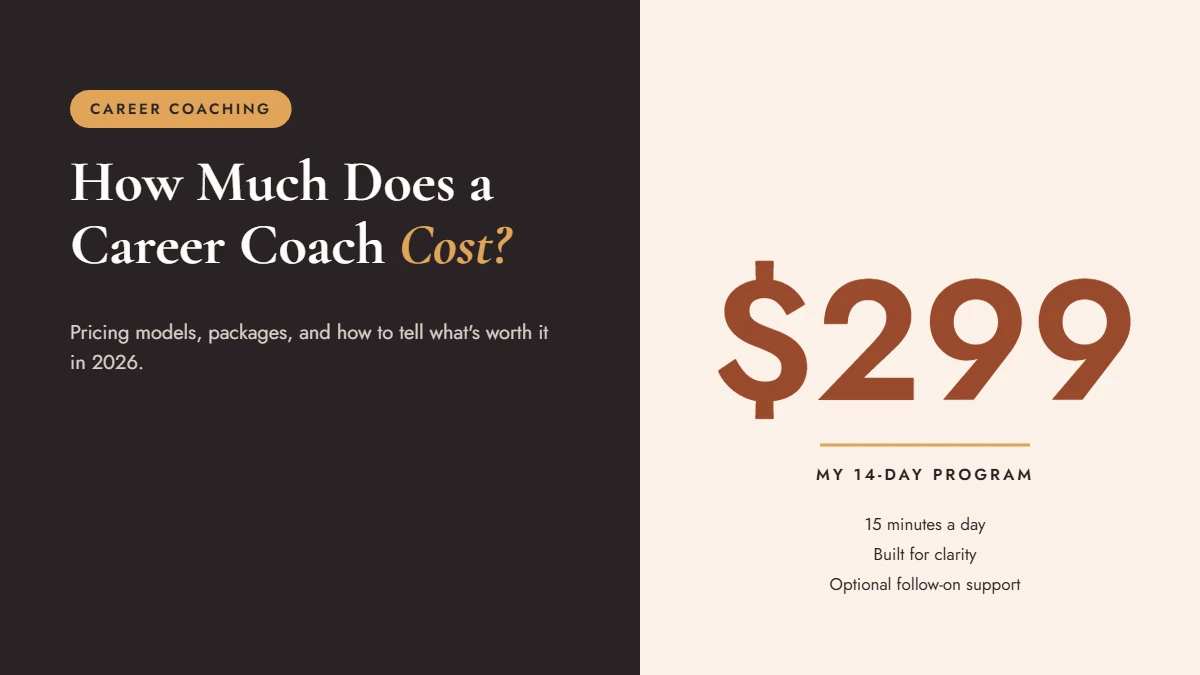
If your stories feel thin, or you freeze the moment a red recording dot appears, that’s precisely what one or two coaching sessions can fix. My interview coaching is $125 per session, and you can book a free consultation to see if it’s a fit before your deadline.
How Do I Stand Out on Camera?
- Answer in 60 to 120 seconds. Shorter feels thin; longer loses people. Watch the timer, but don’t stare at it.
- Lead with the headline. Start with the result or the point, then back it up.
- Use real numbers when you have them. “Cut onboarding time in half” beats “improved onboarding.”
- Smile at the start and the end. It’s the closest you’ll get to a handshake.
- Close each answer cleanly. A short final sentence (“…and that’s the approach I’d bring here”) stops you from trailing off.
It helps to remember who’s on the other end. Recruiters review a lot of these. The LinkedIn Talent Blog and SHRM’s recruiting resources are good windows into how employers think about screening, and they make the process feel a lot less mysterious.
What Happens After a HireVue Interview?
Usually, a recruiter or hiring team reviews your responses and decides who moves forward to a live round. Timelines vary, so don’t panic if a week goes by. In the meantime, start thinking about the next stage, because second interview questions are different in some important ways. If you have a recruiter contact, a short thank-you note is a nice touch, even for a recorded interview.
Questions I Get Asked a Lot
What is a HireVue interview?
HireVue is a hiring platform that many employers use for video interviews and assessments. Most candidates encounter its on-demand format, where you record answers to preset questions on your own schedule instead of talking to a live interviewer.
How long is a HireVue interview?
It depends on how the employer sets it up. Many include a handful of questions, each with a short preparation window and a time limit for your answer, so the whole thing often takes well under an hour. Check your invitation for specifics.
Can I retake a HireVue answer?
Only if the employer allows it. Some interviews permit one or more retakes per question; others don’t. Read the instructions carefully before you start, and treat every take as final.
Is a HireVue interview reviewed by AI or by a person?
Employers decide how responses are reviewed, and practices vary. Some have recruiters or hiring managers watch the recordings; some use assessment tools as part of the process. Either way, clear, specific, well-structured answers are what help you most.
What should I wear for a HireVue interview?
Dress the way you would for an in-person interview at that company, at least from the waist up. Solid colors usually look better on camera than busy patterns.
Walk Into Your Recording Ready
A HireVue interview rewards preparation more than charisma, which is good news for anyone who doesn’t love being on camera. If you have an invitation sitting in your inbox right now, book a free consultation and let’s build your story bank before the deadline. You can also see all coaching options and pricing on my rates page, including my full “Nail Job Interviews” course.