The STAR method Situation, Task, Action, Result is best known as an interview answer framework, but the same structure builds stronger resume bullets too. Both formats are doing the same underlying job: proving you delivered a specific result, not just describing what you were responsible for. Once you build a story using STAR, you can compress it into a resume bullet or expand it into a full interview answer using the exact same underlying material.
What Is the STAR Method?
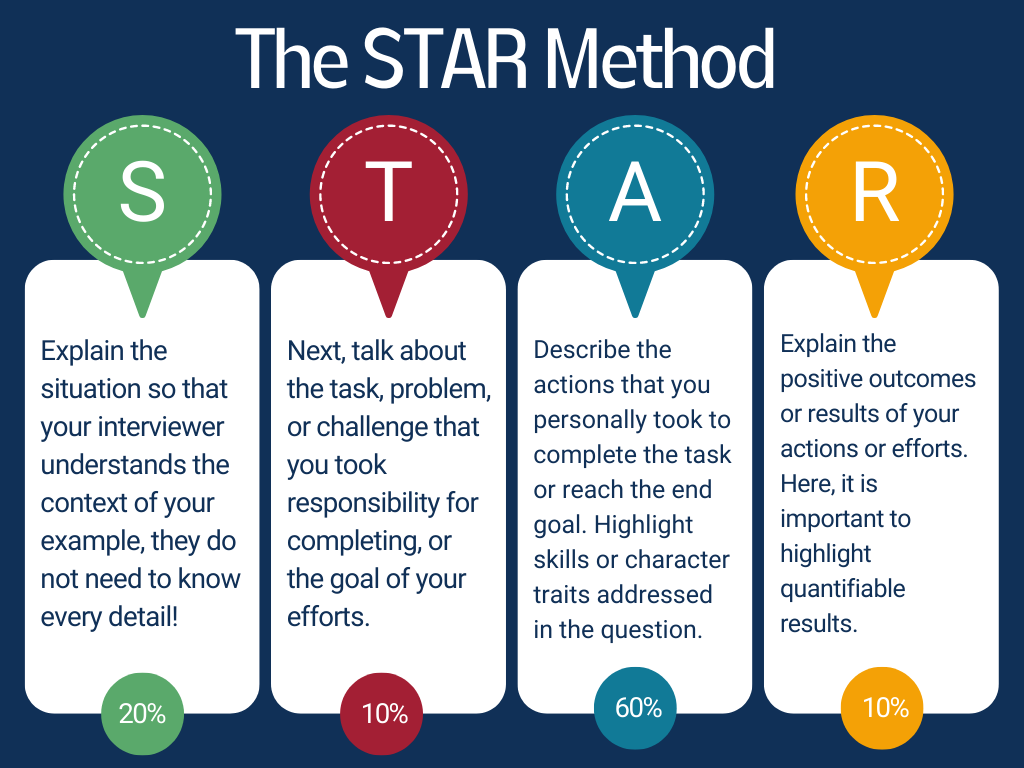
STAR breaks any accomplishment story into four parts:
Situation
The context. What was happening? What problem existed, or what circumstances were you operating in?
Task
Your specific responsibility within that situation. What were you supposed to accomplish or solve?
Action
What you actually did. This is where the real substance lives the specific steps, decisions, or approach you took.
Result
What happened because of your actions. Ideally measurable: a percentage, a dollar figure, a timeframe, a concrete outcome.
Why STAR Works for Resume Bullets, Not Just Interviews
Most people learn STAR exclusively as an interview technique and never realize it’s the same underlying discipline behind writing resume bullets that actually prove something. Both a resume bullet and an interview answer are trying to accomplish the same thing: convince someone you delivered a specific, meaningful result, not just that you held a title or attended meetings.
The difference is format, not substance. An interview answer has room to walk through all four parts conversationally. A resume bullet has one line, maybe two, and needs to compress Situation and Task into a quick setup before spending most of the space on Action and Result the two parts that actually carry the evidence.
STAR Walkthrough: The Interview Version
Imagine you’re asked: “Tell me about a time you had to manage a difficult stakeholder.”
Situation: “In my last role, our biggest client’s VP was pushing back hard on a project timeline change that was actually necessary due to a vendor delay outside our control.”
Task: “I needed to keep the client confident in the project while resetting expectations honestly, without damaging the relationship.”
Action: “I scheduled a direct call within 24 hours, walked through exactly what caused the delay, presented two realistic path-forward options with clear tradeoffs, and proposed a revised timeline with built-in buffer.”
Result: “The client chose the revised timeline, we delivered on the new date with no further slippage, and the VP specifically asked for me on their next project.”
That’s a complete, conversational STAR answer naturally spoken, all four parts present.
STAR Walkthrough: The Resume Bullet Version
Now take that exact same story and compress it into a resume bullet.
Start by identifying just the essential context (a compressed Situation + Task) and the strongest Action + Result:
“Resolved a critical client escalation caused by a third-party vendor delay by proposing a revised timeline with clear tradeoffs, preserving the relationship and securing repeat business from the client’s VP.”
Same underlying story. Same four STAR components are technically present they’re just compressed into a single sentence, with Action and Result doing most of the work, exactly like they should on a resume.
A Second Full Example, Different Theme
Here’s the same process applied to a completely different kind of story, since one example alone can make the pattern feel narrower than it actually is.
Situation: A retail operations team was manually tracking inventory across 12 store locations using spreadsheets, causing frequent stock discrepancies.
Task: Reduce inventory discrepancies and the manual workload involved in tracking them.
Action: Researched and implemented a cloud-based inventory system, trained store managers across all 12 locations, and built a weekly reconciliation process.
Result: Inventory discrepancies dropped 40% within three months, and manual tracking time was cut by roughly six hours per week across the team.
Compressed into a resume bullet:
“Implemented a cloud-based inventory system across 12 retail locations, reducing stock discrepancies by 40% and cutting manual tracking time by 6+ hours weekly.”
Notice the pattern repeats: Situation and Task collapse into a short setup, and the bullet leads with the action verb and closes with two concrete, quantified results.
One Story, Two Formats, Side by Side
| STAR Component | Interview Answer | Resume Bullet |
| Situation | Fully described, sets the scene | Compressed into a few words of context |
| Task | Explicitly stated | Often implied rather than stated directly |
| Action | Walked through step by step | Led with a strong action verb, kept concise |
| Result | Stated, sometimes with follow-up detail | Quantified whenever possible, placed prominently |
Common STAR Mistakes
Spending too much time on Situation and Task, in both formats. This is one of the most common resume mistakes and it shows up in interviews too a long windup with a thin payoff.
Skipping Result entirely. A story that ends at “and that’s what I did” without stating what happened next leaves the most convincing part out.
Using a vague, unquantified Result when a specific one is available. “Improved the process” is weaker than “reduced processing time from five days to two” the same principle behind avoiding a general, forgettable resume.
Choosing a story where the Action wasn’t really yours. If the story is actually about your team or manager’s decision, it doesn’t hold up well as a personal STAR example, in either format.
What If You Genuinely Can’t Remember Enough Detail?
This happens constantly, and it’s not a sign you didn’t accomplish anything it’s a sign the accomplishment has become routine to you, which paradoxically makes it harder to see clearly. If you’re staring at a blank page trying to recall a specific Result, try working backward: think of a project you’re generally proud of, then ask what would have happened if you hadn’t been involved. The gap between those two scenarios is usually where the real Result is hiding.
Building Your Own STAR Story Bank
Rather than building STAR stories on the spot under pressure, prepare several in advance covering different themes: leadership, conflict, failure, change, collaboration, and measurable results.
For each one you develop, jot down the Situation, Task, Action, and Result separately first, then adapt the same material into both a resume bullet and a conversational interview version. That one preparation exercise produces material for the interview questions everyone dreads as well as a stronger resume, since both draw from the same underlying evidence bank.
A useful test for whether a story is strong enough to include: can you state the Result in one specific sentence, without hedging? If the honest answer is “it kind of helped, I think,” that story probably isn’t developed enough yet, or the result genuinely wasn’t there either way, it’s worth choosing a different example rather than forcing a weak one into the framework.
Why Major Tech Companies Standardized on This
STAR became especially associated with large technology companies because it gives interviewers a consistent, comparable way to evaluate candidates rather than relying on gut feeling, interviewers can assess whether a candidate clearly identified a problem, took ownership of specific actions, and produced a measurable outcome.
That same standardization has trickled down into hiring practices well beyond tech. Once a framework becomes common on one side of the interview table, it’s worth using it on the other side too both because it produces genuinely stronger answers, and because it matches what a trained interviewer is often listening for.
How I Use This Framework With Clients
I teach and use this framework for both resumes and interview prep, because it’s the same underlying discipline either way. When I’m working on a client’s resume, I’m pulling out Situation, Task, Action, and Result for each accomplishment, then deciding how much of each belongs on the page. When we move into interview prep, the same stories just get unpacked back out into full, conversational answers.
If interview prep specifically is what you need help with, my job interview coaching services build directly on this same story-development process.
Why This Actually Matters
This isn’t just a formatting trick. SHRM, the leading professional association for HR and talent-acquisition practitioners, has long emphasized that hiring decisions come down to evidence of a candidate’s ability to solve a specific problem STAR is essentially a structured way to consistently produce that evidence.
General guidance from Indeed’s Career Guide reinforces the same principle for both resumes and interviews: specific, quantified accomplishments consistently outperform vague descriptions of responsibilities.
And on the broader career-strategy side, Harvard Business Review has repeatedly covered how structured storytelling the same instinct behind STAR helps professionals communicate their value clearly, in interviews, performance reviews, and beyond.
Frequently Asked Questions
Is STAR the same as the CAR method?
They’re closely related CAR (Challenge, Action, Result) is a shorter, three-part variation of the same underlying idea. STAR is the more widely recognized and searched version, particularly in tech and corporate hiring, so it’s the more useful term to know and use.
Do I need to label the STAR parts explicitly when I write a resume bullet?
No. STAR is a thinking framework for building the content, not a literal template you label on the page. A finished resume bullet should read as one smooth sentence, not four separate labeled fragments.
What if my result wasn’t a clean number?
Not every result is a percentage or dollar figure. A qualitative but specific result “became the go-to resource for X” or “was asked to lead the initiative company-wide afterward” still counts, as long as it’s concrete rather than vague.
How many STAR stories should I prepare?
Five to seven flexible stories covering different themes is usually enough for most interviews, and the same stories can supply material for multiple resume bullets across different sections.
Can I use STAR for a resume summary, not just bullets?
Yes, in a lighter-touch way. A strong resume summary often leads with a condensed Action-and-Result statement pulled from your strongest STAR story, even though the full Situation and Task stay implied rather than spelled out.
Does STAR work for entry-level candidates without much work experience?
Yes. STAR stories don’t have to come from a full-time job internships, class projects, and volunteer work all work as source material for an entry-level resume, using the exact same four-part structure.
Should executive-level resumes use STAR differently?
The structure stays the same, but the scale of the Result usually needs to reflect organizational impact rather than task-level outcomes the same shift covered in how the best resume writing services approach executive-level work.
Want Help Building Your Own STAR Stories?
Turning your actual experience into strong STAR stories and then into resume bullets and interview answers is exactly the kind of work I do with clients. I’m Kyla Duffy, and my resume and cover letter writing services build this framework into every project. Curious what it costs? My rates are posted publicly, and my FAQ page covers what people usually ask first.