A client recently told me she wasn’t qualified for a job she wanted.
By the time we met, she had already decided she didn’t have a chance.
She’d never worked in that industry.
She didn’t know one of the software tools listed in the posting.
She’d never held that exact title.
In her mind, the case was closed.
Twenty minutes later, she was laughing.
As we walked through the job description together, we found connection after connection between her experience and what the employer actually needed.
She had solved similar problems.
She had used comparable technologies.
She had worked with similar stakeholders.
She had delivered similar outcomes.
The industry was different.
The work wasn’t.
I see this all the time.
In fact, one of the biggest obstacles I encounter in career coaching isn’t a skills gap.
It’s a visibility gap.
People can’t see the connection between what they’ve done and what employers need.
We Are Terrible at Evaluating Ourselves
When job seekers read a posting, they tend to focus on everything they don’t have.
They don’t have the exact title.
They don’t have experience in that industry.
They don’t know a specific software platform.
They haven’t worked for a company of that size.
They haven’t managed that exact budget.
What they often overlook are the things they do have:
- Years of experience solving problems
- Project management skills
- Leadership experience
- Customer-facing expertise
- Process improvement experience
- Vendor management skills
- Training and mentoring experience
- Risk management and compliance knowledge
- Communication skills
In other words, they focus on the differences while completely ignoring the similarities.
What Emerging Industries Have Taught Me
Over the past year, I’ve spent time researching emerging industries as part of my own professional development.
I’ve explored sectors like:
- Space pharma
- Blockchain
- Bioprinting
- Nanotechnology
- Clean energy
- Intelligent transportation systems
Initially, I expected to find opportunities mostly for scientists, engineers, and technical specialists.
Instead, I kept finding opportunities for everyone else.
Project coordinators.
Operations managers.
Compliance professionals.
Customer success teams.
Vendor managers.
Technical trainers.
Quality assurance specialists.
Writers.
Analysts.
Risk managers.
HR professionals.
The list went on and on.
That’s when something clicked for me.
Every growing industry creates an ecosystem.
And ecosystems need far more than technical experts.
The Job Isn’t Always What You Think It Is
When people hear “space pharmaceuticals,” they picture rocket scientists.
What they don’t picture is someone coordinating vendors.
Or managing projects.
Or maintaining compliance documentation.
Or overseeing quality standards.
Or supporting customers.
Or building operational processes.
The same thing happens with blockchain.
Most people assume blockchain companies only need software developers.
Yet many of the opportunities I found involved:
- Fraud prevention
- Risk operations
- Trust and safety
- Customer experience
- Regulatory compliance
- Operational support
The technology is new.
The work often isn’t.
The same pattern showed up in bioprinting.
The same pattern showed up in nanotechnology.
The same pattern showed up in clean energy.
Again and again, I found opportunities that reminded me of my clients.
Not because my clients had worked in those industries.
Because they had already developed many of the skills those industries need.
One Exercise That Changes Everything
One of my favorite coaching exercises is surprisingly simple.
We take a target job description and review it line by line.
For every requirement, we ask:
- Have you done this before?
- Have you done something similar?
- Have you solved this type of problem?
- Have you worked with similar stakeholders?
- Is this a skill you could learn quickly?
What starts as a list of deficiencies often becomes a list of strengths.
Clients begin to see patterns.
Connections emerge.
Confidence grows.
Suddenly, the role feels attainable.
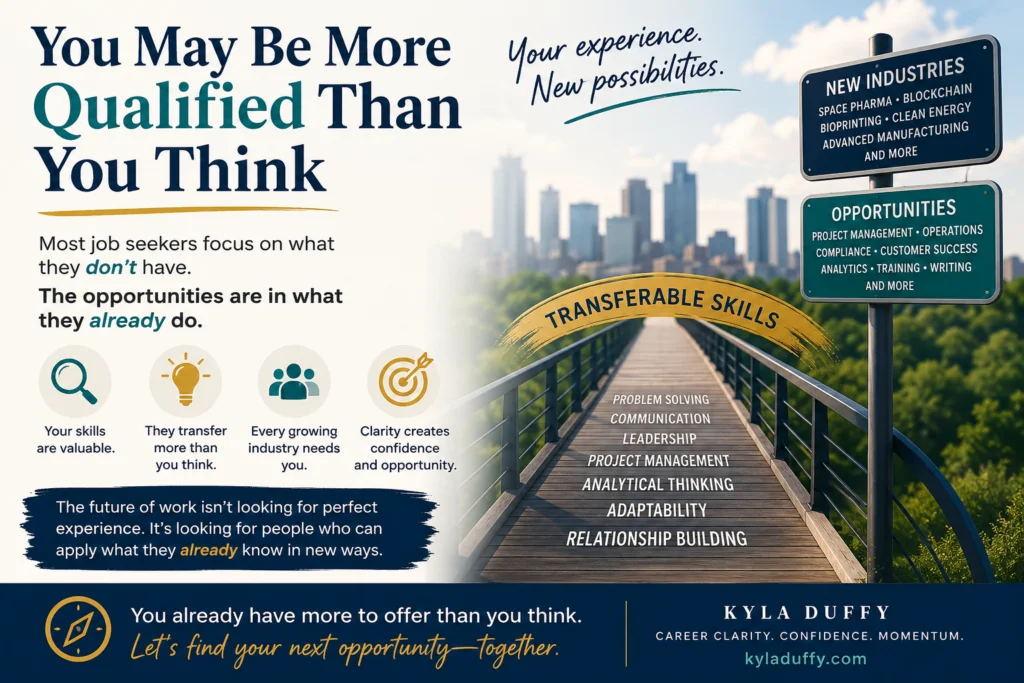
Look for the Bridge
I think many people approach career changes the wrong way.
They look at where they are and where they want to go and focus on the gap.
I encourage clients to look for the bridge.
What skills transfer?
What experiences overlap?
What strengths consistently show up throughout your career?
What problems do you solve better than most people?
What do colleagues rely on you for?
The answers to those questions are often far more important than whether you’ve worked in a particular industry before.
The Future of Work May Need More of Your Experience Than You Think
The biggest lesson I’ve learned from researching emerging industries is this:
The future isn’t looking exclusively for people with perfect experience.
It’s looking for people who can learn.
People who can adapt.
People who can solve problems.
People who can bring proven strengths into new environments.
Most of us spend far too much time focusing on what we’re missing.
Sometimes the better question is:
“What am I overlooking about myself?”
Because the next opportunity may not require you to become someone completely different.
It may simply require you to recognize the value you’ve already built.
And once you can see that, opportunities start appearing in places you never would have considered before.
If you’re feeling stuck, overwhelmed, or unsure how your experience translates into what’s next, I’d love to help.
I’ve helped thousands of professionals uncover their transferable skills, identify new career paths, and build a strategy for moving forward with confidence.
Learn more at kyladuffy.com.