Here’s a fact that surprises a lot of people: most resumes that aren’t getting interviews don’t have a content problem. They have a presentation problem. The experience is there. It’s just buried under duty lists, vague summaries, and formatting that confuses applicant tracking software.
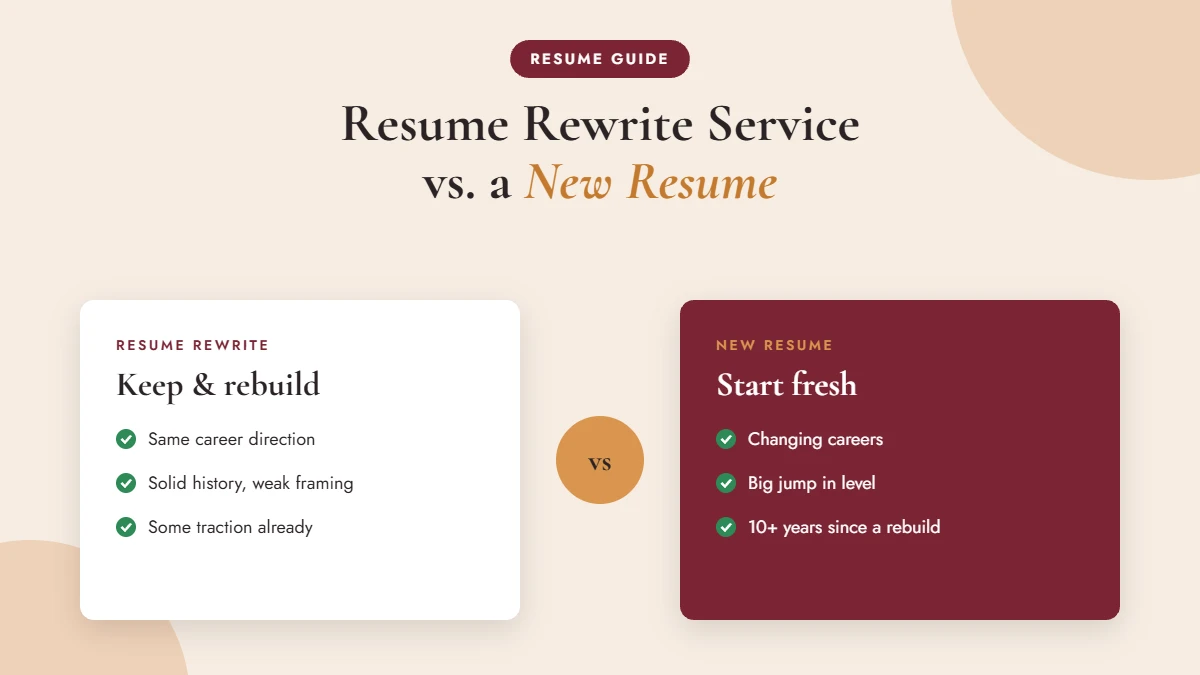
That’s why the first question isn’t “who should write my resume?” It’s “do I need a resume rewrite service or a brand-new resume?” The short answer: choose a rewrite if your career direction is staying the same and your resume has solid raw material that isn’t landing; choose a new resume if you’re changing careers, jumping levels, or working from a document that’s a decade old.
Quick definitions so we’re on the same page. A resume rewrite keeps your work history and rebuilds how it’s presented: structure, summary, bullets, keywords. A new resume starts from a fresh intake conversation and treats your old document as background reading, not a blueprint. Both are part of a professional resume writing service. They just begin in different places.
Five Myths About Rewriting a Resume
I’ve heard every one of these from clients, usually right before they found out the opposite was true.
Myth 1: “A rewrite is basically just editing.”
Reality: Editing fixes commas. Rewriting fixes meaning. A real rewrite asks what each line is supposed to prove, cuts what doesn’t earn its space, and rebuilds accomplishments so a recruiter understands your impact in seconds. If you’re paying for a rewrite and getting your own sentences back with better grammar, that’s an edit wearing a costume.
Myth 2: “My resume isn’t working, so the whole thing has to go.”
Reality: Usually not. When I review a resume that isn’t getting callbacks, the raw material is often perfectly good. The issue is framing: duties instead of results, a summary that could describe anyone, or a layout that hides your best work on page two. I’ve written more about why resumes stop landing interviews, and very few of the reasons require starting over.
Myth 3: “A new resume means losing my history.”
Reality: Starting fresh doesn’t erase your experience. It changes the lens. For a career changer, the same project might be rewritten to emphasize stakeholder management instead of technical delivery, because that’s what the new field cares about.
If you only remember one thing: the decision isn’t about how “bad” your resume is. It’s about whether your direction is changing.
- Same direction, weak results? Rewrite.
- New direction, new level, or a very old document? Start fresh.
Myth 4: “A rewrite is always the cheaper, faster option.”
Reality: Sometimes. But a rewrite of a resume that’s pointed in the wrong direction is money spent polishing the wrong story. And pricing often depends more on your career level than on whether you bring a draft. On my rates page, resume writing is priced by level, from $199 to $599.
Myth 5: “Any professional rewrite will get past the ATS.”
Reality: An applicant tracking system (ATS) is the software many employers use to collect, sort, and search resumes. It rewards clear structure and relevant keywords, and it can stumble over tables, text boxes, and graphics. A rewrite only helps if it’s built with that in mind. Here’s my guide to writing an ATS-friendly resume if you want to check any writer’s work (mine included).
Not sure which camp you’re in? Send me your current resume for a free 5-point resume review. Within two business days, I’ll tell you the five things I’d change first, and whether a rewrite will do the job.
What a Rewrite Actually Changes: One Bullet, Before and After
Here’s an illustrative example (not a real client’s resume) of the kind of change a rewrite makes. Same job, same person, same facts:
Before: “Responsible for managing vendor relationships and overseeing procurement processes for the operations team.”
After: “Renegotiated contracts with 14 key vendors and rebuilt the approval workflow, cutting purchase-order turnaround from 9 days to 3.”
The “before” tells a recruiter what the job was. The “after” tells them what you did with it. Nothing was invented; the numbers came from asking better questions. (The numbers in this example are placeholders to show the structure; yours should come from your own work.) That’s the heart of writing powerful resume bullets, and it’s why I lean on the STAR method for resumes to pull out the results hiding in your experience.
Resume Rewrite vs. New Resume: Side by Side
| Resume rewrite | New resume | |
|---|---|---|
| Starting point | Your existing resume | A fresh intake conversation |
| Best for | Same field, underperforming resume | Career change, big level jump, very outdated resume |
| What changes | Structure, summary, bullets, keywords | Everything, including which experience to feature |
| Biggest risk | Polishing a story pointed the wrong way | Overlooking strong material in the old version |
| Your input | Answering questions about results | A deeper conversation about goals and target roles |
How to Decide in Five Minutes
Answer these honestly:
- Are you targeting the same kind of role you have now? Yes leans rewrite. No leans new.
- Is your resume getting any traction? A few interviews means the bones are there. Total silence often means a deeper problem.
- When was it last rebuilt (not just updated)? If you’ve been tacking jobs onto the top for ten years, it’s probably time to start fresh.
- Does your summary describe you, or anyone? If it’s the latter, read my take on writing a resume summary that gets interviews.
- Is it longer than it needs to be? More isn’t more. Sometimes the best rewrite is a simpler resume with greater impact.
It also helps to know what recruiters are actually scanning for. SHRM’s recruiting resources show the employer side of hiring, and LinkedIn’s Talent Blog is a useful peek at what recruiters are being told to look for. If you’re switching fields, the Occupational Outlook Handbook is a good way to learn the language of your target role before you rewrite a single bullet.
What Working With Me Looks Like
Whether we rewrite or rebuild, it starts the same way: a real conversation about where you’ve been and where you want to go. From there, I’ll recommend the approach that fits (and I’ll tell you if your resume only needs a few targeted fixes). First drafts typically arrive in as little as three days. You can browse resume options for mid-career professionals and senior-level professionals to see what’s included at each stage.
“These are the responses I’ve been receiving after less than two weeks of applying with the résumé and LinkedIn profile prepared by Kyla.”
— Chiara Liuti, Google review
Quick Answers to Common Questions
What is a resume rewrite service?
A resume rewrite service takes your existing resume and rebuilds how your experience is presented: the structure, the summary, the bullet points, and the keywords. Your history stays the same, but the way it’s framed changes so it lands with recruiters and applicant tracking systems.
Is a resume rewrite different from resume editing?
Yes. Editing fixes typos, grammar, and formatting. A rewrite rethinks what you include, what you cut, and how each accomplishment is worded, which is where most of the improvement in interview rates comes from.
How do I know if my resume needs a rewrite or a complete redo?
If you’re staying in the same field and your resume has the right raw material but isn’t getting interviews, a rewrite usually fixes it. If you’re changing careers, targeting a very different level, or haven’t rebuilt it in a decade, starting fresh tends to work better.
How much does a resume rewrite cost?
Industry pricing varies a lot, from low-cost edits to premium executive packages. On my rates page, resume writing is priced by career level, from $199 to $599.
How long does a resume rewrite take?
It depends on the writer and the scope. With me, first drafts typically arrive in as little as three days after our conversation.
Will a rewritten resume pass applicant tracking systems?
It should, if the writer builds it with a clean, ATS-friendly structure and the keywords from your target roles. Ask any writer how they handle ATS before you hire them.
Find Out What Your Resume Really Needs
You don’t have to guess whether you need a rewrite or a fresh start. Upload your resume for a free resume review, and I’ll send you the five changes that would make the biggest difference. If a rewrite is all you need, I’ll say so. If you’d be better served by starting fresh, I’ll explain why, and you can decide from there.