When you start looking for a career coach, you will see a lot of letters after people’s names. ACC, PCC, MCC, BCC, CCSP, CPRW. It is tempting to assume that more letters mean a better coach. Sometimes that is true. Often it is only part of the story, and occasionally it is the least useful thing on the page.
Here is what “certified career coach” actually means, which credentials you will run into most often, what a certificate does and does not prove, and how to tell whether a particular coach is a good fit for you. I will also tell you plainly where I sit on this, because I would rather you decide with the full picture than with a badge.
Is career coaching regulated?
In the United States, career coaching is not a licensed profession. There is no state board, no required examination, and no legal barrier to calling yourself a career coach tomorrow morning. That is exactly why certifications exist: they are the industry’s attempt to signal that somebody has completed training and, in some cases, logged supervised coaching hours.
It is also why a certificate alone should not make your decision. A credential tells you somebody met a training standard. It does not tell you whether they are any good with people like you.
Note the distinction from licensed counseling, which is regulated and which covers different ground. If what you need sits closer to mental health than to career strategy, that is a different professional entirely, and a good coach will say so rather than take the booking.
Common career coach certifications
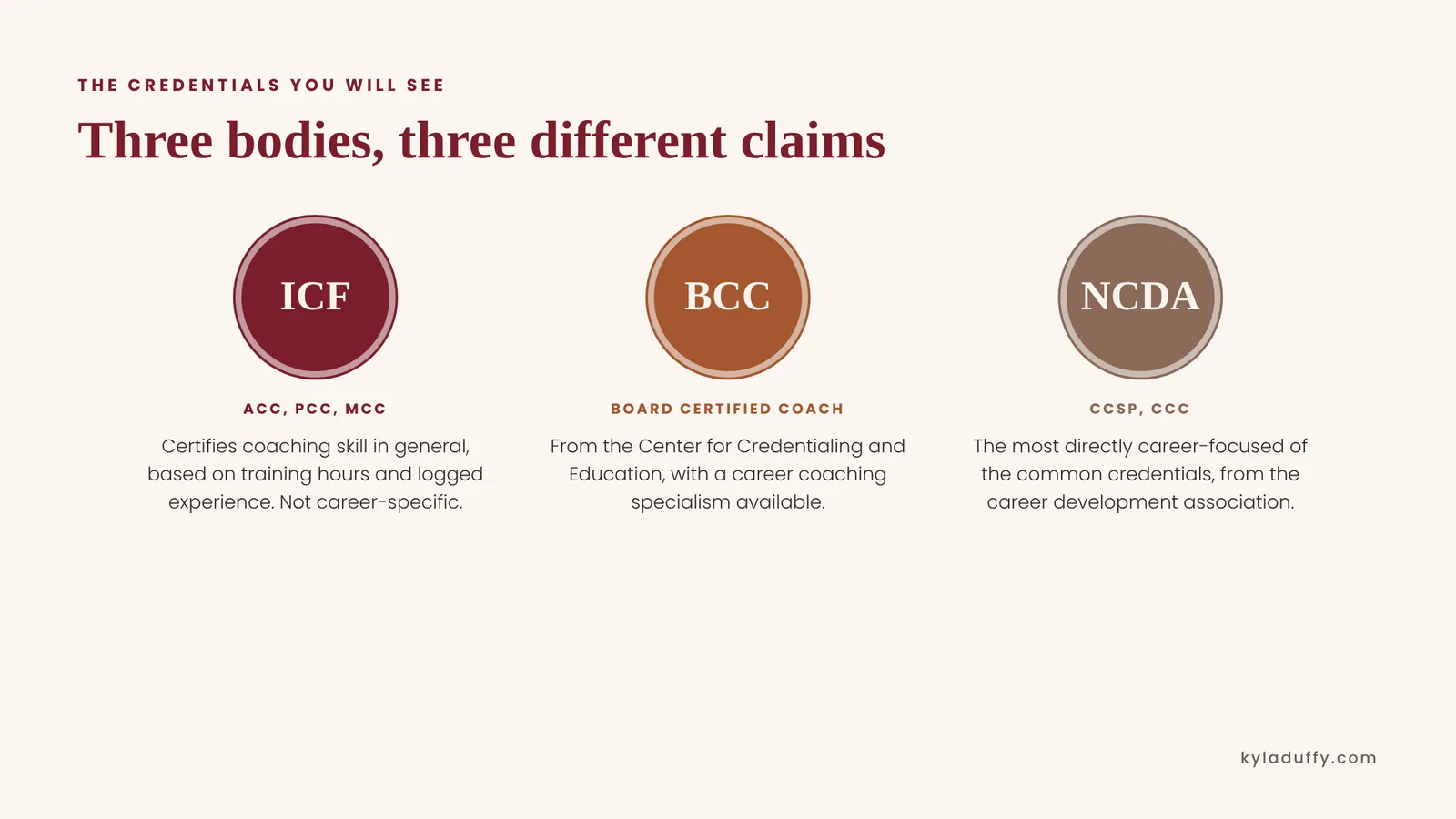
- ICF credentials (ACC, PCC, MCC). The International Coaching Federation offers three levels based on training hours, logged coaching experience, and an assessment. They certify coaching skill in general rather than career expertise specifically, which is an important distinction. An ICF-credentialed coach has demonstrated they can coach. Whether they know your industry is a separate question.
- Board Certified Coach (BCC). Offered by the Center for Credentialing and Education, with specializations available, including career coaching. It tends to sit closer to the counseling tradition.
- NCDA credentials. The National Career Development Association offers career-specific credentials such as Certified Career Services Provider and Certified Career Counselor. These are the most directly career-focused of the common options.
- Resume writing certifications. If your coach also writes resumes, you may see credentials from resume writing associations. These certify document craft rather than coaching.
If you are also hiring someone to write your resume, read what resume writer certifications mean, because the acronyms there follow entirely different rules.
What a certification proves, and what it does not
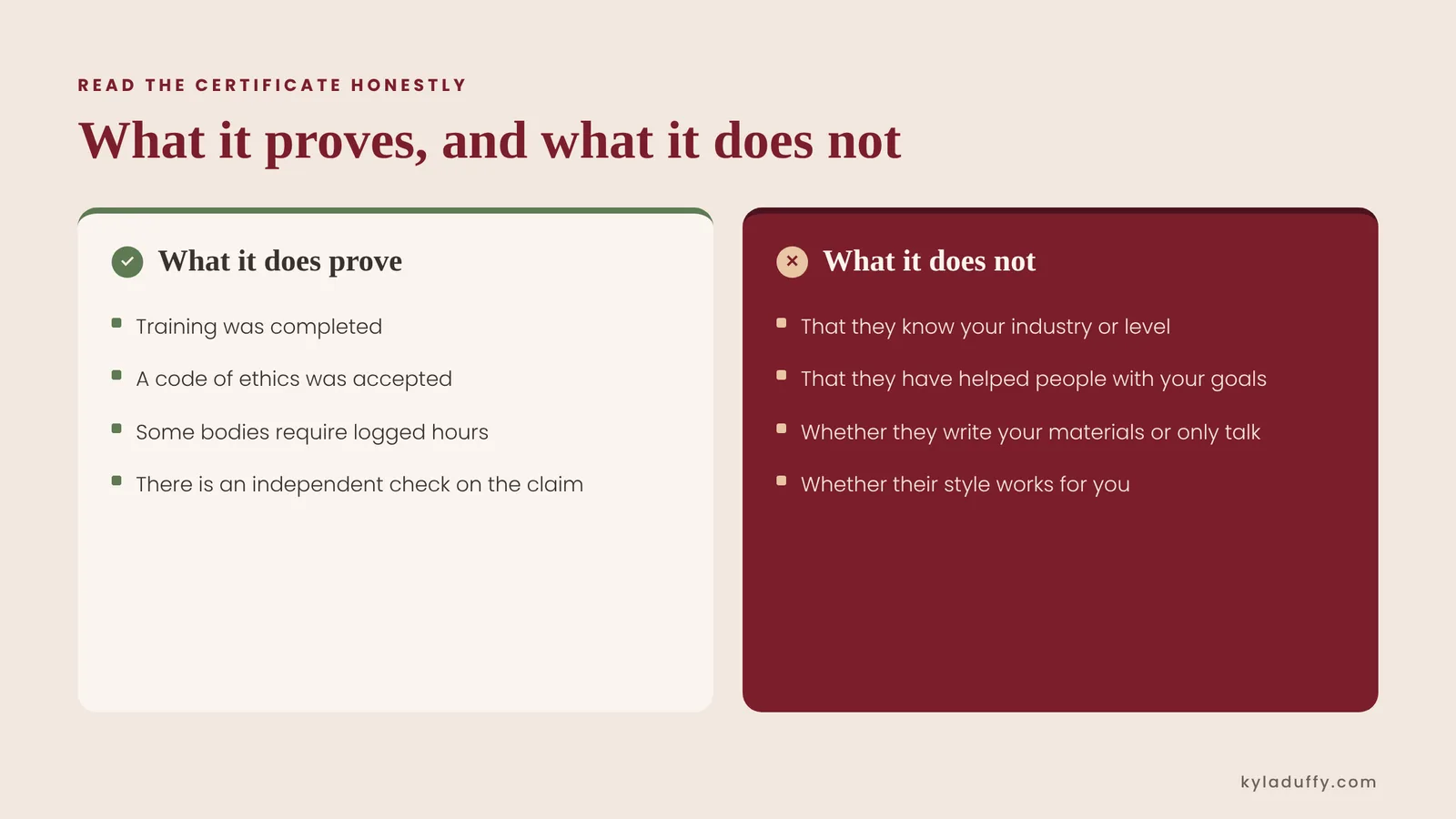
A certification tells you that a coach has invested time and money in training and has agreed to a code of ethics. Both are good signs, and neither is nothing.
Here is what it does not tell you.
- Whether they understand your industry, your function, or your career level.
- Whether they have helped people with goals like yours, as opposed to goals in general.
- Whether they will write your materials, or only talk through them with you.
- Whether their style works for you, which matters more than most people expect.
- Whether they will tell you something you do not want to hear.
There is a quieter issue too. Certification costs money and time, which means it partly measures who could afford the program. Some excellent coaches came up through recruiting, HR, or hiring management and never pursued a credential. Some credentialed coaches have never hired anyone in their lives. Use the certificate as one input, not as the filter.
What matters as much as a certificate
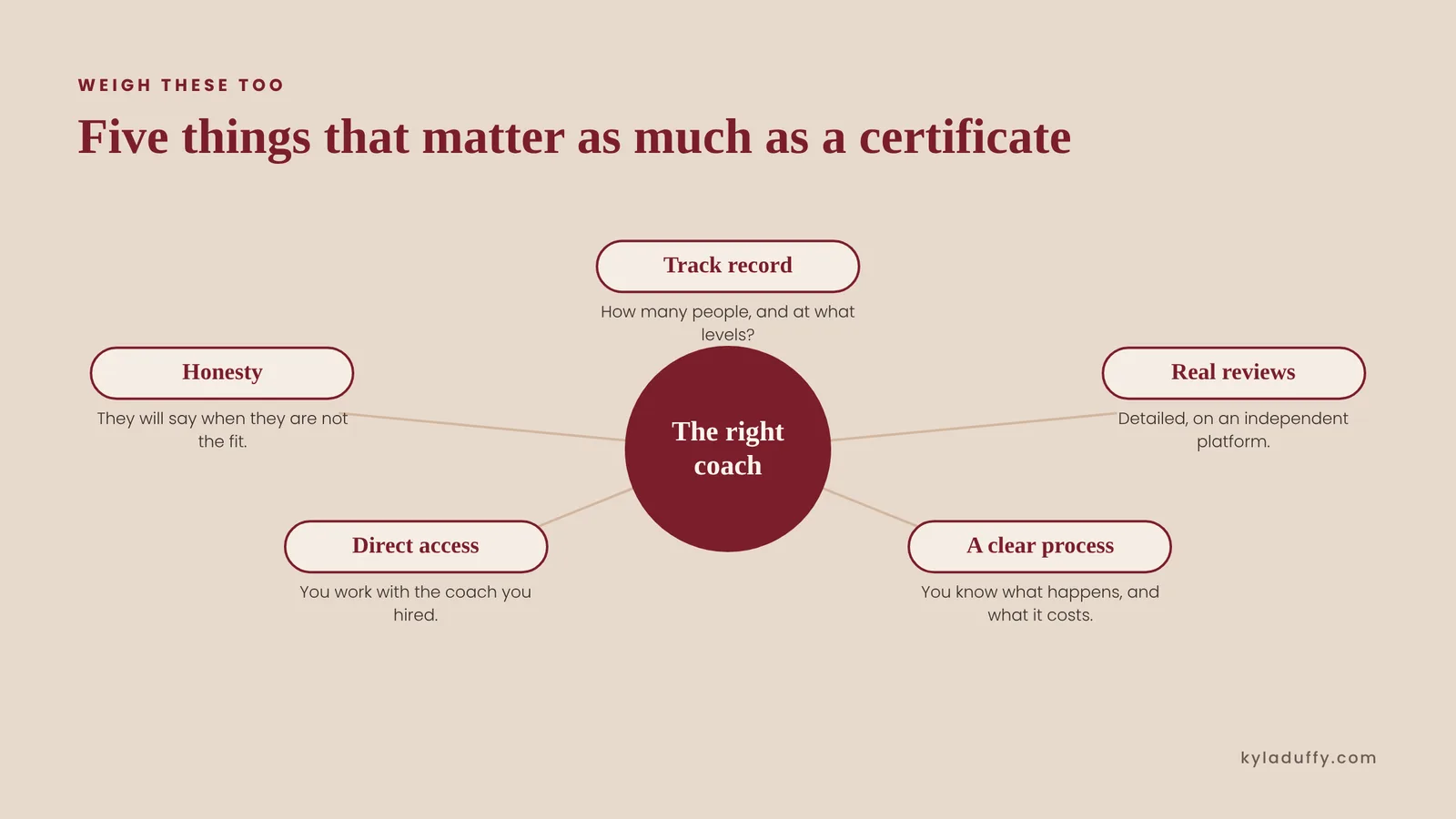
- Track record. How many people have they actually helped, and at what levels? Volume alone is not quality, and a coach who has seen hundreds of searches has pattern recognition that cannot be taught in a course.
- Real reviews. Look for detailed reviews on an independent platform such as Google. Detail is the signal. “Great coach” tells you nothing.
- A clear process. You should know exactly what happens, in what order, by when, and at what price, before you pay anything.
- Direct access. Will you work with the coach you hired, or be handed to someone else once the invoice clears?
- Honesty. A good coach will tell you when they are not the right fit, and will never promise you a job. Nobody can promise an outcome that a hiring committee controls.
For me, that looks like more than 11 years of resume writing and coaching, a master’s degree, over 4,000 professionals helped, and a 4.9-star average from 55 Google reviews. You work with me directly from your first call to your final draft, with no account managers and no junior writers. I would rather be judged on those than on an acronym.
Questions to ask before you hire a career coach
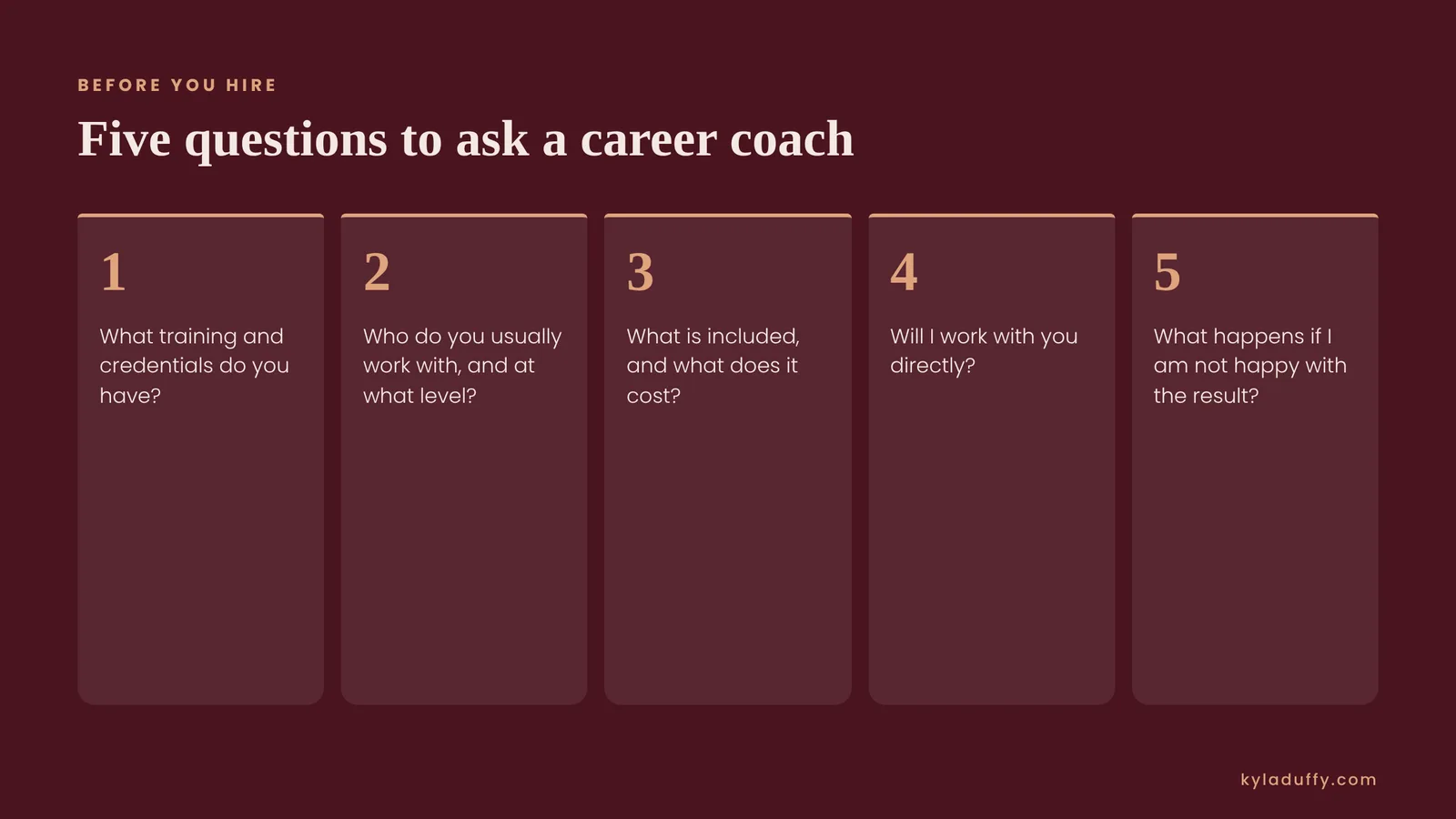
- What training and credentials do you have, and how do they apply to my situation?
- Who do you usually work with, and at what career level?
- What exactly is included, what is not, and what does it cost?
- Will I work with you directly?
- What happens if I am not happy with the result?
Listen for specifics in the answers. A coach who describes a process, names the kind of client they serve well, and tells you who they are not a fit for is thinking about your situation. A coach who answers every question with enthusiasm is thinking about the sale.
For more on deciding whether coaching is right for you at all, read what a career coach actually does and whether career coaching is worth it. If you are weighing coaching against counseling, career counseling vs. career coaching explains the difference properly.
How to shortlist a career coach in 20 minutes
You do not need to interview ten coaches. Here is a quick way to narrow the field without losing an evening.
- Check the website first. Can you tell who they help, what they do, and what it costs? If you cannot, that is useful information in itself. Hidden pricing usually means a long call designed to anchor you high.
- Read the reviews, looking for detail. “She helped me rewrite my story for a move into product management” tells you far more than “Great experience, highly recommend.”
- Look at their writing. A coach’s blog, LinkedIn presence, or guides show you how they think and whether their advice is practical or recycled. You are about to trust this person with your story, so read a few paragraphs of theirs first.
- Book a free call with your top two. Notice who asks better questions about you, rather than who talks longest about themselves. Notice, too, who is willing to say “you probably do not need that.”
Credentials belong in that picture. They are simply one part of it. The right coach is the one who understands your situation and gives you a clear, honest plan you can actually run.
Where credentials matter more, and where they matter less
It would be unfair to dismiss certification entirely, so here is the nuance I would apply.
Credentials matter more when the work is close to counseling: deep direction work, confidence, career identity after a long setback, or coaching inside an organization where a standard has to be demonstrated. They also matter more when you have no other way to assess somebody, because they are at least an independent check.
Credentials matter less when the work is practical and market-facing: positioning, resume and LinkedIn strategy, interview craft, and negotiation. Here, experience of how hiring actually happens tends to beat training hours. What you want is somebody who has read thousands of resumes and knows what makes a recruiter stop.
Professional bodies such as SHRM publish a great deal about how employers really screen and hire, and NACE does the same for early-career hiring. A coach whose advice lines up with what employers actually say they do is more valuable than one whose advice lines up with a curriculum.
What a good first session should feel like
Credentials aside, the fastest way to judge a coach is to notice what the first real conversation is like. A good one has a particular shape.
It starts with questions rather than a pitch. A coach who knows what they are doing will want your situation before they offer a solution, and the questions will get progressively more uncomfortable in a useful way: not just what you want, but why the last two attempts did not work, and what you have been avoiding.
It produces at least one idea you had not considered. Not a sales hook, an actual observation about your situation. If you leave the call with nothing new, that is information about what the paid version would be like.
It ends with a clear recommendation and a clear price. You should know what the coach thinks you should do first, what it costs, and what happens if you do nothing. Vagueness at this stage rarely improves after payment.
Coaching, resume writing, and interview coaching are different jobs
A lot of confusion about credentials comes from treating three different services as one. It is worth separating them before you decide what to buy.
Career coaching answers the question of direction: what next, and why that. It is the right starting point when you are unsure, stuck between options, or rebuilding after a setback.
Resume and LinkedIn writing answers the question of presentation: how your history reads to somebody deciding in ten seconds. It is the right purchase when you know your direction and the documents are not doing the job. If you are comparing providers, how to hire a resume writer and what a resume writer costs cover the market.
Interview coaching answers the question of delivery: whether you can tell the story convincingly under pressure. It is the right fix when you are reaching interviews and not converting them. See what an interview coach actually does if that is where you are stuck.
Plenty of people buy the wrong one of these three, usually because a document feels more tangible than a decision. Buying the right one is often the difference between a fast search and a long one. Practical question banks such as the Indeed Career Guide interviewing section are a decent free supplement to any of them, and commentary in Harvard Business Review is useful for the wider question of how careers are actually built.
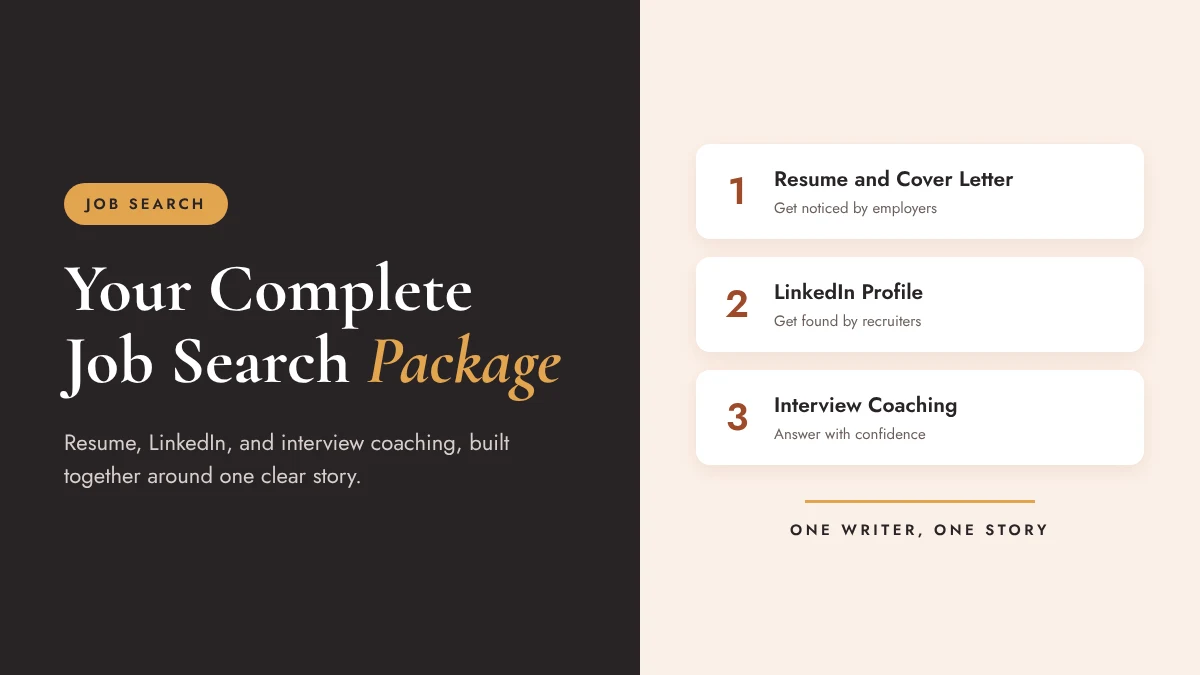
If you want all three handled together, my job search package covers resume, LinkedIn, and interview coaching from one person.
Red flags to watch for
- Guarantees. A promise of a job, an offer, or a specific salary. No coach controls a hiring decision, and anyone claiming otherwise is either naive or dishonest.
- Hidden pricing. Prices that only appear after a long sales call, or that change depending on how much you seem able to pay.
- Pressure. Urgency tactics, limited-time packages, or a push to sign up for a large program before you have discussed your situation properly.
- No real reviews. Only anonymous testimonials, or reviews that sit exclusively on the coach’s own website.
- Templates sold as strategy. If the deliverable is a document you could have downloaded, you are not buying coaching.
- No willingness to decline. A coach who is a perfect fit for every single inquiry is not assessing fit at all.
If you encounter outright scams rather than merely weak services, my post on resume writing scams covers the patterns to watch for and how to protect yourself.
If you are choosing between two coaches
At some point the shortlist comes down to two people who both seem credible, and the certificates stop helping. Three tiebreakers work better than another look at the credentials.
Who understood the problem faster? One of them will have grasped your actual situation more quickly, and usually described it back to you more accurately than you described it yourself. That is the one who will waste less of your time and money.
Whose plan survives contact with your calendar? A plan that assumes you have ten free hours a week is not a plan. The right coach builds around the life you actually have, including a current job, a commute, and the days when nothing gets done.
Who was willing to tell you something unwelcome? This is the strongest signal of the three. A coach who corrected one of your assumptions on a free call will keep doing it once you are paying, which is precisely what you are paying for.
If both pass all three tests, pick the one you would be comfortable sending a rough draft to at nine in the evening, because that is roughly what the working relationship looks like.
And if neither does, keep looking. There are plenty of good coaches, certified and otherwise, and the cost of hiring the wrong one is not just the fee. It is the weeks you spend following advice that was not built for your situation. If you are still weighing the decision itself, how to choose the right career coach walks through it in more detail.
Frequently asked questions
Do I need a certified career coach?
Certification is a helpful signal, and it is not the only one. Experience with people like you, detailed independent reviews, and a clear process matter at least as much, and sometimes more.
Which career coach certification is best?
There is no single best credential. ICF credentials focus on general coaching skill, while NCDA and BCC options are more career-specific. Look at the coach’s actual experience alongside whatever certificate they hold.
How much does a certified career coach cost?
Prices vary widely across the market. My rates are public: career coaching is $299 for my 14-day “Find Your Path” challenge, resumes run $199 to $599 by career level, and interview coaching is $125 a session or $299 for the full course. Every service is listed on my rates page, and how much a career coach costs covers the wider range.
Are you a certified career coach?
I hold a master’s degree and have spent more than 11 years writing resumes and coaching job seekers, with over 4,000 professionals helped and a 4.9-star average from 55 Google reviews. I would encourage you to weigh that track record, and my reviews, rather than any single acronym.
Is a career coach the same as a recruiter?
No. A recruiter works for the hiring company and is paid to fill a role. A career coach works for you, and the agenda is your next move rather than any particular vacancy.
How do I check a coach’s credential is real?
Most certifying bodies publish a public directory of current holders. If a credential matters to you, look the coach up rather than taking the logo on the website at face value.
Want to see if we are a good fit? Book a free strategy call, or read more about my career coaching services.
Related reading: what an executive career coach does, when to hire an MBA career coach, and AI career coach vs. human coach.