The most important resume dos and don’ts in 2026 are these: do tailor every resume to the specific job, quantify your accomplishments, and format for both a human reader and an ATS (the software that screens applications before a person ever sees them). Don’t use an objective statement, don’t list every duty you’ve ever had, and don’t assume a resume that worked five years ago still works now. Get those six right and you’ve already fixed what’s wrong with most resumes I see.
The Quick-Take Summary (bookmark this part)
- Do tailor your resume to each specific job a general resume gets you generally nothing.
- Do quantify your accomplishments with real numbers wherever you can find them.
- Do format for ATS compliance and human readability they’re not the same job, but they’re not in conflict either.
- Don’t open with an objective statement. It’s outdated and it wastes your best real estate.
- Don’t list every duty from every job. List impact instead.
- Don’t treat your resume as finished. It should evolve with every application that matters.
If you only read one section, that’s the one. Now let’s get into why each of these earns its spot on the list and the ones you’ve probably never questioned that deserve a second look.
What Do “Resume Dos and Don’ts” Actually Mean in 2026?
Here’s what I want to clear up first, because it trips people up constantly: resume advice isn’t one static list that’s been true since 1998. Some of the “rules” you learned from a well-meaning relative are actively working against you right now. (I say this with love. That relative meant well. That relative has also not applied for a job since dial-up internet.)
What’s actually changed and what hasn’t comes down to two audiences your resume has to satisfy, in this order:
- The Applicant Tracking System (ATS) software most companies use to scan, sort, and rank resumes before a human ever opens them. If your formatting confuses it, a strong candidate can get filtered out before anyone reads a word.
- The human being who opens it next a recruiter or hiring manager spending, realistically, about six to eight seconds on the first pass. Hiring teams continue to rely heavily on structured, keyword-driven screening precisely because there’s too much volume to read every resume in full on the first look.
A genuinely good resume gets through both gates. That’s the whole game not “creative” in a way that confuses software, and not “keyword-optimized” in a way that reads like a robot wrote it for other robots.
The Resume Dos That Actually Move the Needle
Do Tailor Every Resume to the Job
I know. I know you don’t want to hear this one again. But a general resume gets you generally nothing and tailoring to the job description isn’t about rewriting the whole document every time. It’s about making sure your language mirrors the role’s actual priorities, so both the ATS and the human recognize you as a match on sight.
Do Quantify Everything You Can
“Managed a team” tells me nothing. “Managed a 12-person team and cut onboarding time by 40%” tells me everything. Numbers are the fastest way to make an accomplishment feel real instead of vague and recruiters are trained to look for them specifically because vague self-description is exhausting to evaluate at scale.
Do Make It ATS-Compliant Without Making It Boring
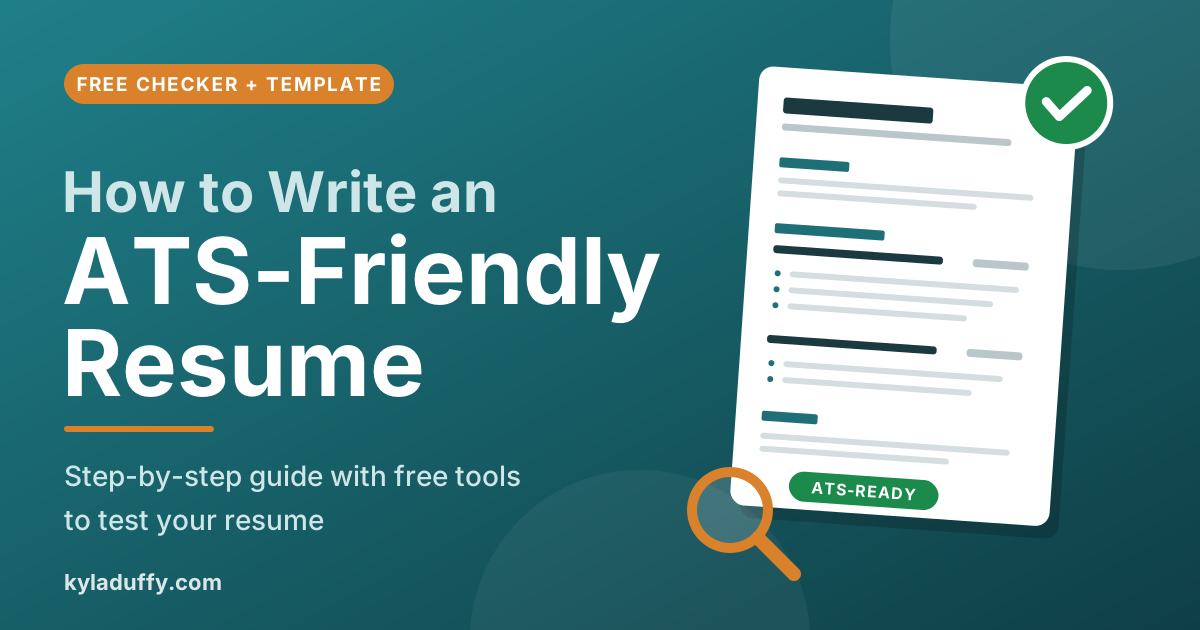
An ATS-compliant resume avoids tables, text boxes, headers/footers, and graphics that confuse parsing software but “ATS-compliant” doesn’t mean “visually dead.” Clean formatting and genuinely good writing aren’t mutually exclusive; they’re just two different problems solved in the same document.
Do Lead With What You Include on Purpose
Every line on your resume should be there because it earns its place, not because it’s chronologically accurate. What to include is as much a strategic decision as what to cut.
Do Write a Summary, Not an Objective
More on why in the Don’ts below but the short version is: a resume summary that leads with your value gets interviews in a way an objective statement structurally can’t.
Do Get the Header and Headline Right
The top third of your resume your name, your title line, your summary is doing the most work of any section, and it’s the section people rush through fastest to get to the “real” content. A strong header and headline tells a recruiter what you are before they’ve read a single bullet point. Get that wrong and everything below it has to work twice as hard to make up the difference.
#1 RULE FOR RESUME WRITING If a recruiter can’t tell what you’re good at within the first six seconds, nothing else on the page matters yet. Fix the top third of your resume before you touch anything else.
The Resume Don’ts That Are Quietly Costing You Interviews
Don’t Open With an Objective Statement
“Seeking a challenging position where I can utilize my skills” tells a recruiter absolutely nothing about you and uses your most valuable real estate to say it. Objective statements are a relic replace that space with a summary that leads with what you actually offer.
Don’t List Every Duty From Every Job
A bullet point that reads like a job description you copy-pasted from the posting itself isn’t telling me what you did it’s telling me what the role generally requires. Recruiters have seen the job description already; what they haven’t seen is what you specifically accomplished inside it.
Don’t Add a Photo (Almost Ever)
I’ve had this conversation more times than I can count, and the answer stays consistent: a photo on your resume does the opposite of what people think it does. In most U.S. hiring contexts, it introduces bias risk without adding a single useful data point about your qualifications.
Don’t Overdesign It
Bold colors, icons, sidebar graphics, creative fonts I understand the impulse to stand out visually. But graphics on a resume are one of the fastest ways to break ATS parsing, which means your beautifully designed resume may never make it to a human eye at all. Stand out with the writing. That part the software can’t mess up.
Don’t Send the Same Resume to Every Job
This is the flip side of “do tailor” above, and it’s worth calling out separately because it’s the single most common mistake I see: one resume, blasted at fifty different roles, with zero adjustments. The mismatch shows both to the software scanning for role-specific language and to the human who can tell within a paragraph that this wasn’t written with their role in mind.
Don’t Bury Your Credentials
Certifications and education matter, but only if someone can actually find them. How you present your credentials placement, wording, order affects whether they register as a strength or get skimmed past entirely.
Don’t Confuse “Different” With “Better”
There’s a version of this advice that swings too far the other way where someone reads “stand out” and decides the answer is an infographic-style resume with a skills chart and a sidebar timeline. There’s a real difference between a networking-style infographic resume and an ATS resume, and using the wrong one for the wrong situation is its own kind of mistake just a fancier-looking one.
Old Habit vs. Modern Fix: A Quick Reference
| Old-School Habit | What to Do Instead |
| Objective statement at the top | A summary that leads with your value and target role |
| Listing job duties | Quantified accomplishments tied to outcomes |
| One resume for every application | A tailored version matched to each job’s language |
| Headshot included | No photo let the writing do the work |
| Decorative graphics and tables | Clean, ATS-compliant formatting with strong writing underneath |
| Every job you’ve ever had, in full detail | Relevant experience prioritized; older or unrelated roles condensed |
How I Approach Resume Dos and Don’ts Differently
I don’t hand clients a generic checklist and send them off to self-edit. Every resume I write comes out of a live working session where we go accomplishment by accomplishment, together because most people are genuinely bad judges of their own best material. (You’ve been living inside your own career for years. Of course you’ve stopped noticing what’s actually impressive about it.)
That means:
- Tailoring isn’t an afterthought. Formatting and structure get built around your target role from the start, not retrofitted after the fact.
- We find the numbers you didn’t think you had. Most people say “I don’t really have metrics for what I do.” Almost everyone does, once we dig you just haven’t had to articulate them out loud before.
- ATS compliance and good writing happen in the same pass. You don’t get a “safe but boring” resume, and you don’t get a beautiful resume that a screening tool can’t read. Both requirements get solved simultaneously, not traded off against each other.
- We’re honest about what’s actually hurting you. If your resume isn’t landing interviews and the real issue is your LinkedIn profile, your target roles, or your application volume I’ll tell you that instead of just polishing prose that was never the actual problem.
None of this is a knock on doing your own resume edits plenty of the fixes on this list are things you can absolutely do yourself once you know to look for them. Where a second set of eyes tends to matter most is exactly where self-editing is hardest: deciding which of your own accomplishments are actually the impressive ones, and which details you’re keeping out of habit rather than strategy.
What This Means for Your Job Search
Here’s the honest, slightly deflating truth: getting the dos and don’ts right doesn’t guarantee an interview. What it does is remove the reasons a qualified recruiter would pass on you for something that had nothing to do with your actual qualifications confusing formatting, buried accomplishments, a summary that says nothing.
Entry-level and early-career hiring trends shift constantly, and so does what “modern” resume formatting even means which is exactly why treating your resume as a document you wrote once and never revisit is one of the quieter mistakes on this whole list. The job market itself moves; your resume needs to move with it. Broader labor market data backs up what most job seekers already feel anecdotally: competition for good roles hasn’t gotten gentler, which makes every one of these small fixes matter more, not less.
If your resume is solid but the interviews still aren’t coming, it’s worth looking at your resume and LinkedIn profile together rather than assuming the resume alone is where the problem or the fix lives.
There’s also a version of this that applies even if you’re not actively job hunting right now. A resume that’s already tailored and ready even loosely, even as a strong draft means you’re not scrambling to build one from scratch the moment an opportunity appears out of nowhere. The hidden job market tends to move fast when it moves at all, and the people who benefit most are usually the ones who weren’t starting from zero.
FAQs About Resume Dos and Don’ts
What’s the single biggest resume mistake people make? Sending the same untailored resume to every job. It’s the root cause behind several other mistakes on this list, because a generic resume almost always defaults to vague duty-listing instead of role-specific, quantified accomplishments.
Should I still include an objective statement? No. Replace it with a resume summary that leads with your value and target role objective statements are outdated and waste prime resume real estate that could be doing actual work for you.
Is it ever okay to include a photo on my resume? In most U.S. hiring contexts, no it introduces bias risk without adding relevant qualification data. Norms differ in some other countries and industries, so this isn’t a universal rule everywhere, but it’s the safer default for most applicants.
Do I need a different resume for every single job I apply to? You need a tailored version for every job that actually matters to you not a from-scratch rewrite each time, but adjustments to language and emphasis so it mirrors what that specific role is asking for.
What does “ATS-compliant” actually mean? It means your resume’s formatting can be accurately read by the applicant tracking system software companies use to scan and sort applications avoiding tables, text boxes, and graphics that can scramble how your information gets parsed.
How long should my resume be? Long enough to show relevant impact, short enough that nothing on the page is filler. For most professionals that’s one to two pages simplifying rather than padding tends to be the harder and more valuable skill.
Should I list every job I’ve ever had? No relevance matters more than completeness. Older or unrelated roles can be condensed or summarized rather than given full bullet treatment, which keeps the focus on what’s actually relevant to the job you want next.
Can AI tools write my resume for me? AI can help with a first draft or a formatting check, but it doesn’t know which of your accomplishments are genuinely impressive versus generically stated that distinction still requires a human who knows how to ask the right questions.
Fix What’s Actually Costing You Interviews
If you’ve read this list and recognized three or four of your own habits in it, that’s not a bad sign it just means you know exactly where to start. The harder part isn’t knowing the rules; it’s seeing your own resume clearly enough to apply them, which is genuinely difficult to do about yourself.
That’s the gap professional resume writing is built to close a resume rebuilt around your real accomplishments, tailored to your target role, and formatted to get through both the ATS and the six-second human scan. Whether you’re early in your career or leading a team, there’s a version of this built for where you are right now.
Schedule your free consultation and let’s fix what’s actually holding your resume back.