My honest opinion: the biggest age bias on many resumes over 50 is self-inflicted. “30+ years of experience.” Graduation years from decades ago. A list of software nobody’s used since dial-up. None of it is wrong, but all of it invites the reader to do math instead of noticing your value.
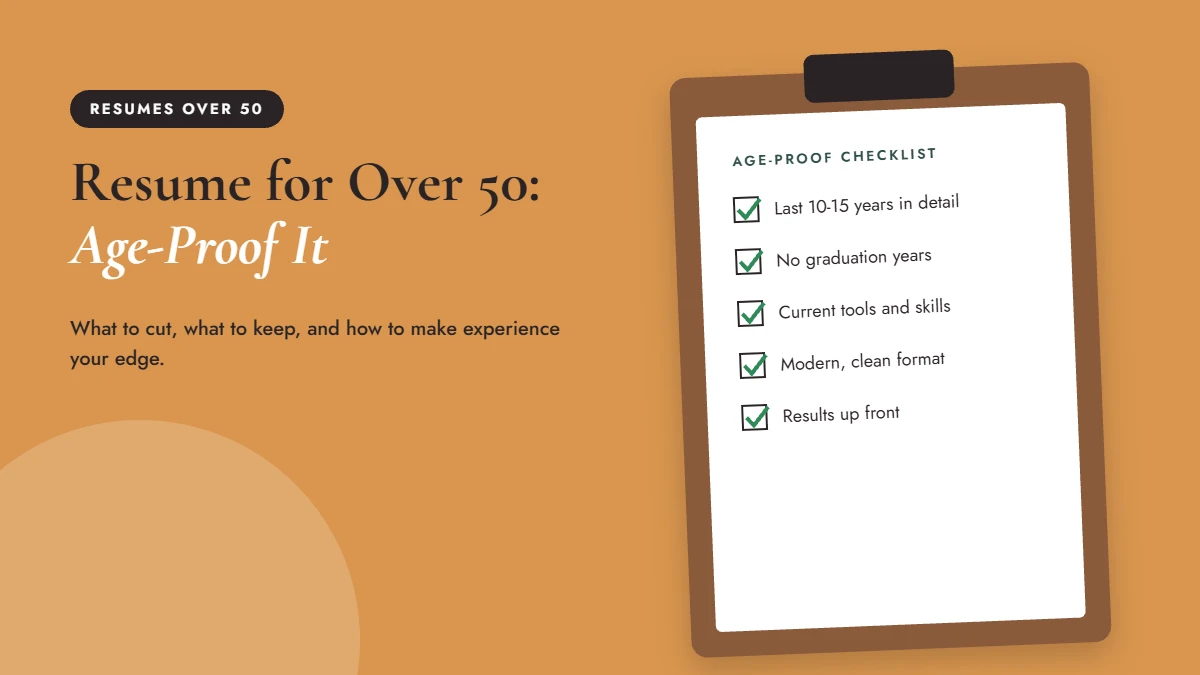
So how do you write a resume for over 50 that works? Focus on the last 10–15 years, lead with recent results and current skills, remove details that date you without adding value, and use a clean, modern format, so your experience reads as an advantage, not a liability.
What Should I Cut, and What Should I Keep?
Quick answer: Keep recent, relevant results and current skills. Cut graduation years, outdated tools, and early-career detail that doesn’t support your target role.
| Keep | Cut or condense | Why |
|---|---|---|
| Last 10–15 years in detail | Early roles (summarize) | Relevance beats completeness |
| Degrees and certifications | Graduation years | Avoids invitations to calculate age |
| Current tools and skills | Outdated software | Signals you’re current |
| Results and scope | Year counts in the summary | Impact is more persuasive than tenure |
| Modern format | Objective statements | Looks current and reads fast |
Wondering whether your resume reads as “seasoned” or “dated”? That’s one of the first things I check. A free resume review is a quick, honest way to find out.
How Should My Summary Read?
Lead with the problems you solve and recent proof, not a year count. Here’s how to write a summary that gets interviews, and why objective statements date a resume.
Should I Stay in My Field or Change Direction?
- Stay if your experience is in demand and you enjoy the work; focus on modernizing your materials.
- Shift roles if you want a different pace or scope; see career change at 50.
- Consider consulting or contract work if you want flexibility and can sell your expertise.
How Do I Show I’m Current?
- List recent training and certifications.
- Include the tools you actually use today.
- Keep an active LinkedIn presence; start with my LinkedIn checklist and check your LinkedIn photo.
- Use a clean format; here’s resume formatting for 2026.
In the U.S., the EEOC explains protections against age discrimination for people 40 and older. Bias can still happen, so presentation matters. The Occupational Outlook Handbook helps you research roles, and Harvard Business Review’s career planning articles are good reading on later-career moves.
Getting Help
Most of my clients over 50 fit my senior-level or executive-level resume services, part of my resume writing service. Resumes range from $199 to $599 depending on experience (see rates).
Questions I Get Asked a Lot
How far back should a resume go if I’m over 50?
Usually 10 to 15 years in detail. Earlier roles can be summarized briefly if they add credibility.
Should I remove graduation dates?
Many experienced professionals do. Your degree still counts without the year.
How do I show I’m current?
List recent training, tools, and certifications, use a modern format, and lead with recent results.
Should I mention years of experience in my summary?
It’s usually better to lead with the problems you solve and recent impact than a year count.
Is age discrimination legal?
In the U.S., federal law protects applicants and employees age 40 and older from age discrimination. Bias can still happen, which is why presentation matters.
Should my resume be one page?
Two pages is normal for experienced professionals, as long as every line is relevant.
What email address should I use?
A simple, professional address with your name, from a current provider.
Make Your Experience Your Edge
Decades of experience should help you, not hold you back. Get a free resume review, and I’ll show you the five changes that will make your resume feel current.