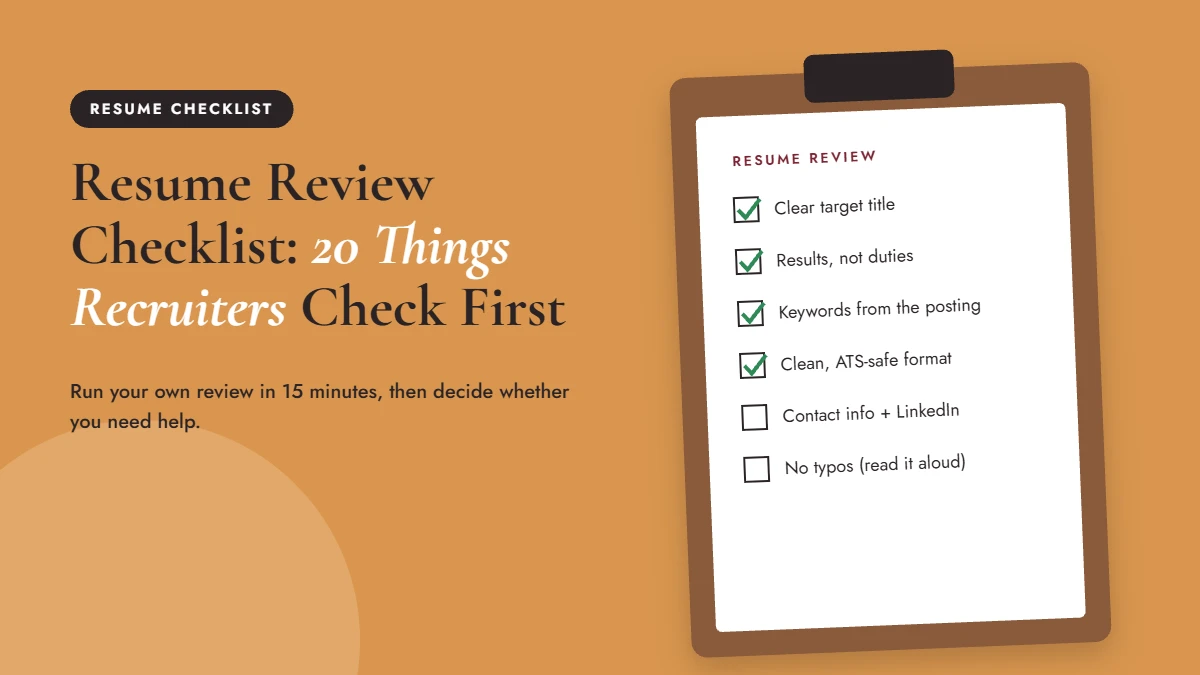
A resume review is a quick, structured check of your resume against what recruiters and applicant tracking software actually look for. The fastest way to do it is to start where recruiters start, the top third of the page, and work down through results, keywords, format, and polish. Use the 20-point checklist below, fix what fails, and then decide whether you need outside help.
One term to know before we dive in: an applicant tracking system (ATS) is the software many employers use to collect, store, and search resumes. Some of the checks below are for human eyes; some are for the software. You need to pass both.
Key takeaways
- Recruiters often skim quickly on a first pass, so your target role and value need to be obvious in the top third.
- Results beat responsibilities, every time.
- Keywords from the job posting help both the software and the human reader.
- Simple formatting is safer than clever formatting.
- If more than five items below fail, it’s usually time for a deeper rewrite, not a quick polish.
The 20-Point Resume Review Checklist
Print your resume (or open it next to a job posting you want) and go through these in order. Each one includes why it matters, so you know what you’re really checking.
The top third: what gets read first
- Your name and contact details are easy to find. Phone, professional email, city and state, and a LinkedIn URL. Why it matters: if they can’t reach you easily, nothing else counts. (A clean LinkedIn URL helps; here’s how to customize yours.)
- There’s a clear target title near the top. Why it matters: it tells the reader which box to put you in. My guide to writing a resume header that gets noticed shows how.
- Your summary is specific to you. If it could describe anyone in your field, it’s not doing its job. Why it matters: it’s your one chance to frame everything below it. See how to write a resume summary that gets interviews.
- No outdated objective statement. Why it matters: objectives talk about what you want; employers want to know what you offer. (Here’s my take on resume objective statements.)
- Your strongest qualification appears in the first few lines. Why it matters: many readers decide whether to keep going right here.
Experience: the proof
- Bullets start with strong verbs, not “responsible for.” Why it matters: verbs show action and ownership.
- At least half of your bullets include a result. Numbers, percentages, time saved, money made, problems solved. Why it matters: results are how a recruiter compares you to other candidates. Here’s how to write powerful resume bullets.
- Your most relevant achievements come first under each role. Why it matters: people read top-down and stop early.
- Each role shows scope. Team size, budget, number of clients, regions. Why it matters: scope tells the reader your level without you having to say it.
- Older roles are trimmed. Detail for roughly the last 10–15 years; earlier roles summarized. Why it matters: relevance beats completeness.
Keywords and skills: matching the job
- The posting’s key terms appear naturally in your resume. Why it matters: recruiters search databases by keyword, and they skim for the same words. See my resume keywords guide.
- Your skills section lists real, relevant skills. No “hard-working” or “team player” filler. Why it matters: soft-skill claims are invisible; proof in your bullets is not.
- Credentials are shown correctly. Certifications that matter for the role are easy to spot. (Wondering about letters after your name? Here’s when to put credentials after your name.)
- No keyword tricks. Hidden text or pasted job descriptions are a bad idea; I explain why in the truth about invisible job descriptions on resumes.
RULE: Write for the job you want, not the job you had. Every line should help a specific hiring manager say yes. If it doesn’t, cut it or rewrite it.
Format and ATS: getting read at all
- Standard section headings. “Experience,” “Education,” “Skills.” Why it matters: software and skimmers both look for familiar labels.
- No text boxes, tables for layout, or important info in headers and footers. Why it matters: some systems can’t read them reliably. My ATS-friendly resume guide covers the details.
- Graphics are minimal or absent. Why it matters: skill bars and icons can confuse software and rarely persuade humans. More in graphics in resumes.
- Consistent, readable formatting. One or two fonts, consistent dates, plenty of white space. See resume formatting for 2026.
Final polish
- Zero typos. Read it out loud, backwards if you have to. Why it matters: errors suggest carelessness, fairly or not.
- The file is named professionally and saved in the requested format. “FirstName-LastName-Resume.pdf” (or .docx if requested). Why it matters: small details signal that you pay attention.
For a longer list of what trips people up, here are the most common resume mistakes I see.
Scoring Your Resume Review: What to Do Next
Count how many items your resume failed. Then use this to decide your next move:
| Items failed | What it usually means | Best next step |
|---|---|---|
| 0–2 | Your resume is in good shape | Fix them yourself and tailor for each role |
| 3–5 | Solid foundation, some weak spots | DIY fixes, plus a second opinion |
| 6–10 | Framing or structure problems | A focused rewrite |
| 11+ | The resume isn’t representing you | Start fresh, ideally with help |
Fix It Yourself, Ask a Friend, or Get Professional Resume Help?
Each option has a place. Here’s how to choose:
- Choose DIY if you failed only a few items, you’re targeting roles similar to your current one, and you have time to tailor each application.
- Choose a trusted friend or mentor if they hire in your field. A peer who doesn’t hire will tell you if it “looks nice,” which isn’t the question.
- Choose a free professional review if you’re not sure what’s wrong, you’re getting few or no interviews, or you want an expert’s priority list before investing time or money.
- Choose a full rewrite if you failed many items, you’re changing direction, or you’re stepping up a level. That’s what my resume writing service is built for.
Want an expert to run this review for you? Get a free 5-point resume review and I’ll send your top five fixes within two business days.
If you want to understand the hiring side better, SHRM’s recruiting resources show how employers structure hiring, and LinkedIn’s Talent Blog shares what recruiters are being taught to look for. Students and recent grads will find useful hiring-trend context from the National Association of Colleges and Employers.
“Kyla was really wonderful to work with! She was very personable as well as professional. I was honestly shocked how quickly she was able to meet my needs while maintaining a high quality of work.”
— Becca Howard, Google review
Frequently Asked Questions
What is a resume review?
A resume review is a structured check of your resume against what recruiters and applicant tracking systems look for: clarity, relevance, results, keywords, and formatting. It tells you what to fix before you send another application.
How long do recruiters spend looking at a resume?
On a first pass, recruiters often skim quickly, sometimes for just a few seconds, before deciding whether to read more. That’s why the top third of your resume needs to make your target role and value obvious immediately.
Can I review my own resume?
Yes, and this checklist is designed for that. The hardest part is objectivity, so it helps to read your resume as if you were the hiring manager for one specific job, or to get a second set of eyes.
Where can I get free resume help?
Many colleges and public workforce centers offer free reviews. I also offer a free 5-point resume review: upload your resume and I’ll send the five changes I’d make first, within two business days.
What is the most common resume mistake?
Listing duties instead of results. A resume that describes what a job required, rather than what you achieved in it, makes it hard for a recruiter to see why you’re the better candidate.
Should my resume be one page or two?
It depends on experience. One page usually works for early-career candidates; two pages is normal for experienced professionals. What matters most is that every line is relevant to the role you want.
How often should I review my resume?
Before every job search, and ideally a quick check every six months while you’re employed. Adding wins as they happen is much easier than reconstructing them years later.
Let Me Run the Review for You
Checklists are great, but it’s hard to be objective about your own story. Upload your resume for a free resume review, and I’ll personally send you the five things I’d change first. No call, no pitch, just a clear priority list you can act on today.