Jordan (a composite, not a real client) is a seventh-year associate. On paper, everything’s on track: strong reviews, a partnership conversation on the horizon. In reality, Jordan dreads Monday mornings and spends evenings googling “jobs for former lawyers.” The question isn’t whether Jordan is good at law. It’s whether Jordan wants the next ten years to look like the last seven.
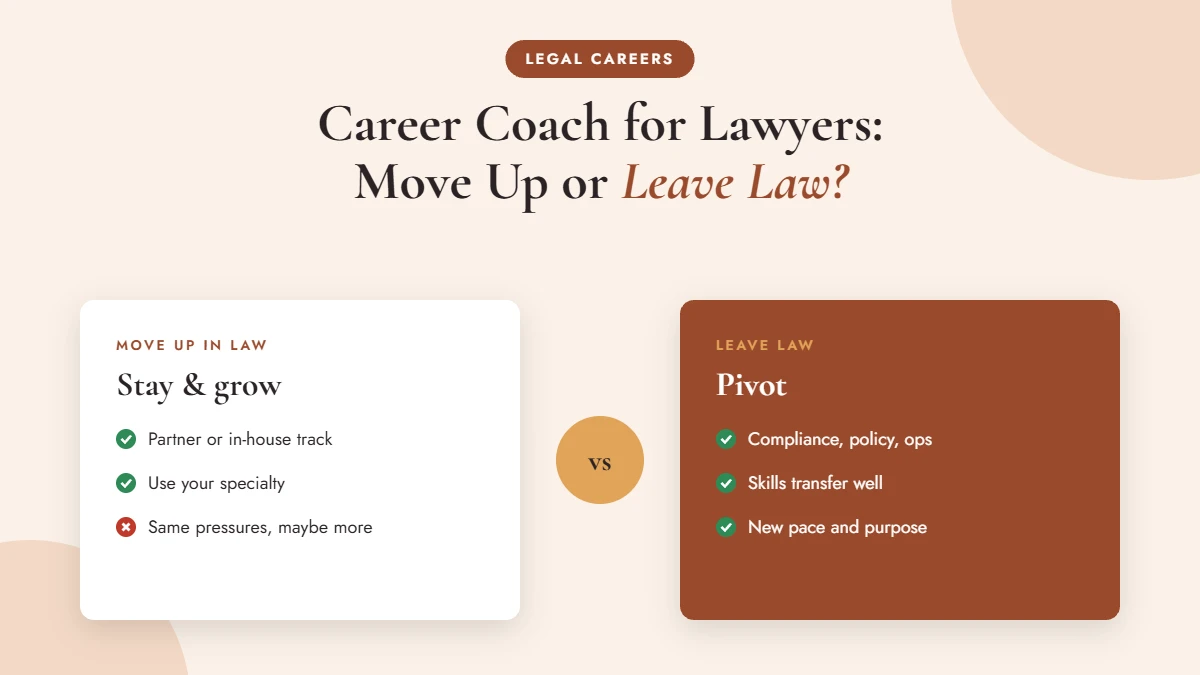
A career coach for lawyers helps you answer exactly that. The decision usually comes down to three paths: move up in your current setting, move sideways to a different legal environment (like in-house or government), or leave law for a field where your skills transfer, and the right choice depends on what’s draining you and what still energizes you.
Quick definitions: in-house means working as a lawyer inside a company rather than at a law firm. JD-advantage roles are jobs where a law degree is valuable but not required, like compliance or policy.
Your Options, Compared
| Path | What changes | Good fit if… |
|---|---|---|
| Move up (partner, senior counsel) | More responsibility, often more pressure | You like the work and the setting |
| Move sideways (in-house, government, nonprofit) | Different pace, clients, and culture | You like law but not your environment |
| JD-advantage role | Legal skills in a business or policy setting | You like the thinking, not the practice |
| Full pivot | New field entirely | The core of the work drains you |
How to Decide: Questions to Ask Yourself
Is it the work or the setting?
If you still enjoy analysis, advocacy, or deal-making but hate the billable-hour culture, a different setting may be enough. If the work itself drains you, look further afield.
What do people rely on you for?
Negotiation? Risk judgment? Explaining complex things simply? Those strengths point toward roles that will feel natural.
What does your runway look like?
Some moves can happen quickly; others take time and possibly a pay adjustment at first. Knowing your constraints shapes the plan.
If you only remember one thing: leaving law is not starting over.
- Analysis, writing, negotiation, and judgment transfer to many fields.
- The work is translating them into the language of your next role.
If you’re turning these questions over and over without landing anywhere, that’s a very normal place to be, and it’s where an outside view helps. You can book a free consultation to talk through your options confidentially.
Translating Legal Experience
Attorneys often undersell themselves outside law because their resumes are full of jargon. Translate into outcomes. An illustrative example: “Drafted and negotiated commercial agreements” becomes “Negotiated 50+ commercial agreements, reducing contract cycle time and protecting the company from key liability risks.” My guide to writing a career change resume walks through the process, and here’s how to position yourself for a new field.
Your LinkedIn profile needs the same translation; start with my LinkedIn profile optimization checklist.
Testing Before You Leap
- Talk to five former lawyers in roles you’re curious about.
- Take on a project at work that touches the new area (compliance, operations, policy).
- Explore roles in the Occupational Outlook Handbook, such as compliance or management analysis.
If you’re also exhausted, read my guide for those weighing a career coach for burnout. And if fear of a pay cut is holding you back, my post on not downgrading your search may help.
Harvard Business Review’s career planning articles are excellent for thinking about reinvention, and SHRM’s recruiting resources show how employers in other fields hire.
Not sure what coaching involves? Here’s what a career coach actually does, and you can see all my offerings on the services page.
How I Work With Attorneys
My career coaching starts with a 14-day “Find Your Path” challenge ($299) that takes about 15 minutes a day, which fits even a demanding legal schedule. From there, we can rewrite your resume and LinkedIn and prepare for interviews. If you’re senior, an executive bio can help with board or leadership opportunities. See all options on my rates page and read signs you need a career change coach.
Questions I Get Asked a Lot
What does a career coach for lawyers do?
A legal career coach helps attorneys clarify whether to advance in law, move to a different legal setting, or leave law, then builds a plan, materials, and a networking strategy to get there.
What jobs can lawyers do outside of law?
Common paths include compliance, risk, policy, contracts and procurement, operations, consulting, HR and employee relations, privacy, and roles in legal technology. The right fit depends on your strengths and interests.
Is it a mistake to leave law?
Not if it’s a considered decision. Many attorneys build fulfilling careers in adjacent fields. The key is to test options before leaving, so you’re moving toward something rather than only away.
How do lawyers rewrite their resume for a non-legal job?
Translate legal work into business outcomes: risk reduced, deals closed, processes improved, stakeholders advised. Cut jargon and lead with transferable strengths.
Should I go in-house instead of leaving law entirely?
In-house roles can offer more business involvement and a different pace while using your legal training. They’re worth exploring before a bigger leap.
How long does it take to leave law?
It varies. Adjacent moves like compliance or in-house roles can happen in months; bigger pivots can take longer. A coach helps you choose a realistic path.
Do you coach attorneys specifically?
I coach professionals across fields, including attorneys considering their next move, with a focus on clarity, translation of experience, and a practical plan.
Let’s Figure Out Your Next Chapter
Whether you want to make partner, go in-house, or leave law entirely, you deserve a clear, confident plan. Book a free consultation, and let’s talk through where you are and where you want to be.