I’ll say the quiet part out loud: most executive resumes I see undersell the executive. Brilliant leaders who’ve run divisions, turned around teams, and grown revenue hand me documents that read like job descriptions from 2009. “Responsible for.” “Oversaw.” “Results-driven.” It drives me a little bit up the wall, because the fix is usually right there in their own heads.
That’s why I put together these executive resume examples. Below you’ll find before-and-after rewrites of the sections that matter most, each with the reasoning behind the change. The pattern you’ll see: strong executive resumes lead with scope and measurable outcomes, cut anything that doesn’t support the next role, and stay clean enough to pass applicant tracking software.
One important note: every example here is illustrative. They’re composites built to show technique, not real clients’ resumes, and the numbers are placeholders. Yours should come from your own record.
What Makes an Executive Resume Different?
Quick answer: An executive resume proves business impact at scale. Where a mid-level resume shows you did the job well, an executive resume shows you changed the trajectory of a team, a function, or a company, and it makes the size of what you led (people, budget, revenue, geography) obvious in seconds.
A few terms you’ll see below. Scope means the size of your responsibility: headcount, budget, P&L, number of sites or markets. A P&L (profit and loss) role means you were accountable for both revenue and costs. And an applicant tracking system (ATS) is the software many employers and recruiters use to store and search resumes, which matters even at the C-suite level.
Five Executive Resume Myths, Rewritten
Myth 1: “My years of experience speak for themselves.”
Reality: Years are a number. Impact is a story. Leading with a year count invites the reader to do math about your age instead of thinking about your value.
Before (summary): “Results-driven executive with 25+ years of experience in operations and supply chain. Proven leader with strong communication and strategic planning skills.”
After (summary): “Operations executive who turns complex, multi-site supply chains into reliable growth engines. Led a 600-person, 9-facility network through a consolidation that cut costs and improved on-time delivery. Trusted by boards and PE sponsors to stabilize operations during rapid change.”
Why it works: The “after” names the kind of problem this person solves, gives scope (600 people, 9 facilities), and hints at results and audience (boards, PE sponsors). Every adjective was replaced with evidence.
Myth 2: “Listing my responsibilities shows how senior I am.”
Reality: Responsibilities show what the company expected. Recruiters want to know what you delivered.
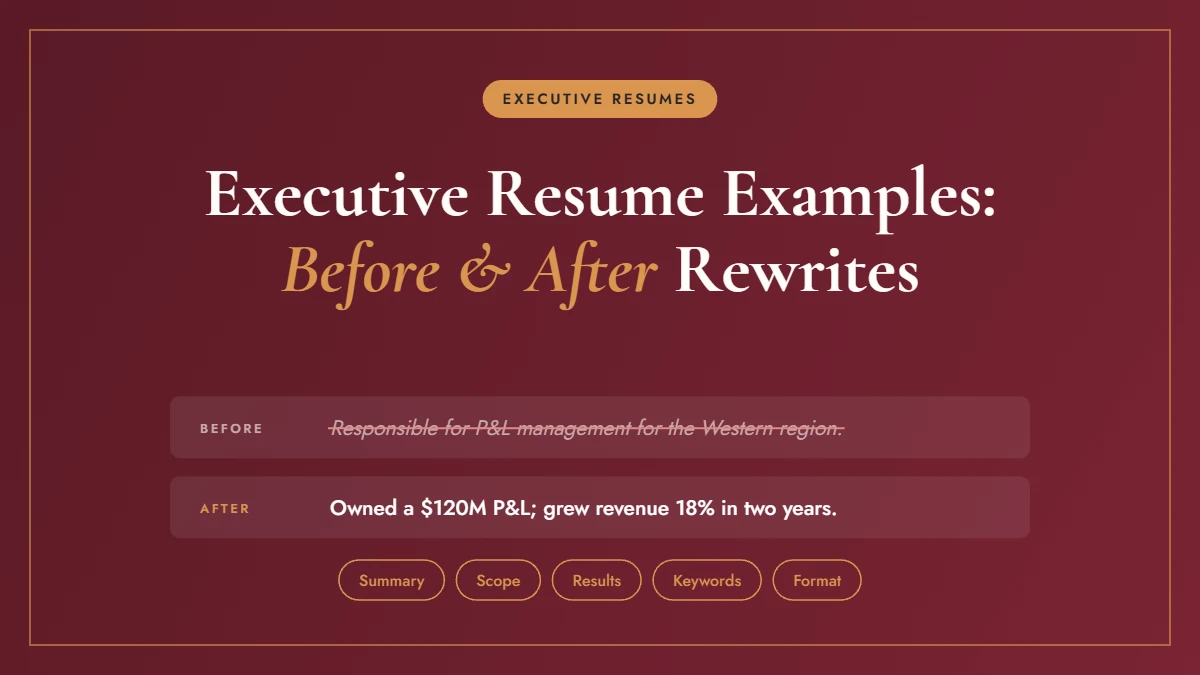
Before (bullet): “Responsible for P&L management for the Western region.”
After (bullet): “Owned a $120M Western region P&L; grew revenue 18% in two years while reducing operating costs 7% by restructuring the sales territory model.”
Why it works: Scope, result, and how, all in one line. This is what recruiters mean when they talk about the one thing they want to see on your resume: proof.
Myth 3: “Executives don’t need to worry about keywords.”
Reality: Executive searches still run through databases, recruiter searches, and applicant tracking systems. If your resume says “people leader” and every search says “VP of Human Resources,” you’re invisible.
Before (headline): “Strategic Visionary | Change Agent | Thought Leader”
After (headline): “Chief People Officer | Talent Strategy, M&A Integration & Culture Transformation | Healthcare and Life Sciences”
Why it works: The “after” uses the exact titles and terms recruiters search for, plus an industry anchor. My guides to resume keywords and to writing a resume header that gets noticed go deeper.
Reading these and recognizing your own “before” lines? You’re in very good company. If you’d like a second set of eyes on your executive resume, book a free consultation and we’ll talk about where you’re headed and what your resume needs to say to get you there.
Myth 4: “A heavily designed resume signals seniority.”
Reality: Two-column layouts, icons, and skill bars can look sharp to humans and turn into scrambled text for software. Polish comes from writing and white space, not graphics. I’ve explained the trade-offs in graphics in resumes. If you want a designed version for networking, keep a clean ATS version too; here’s the difference between a networking resume and an ATS resume.
Myth 5: “Board and advisory work is a side note.”
Reality: For senior leaders, governance experience is a differentiator. It shows judgment, strategic perspective, and trust from peers.
Before: “Board member, local nonprofit (2019–present).”
After: “Board Director and Finance Committee Chair, regional food bank: guided a capital campaign and the shift to a multi-year funding model during a period of rapid demand growth.”
Why it works: Role, committee, and outcome. It now reads like governance experience, not a hobby.
The Changes at a Glance
| Section | Common “before” | Stronger “after” |
|---|---|---|
| Summary | Years of experience + adjectives | The problem you solve + scope + proof |
| Bullets | “Responsible for…” | Scope + measurable result + how |
| Headline | Abstract labels (“visionary”) | Searchable titles + specialties + industry |
| Design | Columns, icons, skill bars | Clean, ATS-friendly layout with strong typography |
| Board work | One-line mention | Role, committee, and outcome |
| Length | Every role since the first job | Detail for 10–15 years; earlier career summarized |
How to Use These Executive Resume Examples on Your Own
- Write your target first. Name the exact title and type of organization you want next. Everything on the page should support that.
- Collect your numbers. Revenue, cost, headcount, budget, retention, time saved. If you don’t have exact figures, use honest ranges or relative change.
- Rewrite your summary last. It’s easier once your bullets are strong.
- Check it against the market. The BLS Occupational Outlook Handbook entry for top executives is a useful plain-language description of what senior roles involve, and SHRM’s recruiting resources show how organizations approach hiring.
- Align your LinkedIn. Your LinkedIn About section should tell the same story in a warmer, first-person voice.
For the leadership-and-strategy side of the next move, Harvard Business Review’s career planning articles are a smart companion read.
When to Bring in a Professional
Some executives write excellent resumes themselves. Many don’t have the time or the distance to see their own impact clearly. If you’re weighing it up, I’ve written about when you actually need an executive resume writer and what executive resume writing services include and cost.
My executive-level resume service is part of my broader resume and cover letter writing services. Many executives also pair it with an executive bio ($199 to $599) for board applications, speaking, and leadership pages.
“I got the offer and negotiated +$60k on target earnings salary increase.”
— Client review on kyladuffy.com
Questions I Get Asked a Lot
How long should an executive resume be?
Two pages is the norm for most executives, and three can be fine for very senior leaders with board roles, publications, or complex portfolios. Length should follow relevance: every line has to earn its place.
What should an executive resume include?
A sharp leadership summary, clear scope for each role (team size, budget, P&L, geography), measurable results, and a modern, ATS-friendly format. Board roles, advisory work, and key credentials belong too when they support your target role.
Do executive resumes need to be ATS-friendly?
Yes. Even senior searches often run through applicant tracking systems or recruiter databases. A clean structure and the right keywords keep your resume searchable without sacrificing polish.
Should an executive resume use a designed template?
Usually not for applications. Heavy graphics and columns can break applicant tracking systems. A designed version can work for networking or as a leave-behind, alongside a clean ATS version.
How far back should an executive resume go?
Typically 10 to 15 years in detail. Earlier roles can be summarized in a short ‘Earlier career’ line if they add credibility to your story.
How much does an executive resume writer cost?
It varies widely in the industry. On my rates page, resume pricing goes up to $599 for executive-level work, and executive bios run $199 to $599.
Let’s Make Your Resume Match Your Impact
You’ve done the hard part already: you built the career. Your resume just needs to show it in the language recruiters and boards respond to. Book a free consultation, tell me about the role you want next, and I’ll show you exactly where your current resume is underselling you.