If you are a director, a VP, or a senior leader thinking about your next move, you have probably noticed something uncomfortable: the advice that carried you this far stops working. Nobody hires a VP because of a tidy list of duties. They hire the person whose story, scope, and results make the decision feel safe to everyone sitting around the table.
That gap is where an executive career coach earns their keep. In more than 11 years of writing resumes and coaching senior professionals, I have watched capable leaders spend six months applying into a void, not because they lacked the experience, but because nobody could repeat back what they were actually offering.
Below, I will walk you through what this kind of coach really does, how the role differs from a leadership coach or a recruiter, what senior searches look like from the inside, what coaching costs, and how to tell whether you need one right now. Everything I do happens online, so none of this depends on where you live.
What does an executive career coach do?
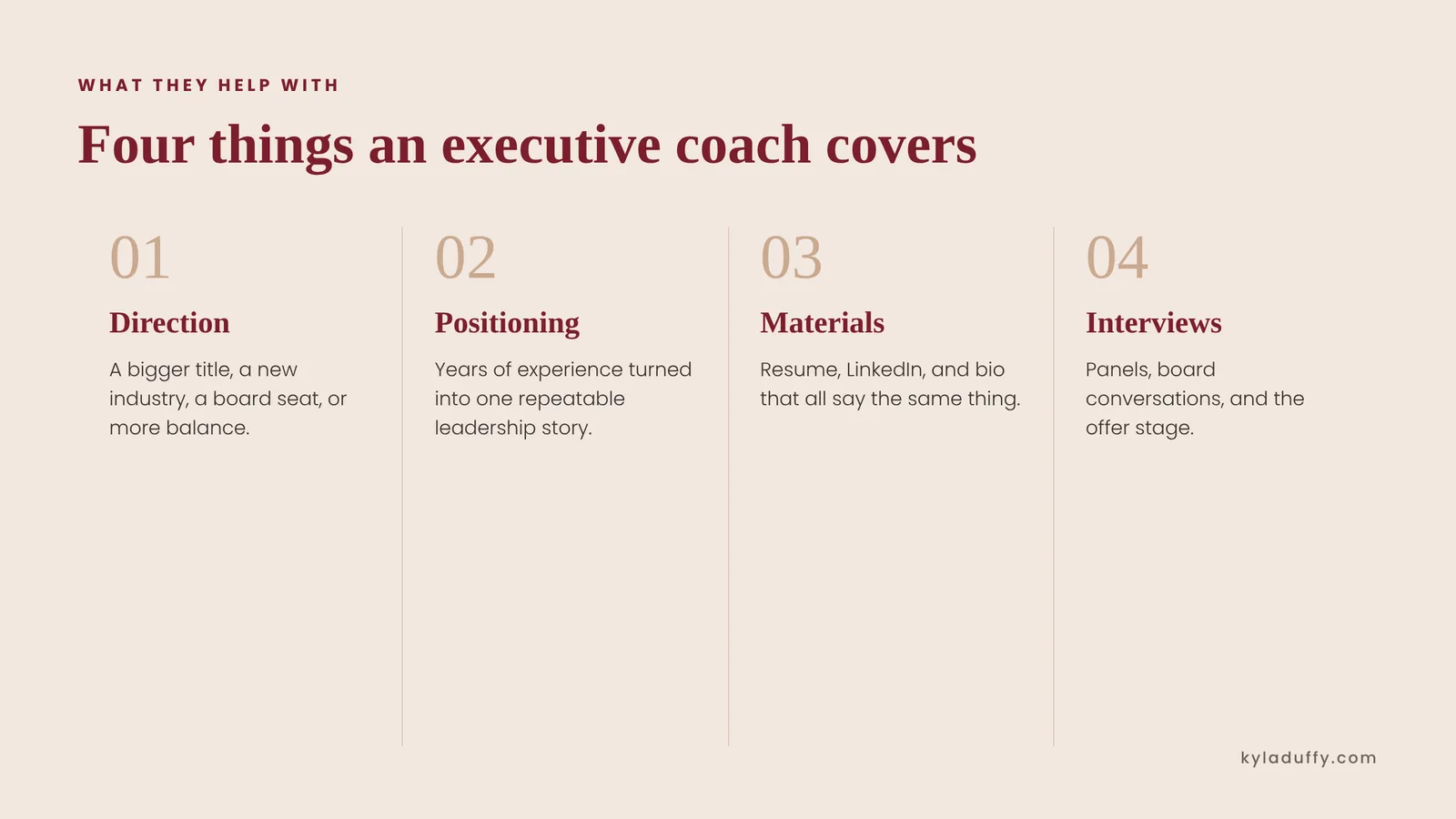
An executive career coach helps senior professionals decide on, prepare for, and land their next role. In practice that work falls into four buckets.
- Direction. Deciding what you actually want next: a bigger title, a different industry, a board seat, a turnaround, or a role that gives you your evenings back. This is the step people skip, and skipping it costs more than any other shortcut.
- Positioning. Turning two decades of experience into a clear, confident leadership story that a CEO, a board member, or a search consultant can repeat accurately after one conversation.
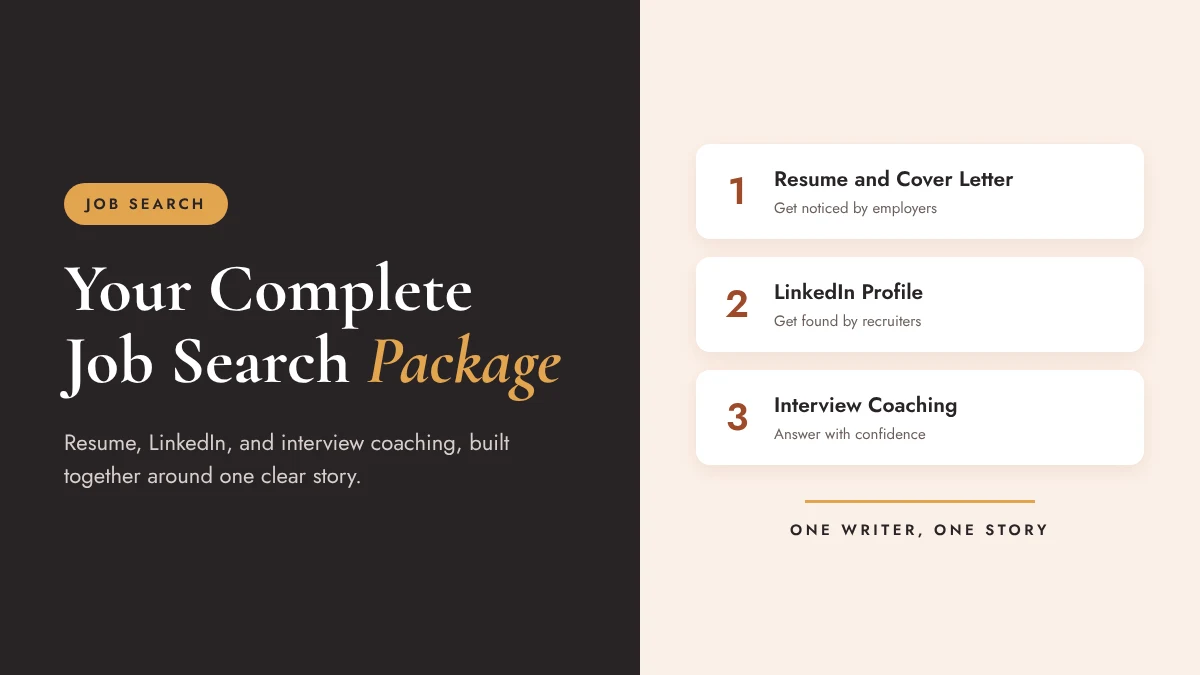
- Materials. An executive resume, a LinkedIn profile, and a professional bio that all tell that same story, in the same language, with the same proof points.
- Interviews and negotiation. Preparing for panel interviews, board conversations, plans for the first ninety days, and the offer stage, where senior candidates most often leave value behind.
What a good executive career coach does not do is hand you a template or promise you a job. No honest coach can promise an outcome that depends on a hiring committee. Your experience is specific, your market is specific, and your strategy should be too. If you want a fuller picture of the role in general, I wrote about what a career coach actually does day to day.
Executive career coach vs. leadership coach vs. recruiter
These three roles get blurred together constantly, and the difference matters a great deal when you are deciding who to hire and what to expect.
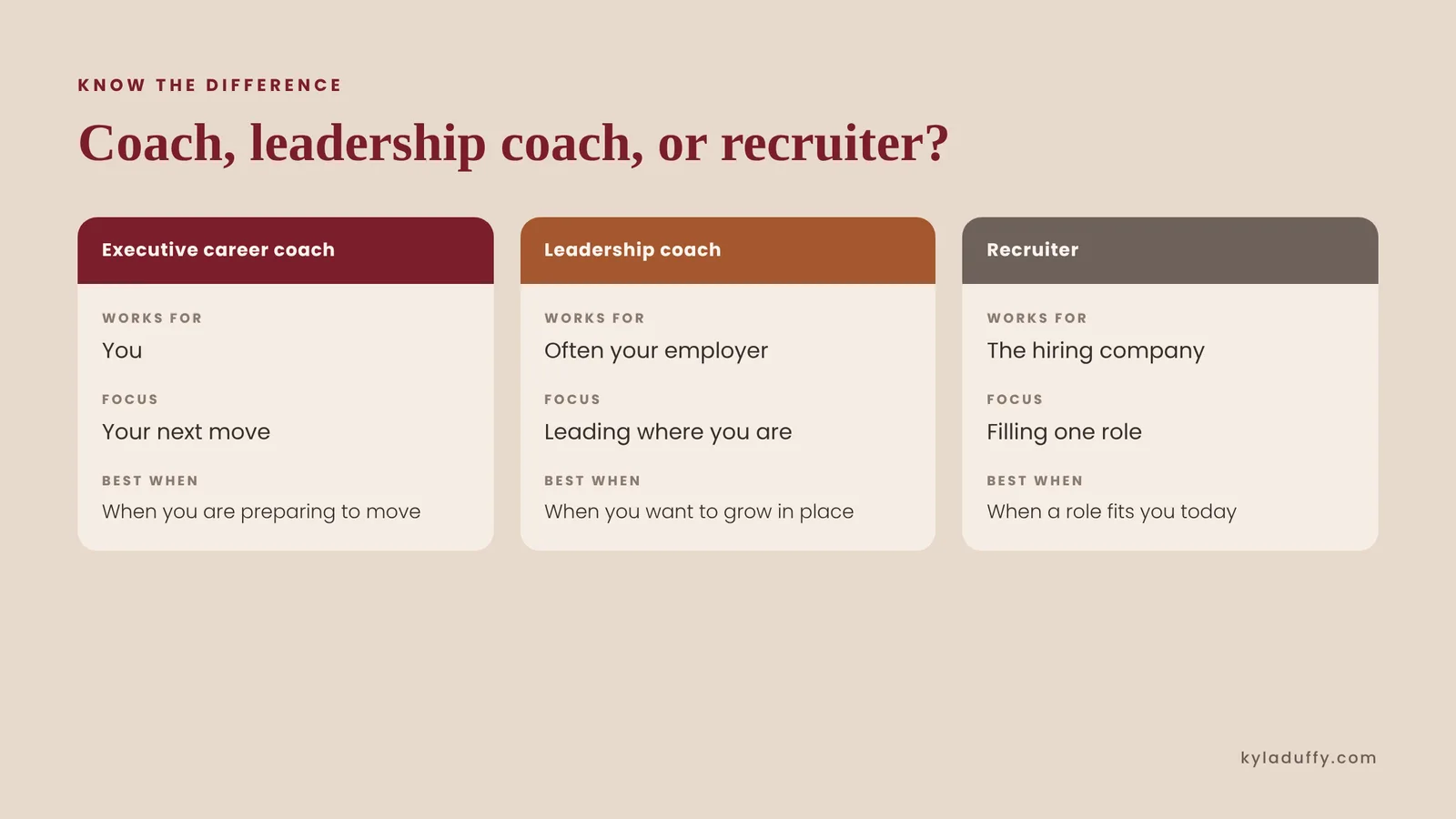
- An executive career coach works for you, and the focus is your next move: direction, positioning, materials, and interviews. You pay, so your goals set the agenda.
- A leadership or executive coach usually focuses on how you lead inside your current role: influence, team dynamics, communication, and executive presence. Often your employer pays, and the goal is performance within the company. It is valuable work, and it is a different job.
- A recruiter or search firm works for the hiring company. They are an excellent relationship to build, and they are not your advisor. Their mandate is to fill a particular role with the best available candidate, not to shape your ten-year arc.
A simple test: if you want to get promoted where you are, a leadership coach is probably the right call. If you are preparing to move, you want somebody on your side of the table. And if you are not sure which of the two you need, that uncertainty is itself worth one honest conversation. It is also worth reading the difference between career counseling and career coaching, since the two get used interchangeably and are not the same service.
Signs you would benefit from an executive career coach
You do not need a coach for every career decision, and I will tell you when I think you do not. In my experience it is worth the investment when one or more of these is true.
- You have been at the same company for years, and you have not had to sell yourself in a very long time.
- Recruiters keep seeing you as one thing, and you want to be considered for something broader, bigger, or different.
- You are getting first interviews but not final rounds, or final rounds but not offers. That pattern usually points at the story, not the credentials.
- Your resume reads like a list of responsibilities rather than a record of decisions, trade-offs, and results.
- You are considering a career change at a senior level and want to avoid taking a step backward in scope or compensation.
- You have been laid off or restructured out, and you want to move quickly without looking rushed.
- You are weighing an internal promotion against an external move. I have written separately about how to approach internal promotions when you are already on the inside.
If two or more of those sound familiar, a few focused weeks of support can save you months of trial and error. If none of them do, save your money. A coach is not a status symbol.
What actually changes in a senior search
Executive searches work differently from the ones you ran earlier in your career, and a lot of frustration comes from running the old playbook in a new game. Here is what changes.
There are fewer roles, and they take longer
There are simply fewer seats at the top, and each one involves more stakeholders: a hiring manager, a committee, a search firm, sometimes a board. More stakeholders means more calendars, more rounds, and more waiting. Patience and a steady weekly plan beat a burst of applications followed by three quiet weeks. The Bureau of Labor Statistics Occupational Outlook Handbook is a useful reality check on how different senior functions are actually growing, rather than how they feel to be growing.
More of the market is hidden
Many senior roles are filled through referrals, board relationships, and retained search before they are ever posted publicly. That is not a conspiracy, it is just how risk-averse hiring works at that level. Your network and your reputation end up doing a large share of the work, which is why a quiet, consistent presence matters more than a burst of activity when you need something.
Your story gets retold without you in the room
A recruiter repeats your pitch to a hiring manager, who repeats it to a CEO, who repeats it to a board. If your positioning is not simple and memorable, it degrades at every handoff. By the time it reaches the decision maker, it is a job title and a company name. The fix is not a longer resume. It is a sharper, more repeatable core message.
Proof beats polish
Scope, decisions, and outcomes matter more than vocabulary. “Led a team” says almost nothing. “Rebuilt a 40-person operations team, cut delivery time in half, and held attrition under ten percent through the transition” says a great deal. For how this plays out on the page, read what changes in a C-suite or VP resume and look at a few executive resume examples before you start rewriting.
Compensation is a conversation, not a number
At senior levels the offer is a structure: base, bonus, equity, severance, vesting, and scope. Candidates who treat it as a single number tend to leave real value on the table. Professional bodies like SHRM publish plenty on how employers think about total rewards, and reading from the employer side is a quiet advantage in a negotiation.
What working with me looks like
I keep this simple, and everything happens online, so it fits around a full calendar and a current job you still have to do well.
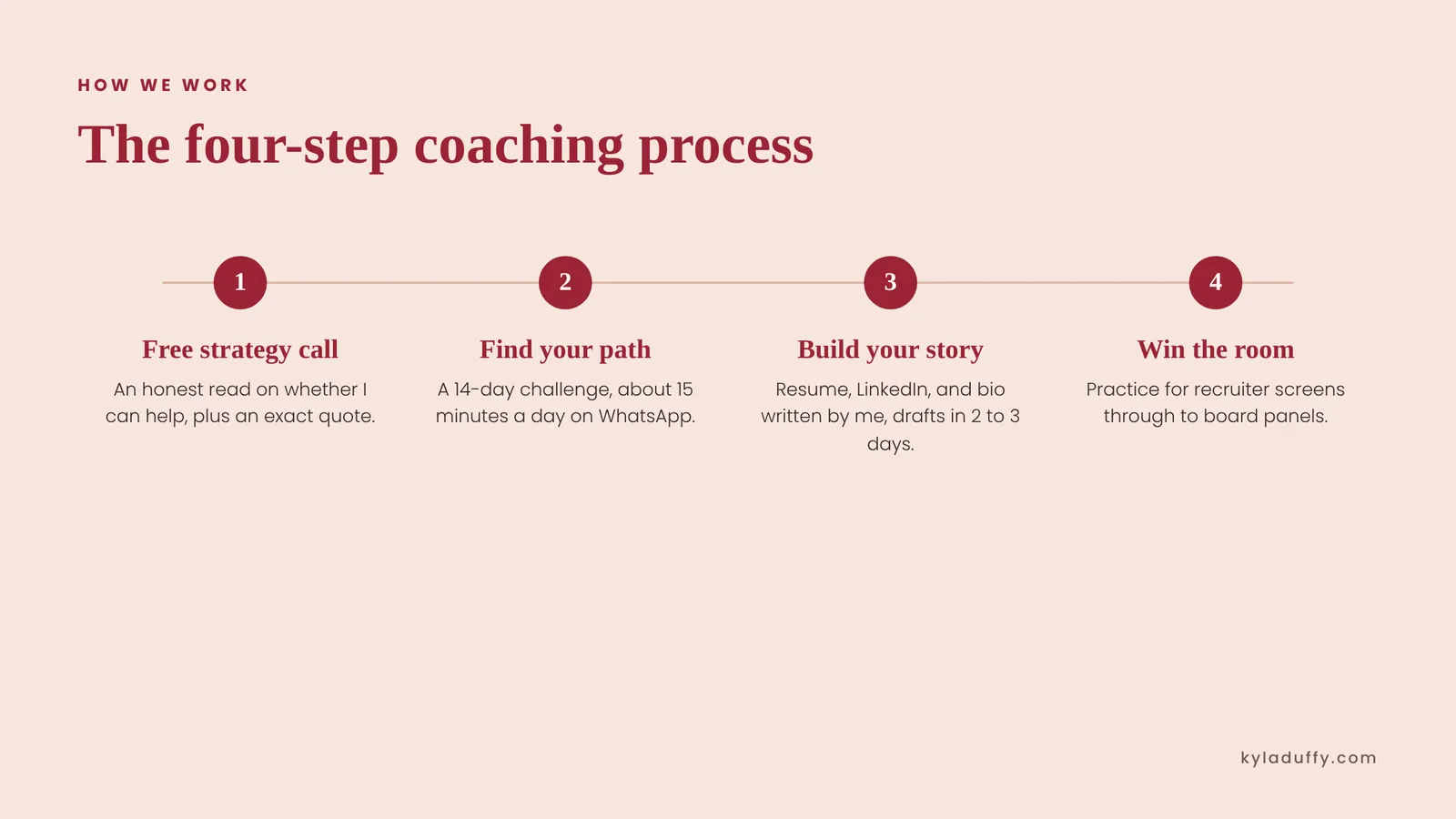
- A free strategy call. You tell me where you are and where you want to go. I will tell you honestly whether I can help, and you get an exact quote before anything begins. No long sales call, no pricing reveal at the end.
- Find your path. If direction is the real question, my 14-day “Find Your Path” challenge takes about 15 minutes a day, with daily one-on-one support on WhatsApp. It is deliberately small and daily, because clarity comes from reps, not from one long workshop.
- Build your story. I write your executive resume, your LinkedIn profile, and, when you need one, your executive bio, so all three say the same thing. First resume drafts typically reach you in 2 to 3 business days.
- Prepare to win the room. We practice the conversations that decide it, from the recruiter screen to the board-level panel, with direct feedback rather than encouragement.
You work with me directly from the first call to the final draft. No account managers, no junior writers, no handoffs. That is a deliberate constraint on how many clients I take, and it is the part people tell me matters most.
How long does executive career coaching take?
It depends on which problem you are actually solving. If you already know your direction, getting your resume, LinkedIn profile, and interview story ready usually takes a few focused weeks. If you are still deciding where to go next, start with direction, because clarity up front makes every later step faster and cheaper.
The search itself is longer. Senior candidates should plan in months, not weeks, and should measure progress by conversations started rather than applications sent. A realistic plan that you can sustain for six months beats an intense one you abandon in three. If the search has already dragged on, I have written about how to get a handle on an endless job search.
How much does an executive career coach cost?
Prices vary enormously, and the range is genuinely confusing. Some executive coaching programs run well into four figures for a few months of sessions, and for long-term leadership development that can be money well spent. Others charge a premium largely for the word “executive” in the name.
My pricing is public on my rates page, and it is the same wherever you live:
- Career coaching: $299 for the 14-day “Find Your Path” challenge
- Resume and cover letter: $199 to $599 depending on career level
- Cover letter on its own: $149
- LinkedIn profile: from $179 with a resume order
- Interview coaching: $125 a session, or $299 for the full “Nail Job Interviews” course
- Executive bios: from $199
- Fast Track: $1,199
For a wider look at what drives coaching prices across the market, read how much a career coach costs, and if you are weighing the spend at all, is career coaching worth it is the honest version of that question.
How to choose the right executive career coach
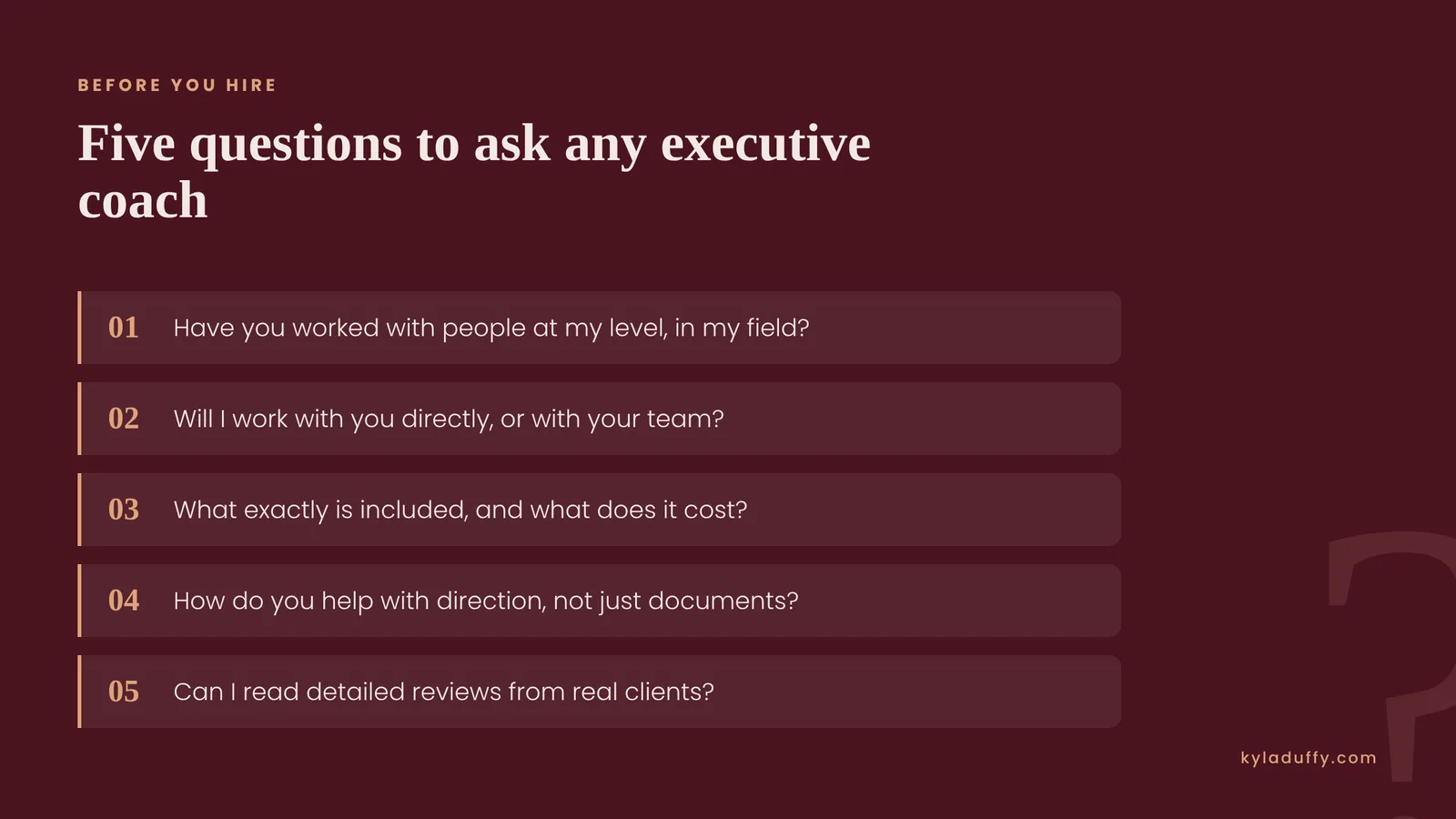
Before you hire anyone, ask these five questions, and listen for specifics rather than enthusiasm.
- Have you worked with people at my level, in my function, and in my industry?
- Will I work with you directly, or will I be passed to someone on your team?
- What exactly is included, what is not, and what does it cost?
- How do you help with direction, not just documents?
- Can I read detailed reviews from real clients on an independent platform?
For my part: more than 11 years of resume writing and coaching, a master’s degree, over 4,000 professionals helped, and a 4.9-star average from 55 Google reviews. If you want a broader checklist, I wrote one on how to choose the right career coach.
Two more things worth checking. First, does the coach publish their prices? Hidden pricing usually means a long call designed to anchor you high. Second, will they tell you when you do not need them? A coach who says yes to every inquiry is selling, not advising.
A realistic 90-day plan for a senior search
If you want a structure to work from, this is roughly the shape I use with executive clients.
Days 1 to 15: decide and position
Settle on two target role types at most, and write the three-sentence version of your story. Name the scope you have owned, the decisions you have made, and the results that followed. Everything downstream depends on this, and most people rush it.
Days 16 to 40: build the materials
Resume, LinkedIn profile, and bio, all saying the same thing. Your executive LinkedIn profile matters more than it did ten years ago, because it is the first thing a search consultant reads and often the only thing a board member reads. If you need a senior-level starting point, see my executive-level resume page.
Days 41 to 70: open conversations
Target a steady weekly rhythm of real conversations: former colleagues, search consultants in your sector, and people doing the job you want next. Specific, short, respectful outreach beats volume every time. Research from NACE and commentary in Harvard Business Review both land on the same point: relationships carry more weight at senior levels than applications do.
Days 71 to 90: convert
Now the work is interview craft and negotiation. Practice the panel, the board conversation, and your plan for the first ninety days out loud, not in your head. If that is the stage you are stuck at, an executive interview coach is usually a faster fix than another resume rewrite.
What to do when a senior search stalls
Almost every executive search goes quiet at some point, and the quiet is where good candidates start making bad decisions. They widen their target to everything, they rewrite the resume for the fourth time, or they go silent for a month and lose the momentum they had built. Here is the sequence I would work through instead.
- Check the funnel, not the feelings. Count how many real conversations you started in the last four weeks, how many reached a second round, and where the drop-off sits. A stall at the screening stage is a positioning problem. A stall at the final round is an interview problem. They need opposite fixes.
- Narrow before you widen. When nothing is landing, the instinct is to broaden. At a senior level that usually makes the story vaguer and the referrals weaker. Two sharp targets will almost always outperform six loose ones.
- Go back to the people who already know your work. Former managers, former direct reports who have moved on, and old clients are the warmest route into a hidden market, and they are the group most people under-use because it feels awkward to ask.
- Change the input, not the volume. If a month of applications has produced nothing, another month of the same applications will not change the result. Change the targets, the story, or the route in.
- Protect your energy. A long search is draining, and tired candidates interview badly. Build the week around a sustainable number of real conversations rather than a heroic number of applications.
If you want a practical framework for the whole thing, my guide to launching an effective job search covers the mechanics, and my clear-eyed look at the 2026 job market sets expectations for the conditions you are actually searching in.
Frequently asked questions
Is an executive career coach worth it?
It is worth it when the cost of a slow or misdirected search is higher than the cost of help. At a senior level, a few extra months between roles, or accepting a role that turns out to be the wrong fit, usually costs far more than coaching does.
Do I need to live near my coach?
No. I work with every client online, so you can be anywhere. Video calls and WhatsApp make it straightforward to fit coaching around a demanding schedule and a current job.
Can a coach guarantee me a job?
No honest coach can. What I can do is make sure your direction, your story, and your materials are as strong as they can be, so you walk into every conversation prepared and nothing avoidable is working against you.
Should I use an executive career coach or an executive resume writer?
If you know exactly what you want next and only need the documents, a writer is enough. If the question is what comes next, or why the current approach is not working, you want coaching first and documents second. I do both, which means I can tell you honestly which one you actually need. Here is more on when you actually need an executive resume writer.
What if I am employed and need this kept quiet?
That is the normal case, not the exception. Everything we do is private, sessions happen on your schedule, and we can plan your LinkedIn activity so it supports you without announcing anything.
How quickly can we start?
Usually within a few days of your free strategy call. Resume first drafts typically arrive in 2 to 3 business days after we have what we need.
Ready to plan your next move? Book a free strategy call and we will talk through where you are, where you want to go, and the fastest sensible way to get there. You can also read more about my career coaching services.
Related reading: if you are weighing credentials when you shortlist, see what a certified career coach credential really means, and if your next step is a market with its own rules, online career coaching for New York professionals.