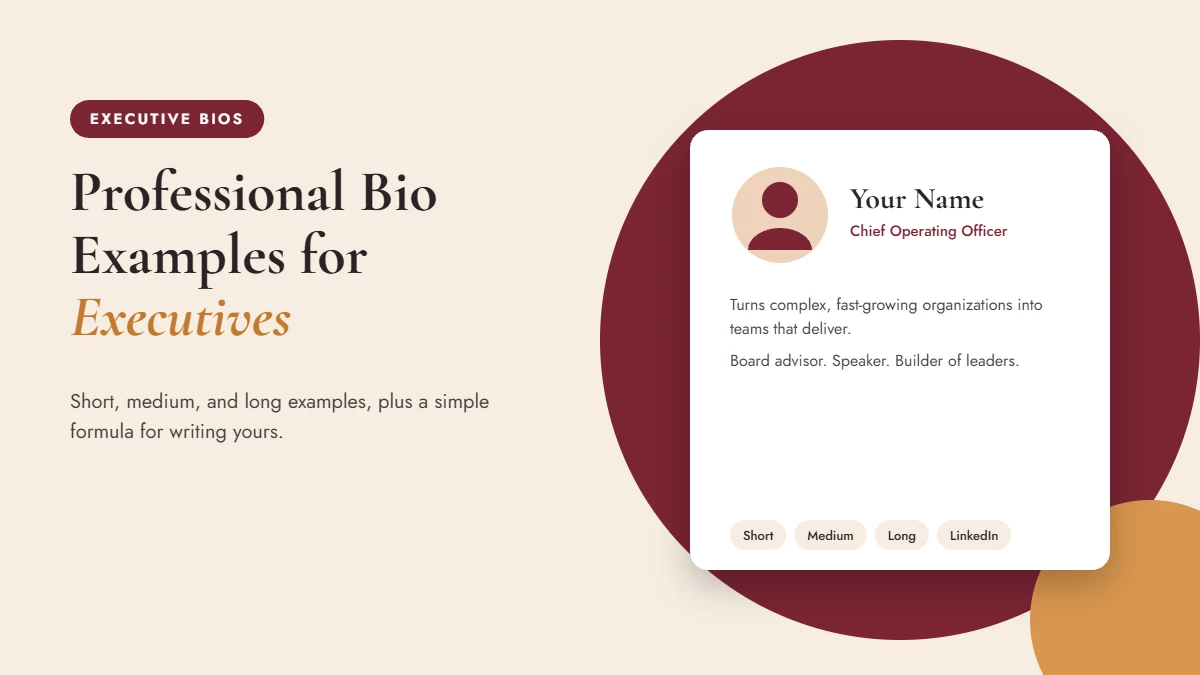
What is a professional bio, and why does yours feel so painful to write? A professional bio is a short narrative that introduces who you are, what you’re known for, and why people should trust you. The best executive bios lead with the problems you solve, back it up with two or three signature achievements, and end with a touch of humanity, all in a length that fits where it’s being read.
And it’s painful to write because describing yourself is awkward for nearly everyone. (I write bios for a living, and I still procrastinate on my own. You’re in good company.) Below you’ll find examples you can adapt, the myths that make bios fall flat, and a simple formula to get yours done.
One note before the examples: every bio below is fictional, written to illustrate technique. Names, companies, and numbers are invented placeholders.
Professional Bio Examples by Length
Short professional bio examples (about 50 words)
Use these for conference programs, social profiles, author boxes, and quick introductions.
Jordan Ellis is Chief Operating Officer at Northline Health, where she leads a 1,200-person organization across 14 clinics. Jordan is known for turning fast growth into reliable operations, and for developing leaders who stay. She serves on the board of a regional community health foundation.
Marcus Reed is a technology executive who helps mid-market companies modernize without breaking what works. As CIO of a national logistics firm, he led a cloud migration that cut infrastructure costs and improved uptime. Marcus mentors first-time IT leaders.
Medium professional bio example (100–150 words)
Use this for company leadership pages, speaker introductions, and press releases.
Priya Shah is Vice President of Revenue at Brightway Software, where she leads sales, customer success, and revenue operations for a growing B2B platform. Since joining, Priya has built the company’s enterprise sales motion from the ground up and helped the business more than double its annual recurring revenue.
Before Brightway, Priya led sales teams in the HR technology space, where she earned a reputation for hiring well and coaching better. She’s especially passionate about developing women in sales leadership and regularly speaks on building predictable revenue engines.
Priya holds an MBA and lives in Denver, where she spends weekends hiking with a very energetic dog.
Long professional bio example (250+ words)
Long bios belong on personal websites, board applications, and detailed speaker pages. They follow the same structure as the medium version, expanded with more context: a short origin story (why you do this work), three or four signature achievements, board and community roles, recognition or publications, and a closing line about what drives you. The key is that every added sentence still answers “why should I trust this person?”
Five Professional Bio Myths (and What’s True Instead)
Myth 1: “A bio is just my resume in paragraph form.”
Reality: A resume is a record; a bio is a story. Listing every role in sentence form creates a wall of text no one finishes. Pick the throughline (the kind of problem you solve) and choose only the achievements that support it. If you’re looking for resume-style examples instead, see my executive resume examples.
Myth 2: “Third person always sounds more professional.”
Reality: Third person is standard for company sites, programs, and board packets, because someone else is introducing you. On LinkedIn, it can feel stiff and oddly distant. That’s why your LinkedIn About section should usually be first person.
If you only remember one thing: lead with the problem you solve, not your title.
- Titles are common. “Turns fast growth into reliable operations” is memorable.
- Your title still belongs in the first sentence; it just shouldn’t be the whole sentence.
Myth 3: “One bio works everywhere.”
Reality: A 400-word bio read aloud before a 20-minute talk will make the audience (and the emcee) wilt. Keep three versions ready: short, medium, and long. You’ll use all of them.
Myth 4: “Personal details are unprofessional.”
Reality: One well-chosen human detail makes you approachable and memorable. One. Pick something that reflects your values or personality (mentoring, a cause, a hobby that says something about you), and keep it to a single sentence.
Myth 5: “The more I include, the more impressive I sound.”
Reality: Executive presence is partly about editing. A tight bio signals confidence. Trying to include everything signals the opposite.
RULE: Every sentence in your bio must answer one question: why should I trust this person? If a sentence doesn’t, cut it.
A Simple Formula for Writing Your Professional Bio
- Who you are now: name, current role, organization, and scope.
- What you’re known for: the problem you solve or the value you create, in plain language.
- Proof: two or three signature achievements, with results where possible.
- Credibility markers: board roles, advisory work, recognition, education (only what’s relevant).
- A human note: one sentence that makes you real.
Write the medium version first. Then cut it down for the short version and expand it for the long one. It’s far easier than writing three from scratch.
Rather not write about yourself at all? Book a free consultation and let’s talk about an executive bio written for you.
Where Your Bio Will Show Up (and How to Keep It Consistent)
Your bio is one piece of your professional brand, alongside your resume, LinkedIn profile, and photo. They should all tell the same story. A few quick checks:
- Your LinkedIn headline and your short bio should echo the same value statement.
- Your bio is only as strong as the profile around it, so check yours against the anatomy of a healthy LinkedIn profile.
- Your photo should match the tone of the setting. Here’s how to know if your LinkedIn photo is helping or hurting.
- If you use a designed one-pager for networking or board searches, make sure it’s consistent with your ATS resume. I explain the difference between a networking resume and an ATS resume.
Personal branding sounds lofty, but it really comes down to consistency. Here’s why your job search is the launchpad for personal branding. For leadership-communication thinking at a higher level, Harvard Business Review’s career planning articles are worth exploring, and the LinkedIn Talent Blog offers a recruiter’s-eye view of how profiles are read. If your bio is supporting a job search, SHRM’s recruiting resources show how organizations evaluate senior candidates.
Executive Bio Writing, Done for You
My executive bio writing service ($199 to $599, see all rates) delivers a polished bio built around your strongest story, available as a traditional bio or an infographic-style version. Many executives pair it with an executive-level resume through my resume and cover letter writing services, so everything tells the same story.
Frequently Asked Questions
What is a professional bio?
A professional bio is a short narrative summary of who you are professionally: your role, expertise, key achievements, and what you’re known for. It’s used on company websites, LinkedIn, speaker pages, board materials, and press releases.
Should a professional bio be in first or third person?
Third person is standard for company websites, speaker introductions, and board materials. First person works better on LinkedIn and personal websites, where readers expect to hear from you directly.
How long should a professional bio be?
Keep a short version of about 50 words, a medium version of 100 to 150 words, and a long version of 250 to 400 words. Different settings call for different lengths, so having all three saves time.
What should an executive bio include?
Your current role and scope, the problems you’re known for solving, two or three signature achievements, relevant board or advisory roles, and a brief human touch, such as a value or interest that rings true.
Should I include personal details in my professional bio?
A brief, relevant personal detail can make a bio memorable and approachable. Keep it to one sentence and choose something that reflects your values or personality without oversharing.
How is a professional bio different from a resume?
A resume is a structured record of experience built to win interviews. A bio is a narrative introduction built to build credibility and connection. They should tell the same story in different forms.
Let’s Write the Bio You Keep Putting Off
You’ve done impressive work. Your bio should make that obvious in 50 words or 400. If you’d like a partner to find your story and put it into words, book a free consultation. We’ll talk through where your bio will be used and what you want people to remember about you.