If you live or work in New York City, you already know two things: the opportunities are enormous, and your time is not. Between a commute, long hours, and a calendar that fills up weeks ahead, finding a career coach who fits your schedule can feel like one more item on a list that is already too long.
That is why so many New Yorkers end up choosing an online career coach. I work with every client online, which means a session fits into a lunch break rather than an afternoon. Here is what to look for, how online coaching actually works, what the New York market demands of candidates, and what it costs.
Why online coaching works so well in NYC
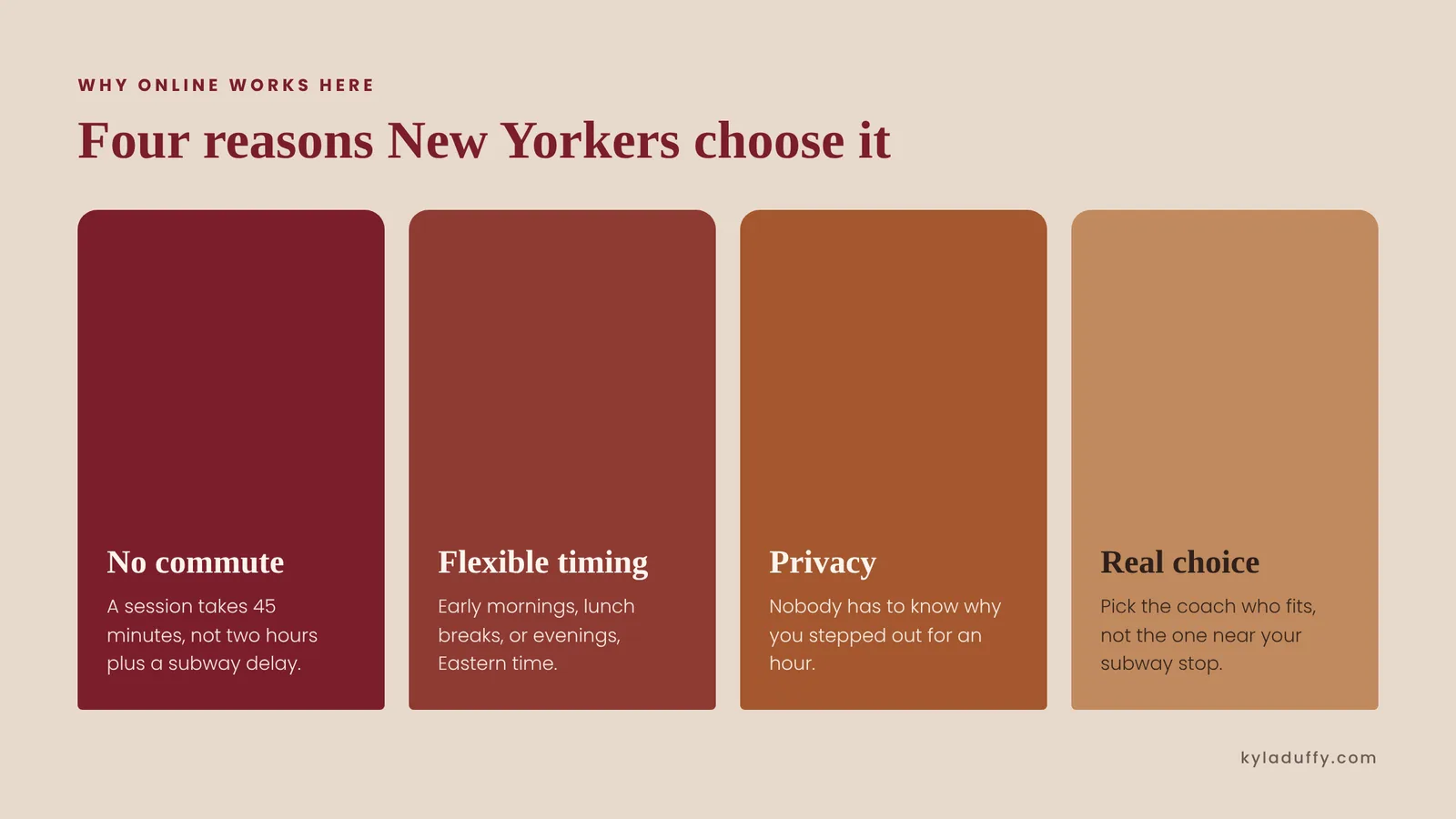
- No commute. A session from your apartment or your office takes 45 minutes, not two hours plus a subway delay.
- Flexible timing. Early mornings, lunch breaks, or evenings, Eastern time, around the schedule you already have.
- Privacy. You do not have to explain to anyone why you are stepping out for an hour, which matters a great deal when you are employed and looking quietly.
- A wider choice of coaches. You can pick the coach whose experience fits your situation, not the one closest to your subway stop.
- Easier continuity. Travel, a move, or a change of job does not interrupt the work.
I have written a fuller comparison in online career coach vs. local coach if you want to weigh the trade-offs properly rather than take my word for it.
What makes the New York job search different
New York has an extraordinary range of employers: finance, media, technology, healthcare, fashion, advertising, nonprofits, higher education, and plenty that resists easy categories. That breadth is the upside, and it is genuinely rare.
The downside is competition and pace. Popular roles attract a flood of strong applicants, many with impressive backgrounds and well-placed networks. Hiring processes move quickly when they move at all, and they stall without explanation when priorities shift. Both of those realities reward preparation and punish improvisation.
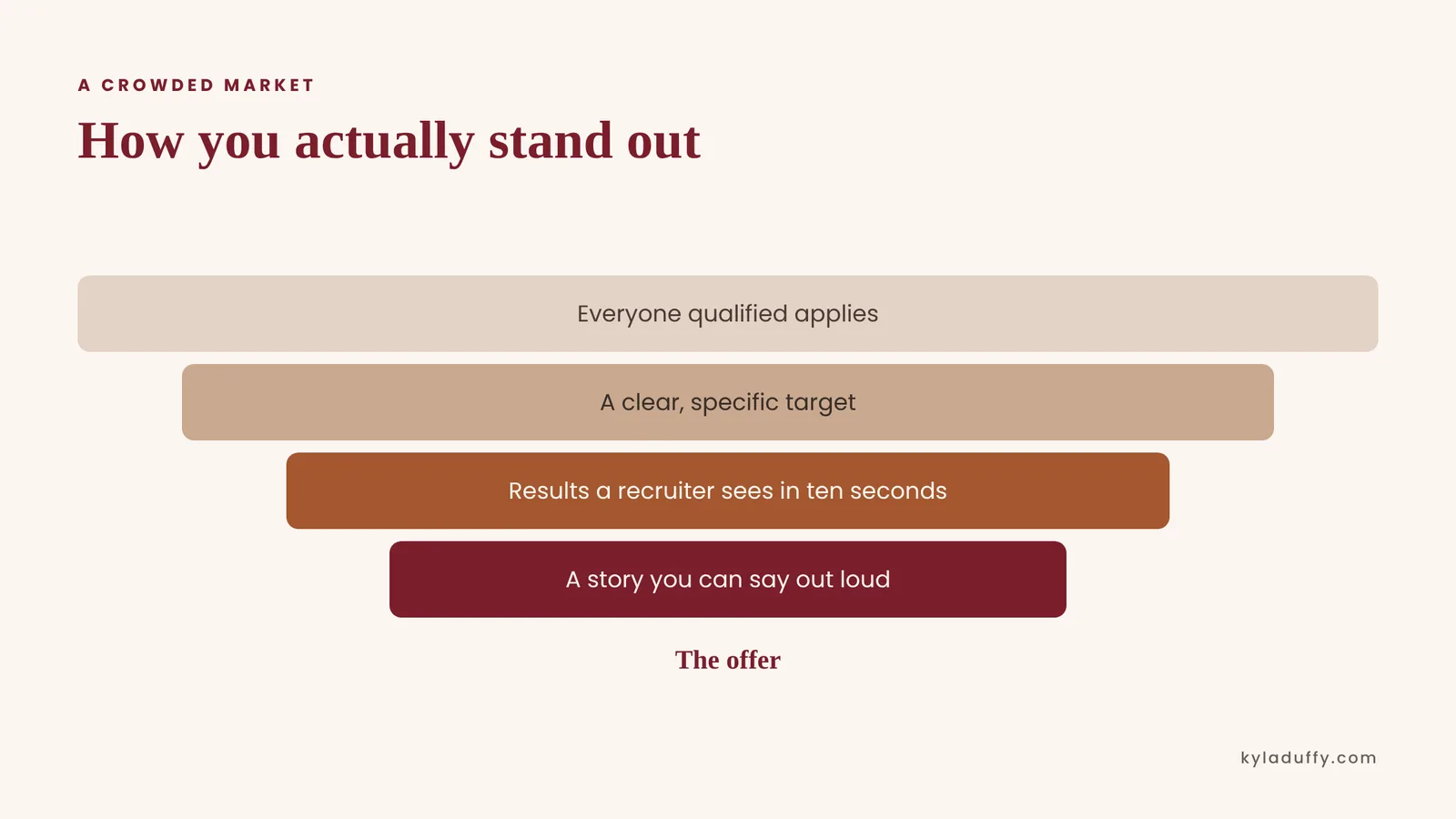
In a market like that, being qualified is the entry fee rather than the advantage. You need a clear story, materials that make your results obvious within about ten seconds, and the ability to talk about your work without hedging or underselling it. If you want a view of broader hiring conditions rather than the mood on your feed, the Bureau of Labor Statistics Occupational Outlook Handbook is a steadier reference.
Mistakes I see in competitive markets
Big markets reward focus and punish scatter. These are the habits that slow people down most.
Applying everywhere
Hundreds of applications with one generic resume almost never beat a smaller number of targeted ones. The volume approach feels productive because it generates activity, and activity is not the same as progress. If you are unsure whether a role deserves your time, my short filter on whether to apply for a job will save you hours.
Applying late
Popular New York roles fill fast. Applying in the first few days, and then finding someone inside the company to speak with, makes a real difference to whether your application is read by a human at all.
Underselling results
In a city full of accomplished people, “responsible for” does not distinguish you from anyone. Numbers, scope, and outcomes do. Replace the duty with the decision and the result, every time. My guide to powerful resume bullets covers the mechanics.
Treating networking as a favor
A short, specific message to the right person is welcome and usually answered. A vague request for “any opportunities” usually is not, because it puts the work of figuring out how to help onto a stranger. Ask one precise question that only that person can answer.
Letting the search run with no structure
A search without a weekly rhythm turns into a slow drip of applications and anxiety. Decide how many real conversations you want each week and track them. If yours has already dragged on, how to get a handle on an endless job search is the reset.
If you want a head start, my free eBook, Strategize Your Job Search, walks through job boards, networking, and staying organized. You will find it in the popup on my site.
What to look for in a New York career coach
- Experience with people at your career level, in fields like yours.
- A clear process and published prices, so there are no surprises at the end of a sales call.
- Real, detailed reviews on an independent platform such as Google.
- Direct access to the coach you actually hired, rather than a handoff to a junior writer.
- Honest advice, including a straight answer when coaching is not what you need.
For a longer checklist, see how to choose the right career coach, and if you are still deciding whether to spend the money at all, is career coaching worth it gives you the unflattering version too.
What a career coach can help you with
- Direction. Deciding whether to move up, move on, or change fields entirely, before you spend six months testing the wrong hypothesis.
- Your story. Explaining your experience so it makes immediate sense for the role you want next.
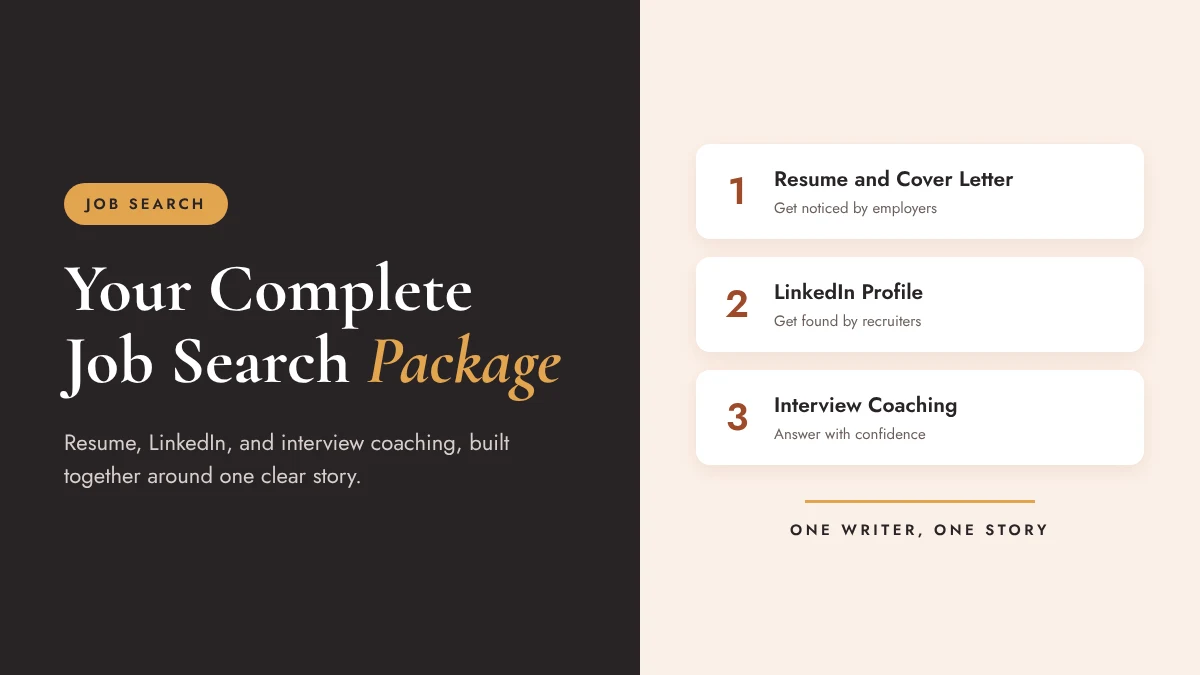
- Your materials. A resume and a LinkedIn profile that tell the same story in the same language.
- Interviews. Preparing for screening calls, panels, and final rounds, with feedback you can act on.
- Negotiation. Knowing what to ask for, and what else is negotiable, before you say yes.
If you are changing fields rather than moving up, my work on career change coaching is the closer fit, and the career change resume covers how to make the jump legible on paper.
How I work with New York clients
Everything happens online, so New York is exactly as close as anywhere else.
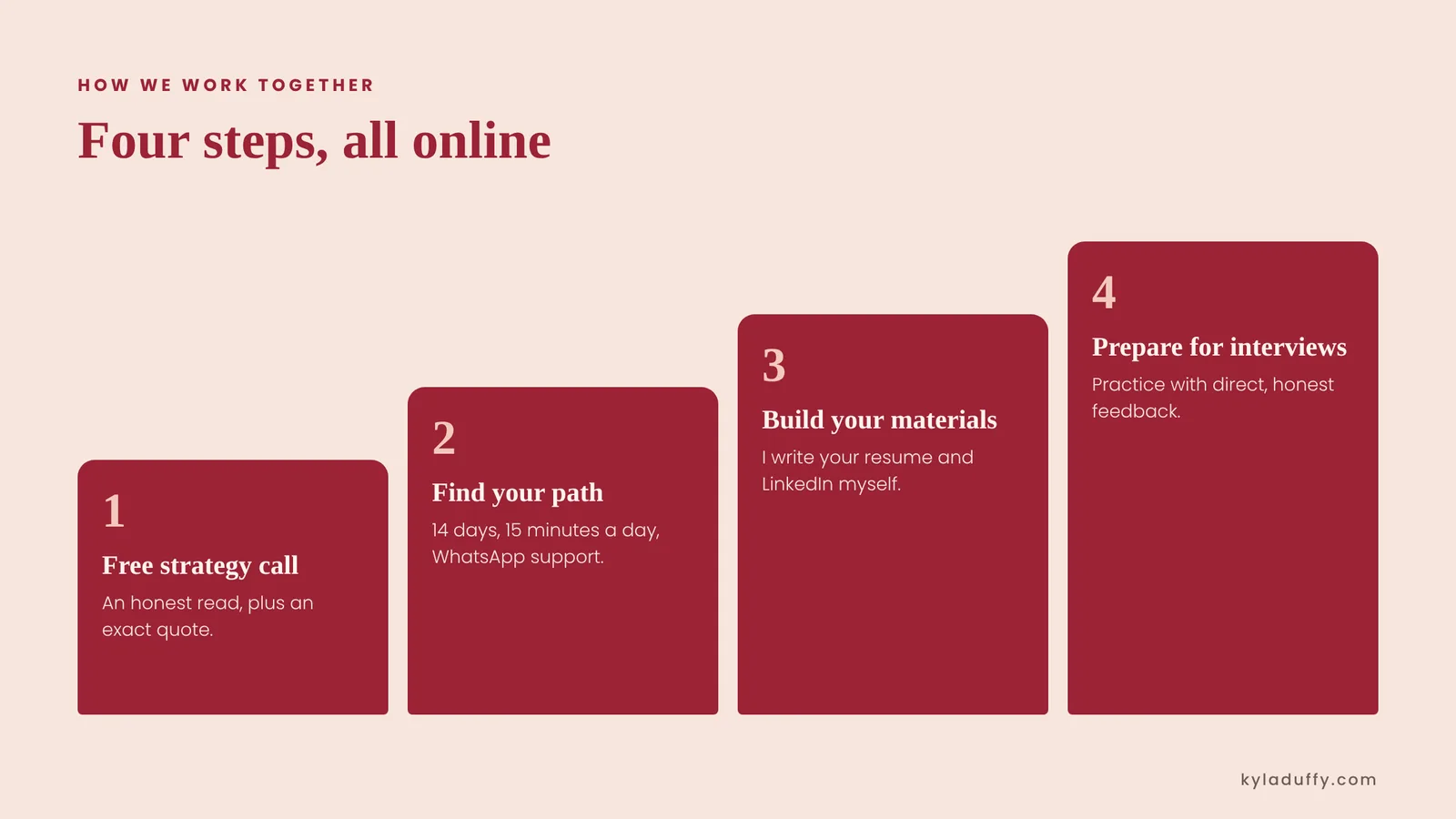
- A free strategy call. We talk about where you are and where you want to go, and you get an exact quote before anything begins.
- Find your path. My 14-day “Find Your Path” challenge takes about 15 minutes a day, with daily one-on-one support on WhatsApp. It is built for people who cannot block out half a day.
- Build your materials. I write your resume and your LinkedIn profile myself. First drafts typically reach you in 2 to 3 business days.
- Prepare for interviews. We practice the conversations that decide it, with direct and honest feedback rather than reassurance.
You work with me directly from the first call to the final draft. For context: more than 11 years of resume writing and coaching, a master’s degree, over 4,000 professionals helped, and a 4.9-star average from 55 Google reviews.
Scheduling around a New York week
The practical question I get most from New York clients is not whether coaching works. It is when on earth they are supposed to do it. A few things make it manageable.
First, we schedule in Eastern time, including early mornings before the day starts and evenings after it ends. Second, the direction work is deliberately built in short daily pieces rather than long sessions, so it survives a week that goes sideways. Third, the writing happens on my side. You answer questions, I draft, and you review, which keeps your time commitment predictable.
If you are employed and looking quietly, that structure helps in another way: there is no office to visit, no appointment anyone can see, and nothing on your calendar that needs explaining.
How hiring differs across New York industries
One reason a single approach stalls in New York is that the city is really several job markets stacked on top of each other, and they do not hire the same way.
Finance and professional services
Structured, calendar-driven, and credential-sensitive. Processes tend to be formal, with multiple rounds and clear criteria. Precision matters here more than personality: numbers must be exact, scope must be unambiguous, and vague ownership language gets probed hard.
Media, advertising, and fashion
Far more relationship-driven. Roles often circulate through networks before they are posted, portfolios and reputation carry real weight, and timing can be unpredictable. If this is your world, your energy belongs in conversations rather than application forms.
Technology and startups
Fast, informal, and inconsistent between companies. One process will be three conversations in a week, the next will be six rounds and a take-home exercise. Be ready for both, and decide in advance how much unpaid work you are willing to do.
Healthcare, education, and nonprofits
Slower and more procedural, often with fixed budget cycles and committee decisions. Patience is not optional here, and following the stated process carefully matters more than it does elsewhere.
The practical point is that your resume, your outreach, and your expectations about timing should all shift depending on which of these you are aiming at. Reading employer-side research from NACE is a useful corrective if your sense of “normal” was formed in a single sector.
A 30-day plan for a New York search
If you want a structure you can actually run alongside a demanding job, this is the shape I would use.
Week 1: decide and prepare
Pick two target role types, no more. Write the three-sentence version of your story and say it out loud to someone who will tell you if it is vague. Get your resume into shape before you start applying, because fixing it mid-search means every early application was wasted. My guide to launching an effective job search covers the setup in detail.
Week 2: get visible
Bring your LinkedIn profile into line with your resume, in the same language, with the same proof points. Recruiters in New York search LinkedIn constantly, and an out-of-date profile quietly removes you from searches you would have ranked well in. Work through the LinkedIn profile optimization checklist once, properly, and then leave it alone.
Week 3: start conversations
Set a number of real conversations per week that you can sustain, and hold to it. Former colleagues first, then second-degree introductions, then recruiters who specialize in your function. Keep each message short and specific, and always name the one thing you are hoping to learn.
Week 4: practice and apply
Now apply, in a focused way, to roles you have a genuine case for, and rehearse out loud before the first screen rather than after it. Free question banks such as the Indeed Career Guide interviewing section are fine for volume, and the part that changes outcomes is having somebody tell you how you actually came across.
Then repeat, adjusting one variable at a time. If screens are not converting, the story needs work. If final rounds are not converting, the interview craft does. Changing everything at once tells you nothing about what was wrong.
What does a career coach cost in NYC?
Coaching prices in big cities can be high, especially for multi-month programs, and in New York the range is wide enough to be genuinely confusing. My prices are the same wherever you live, and they are listed on my rates page:
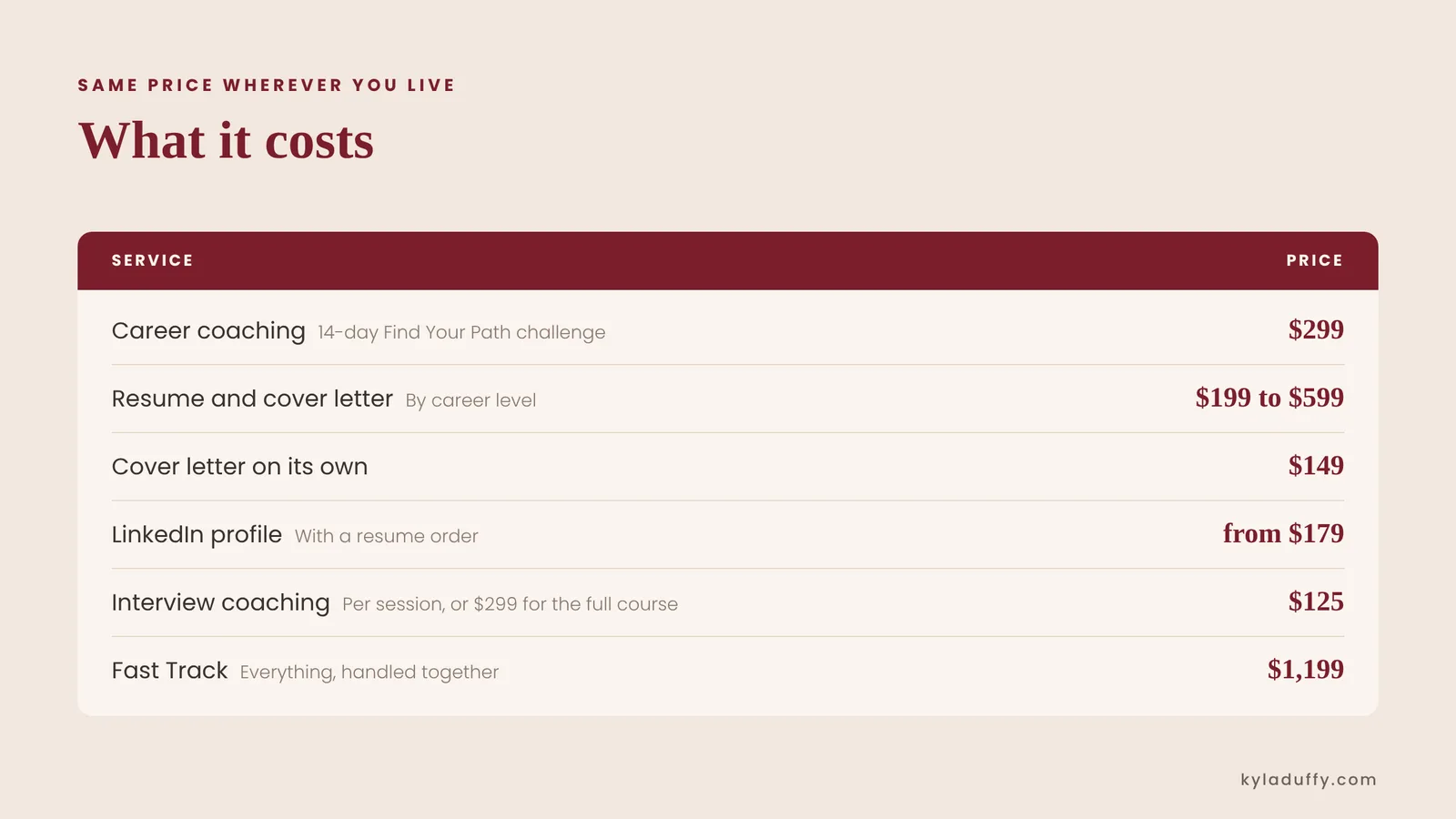
- Career coaching: $299 for the 14-day “Find Your Path” challenge
- Resume and cover letter: $199 to $599 depending on career level
- Cover letter on its own: $149
- LinkedIn profile: from $179 with a resume order
- Interview coaching: $125 a session, or $299 for the full “Nail Job Interviews” course
- Executive bios: from $199
- Fast Track: $1,199
For a broader look at pricing across the market, see how much a career coach costs. If your question is specifically about interview support, I have broken down what interview coaching costs separately.
A note on value rather than price. In an expensive city, the real cost of a slow search is usually the months, not the fee. Commentary in Harvard Business Review has made this point repeatedly: the expensive mistakes in a career are rarely the ones with an invoice attached.
Signs it is time to stop searching alone
Plenty of New Yorkers run a perfectly good search by themselves, and I will say so on a call if that is what I think. These are the signals that usually mean outside help will pay for itself.
- You are getting screens but not second rounds. That pattern almost always points at positioning rather than credentials, and it is very hard to diagnose from inside your own story.
- You have rewritten your resume more than twice. Repeated rewriting is usually a symptom of an unresolved direction question, not a formatting one.
- You are applying to roles you do not want. This is the clearest sign a search has drifted from strategy into activity.
- Your network is going quiet. Usually because the ask has become vague. A specific, small request gets answered far more often than an open one.
- You are avoiding the search. Procrastination in a job search is rarely laziness. It is normally a sign that some part of the plan does not feel honest or achievable.
If two or more of those are true, a short, structured intervention is usually faster and cheaper than another three months of the same approach.
What to ask me on the free call
The strategy call is free, it is genuinely a conversation rather than a sales process, and you will get an exact quote before anything begins. To make it useful, come with the real question rather than the polite one. Good examples:
- Here is my situation. What would you do first, and why that first?
- Do I need coaching, or just a better resume? Be blunt.
- What is realistic for someone at my level, in my field, in this market?
- What should I not spend money on right now?
You will get a straight answer to all four, including when the answer is that you do not need to hire anyone.
Frequently asked questions
Do I need a career coach who lives in New York?
No. What matters is experience, fit, and a clear process. Online coaching gives you the same one-on-one support without the travel, and it widens the pool of coaches you can actually choose from.
What time zone do sessions use?
We schedule around your calendar in Eastern time, including early mornings and evenings where possible.
How quickly can we start?
Usually within a few days of your free strategy call. Resume first drafts typically arrive in 2 to 3 business days once I have what I need.
Do you know the New York market specifically?
I work with clients across the United States, including New York, and the work is the same: direction, story, materials, and interview craft. What I will not pretend to offer is a local referral network, because that is not what online coaching is for.
Can you help if I am employed and need to keep this quiet?
Yes, and most of my clients are. Everything is private, sessions fit around your working day, and we can plan your LinkedIn activity so it supports a search without announcing one.
What if I am not sure I want to stay in my industry?
Then start with direction rather than documents. Rewriting a resume for a field you are about to leave is the most common waste of money I see.
Ready to make your next move in New York? Book a free strategy call, or read more about my career coaching services.
Related reading: what an executive career coach does if you are searching at a senior level, and what a certified career coach credential really means before you shortlist anyone.